
 AS 9100
 SPACE 2009
 AS 9120




2011
A-U5PbBi / AlCu6BiPb / 2011 / T4
| Chemical Properties | % Value |
| Silicon (Si) | 0,40 Max |
| Copper (Cu) | 5,00 - 6,00 |
| Lead (Pb) | 0,20 - 0,60 |
| Iron (Fe) | 0,70 Max |
| Zinc (Zn) | 0,00 - 0,30 |
| Aluminium (Al) | Balance |
| Physical Properties | Value |
| Density | 2.82 g/cm³ |
| Melting Point | 540 °C |
| Thermal Expansion | 22,9 µm/m.°C |
| Modulus of Elasticity | 70 GPa |
| Thermal Conductivity | 150 W/m.K |
| Electrical Resistivity | 39% IACS |
| Mechanical Properties | Value |
| Yield Strength | 140 MPa |
| Ultimate Strength | 310 MPa |
| Shear Strength | 190 MPa |
| Elongation A50 mm | %18 |
| Hardness | 70 HB |
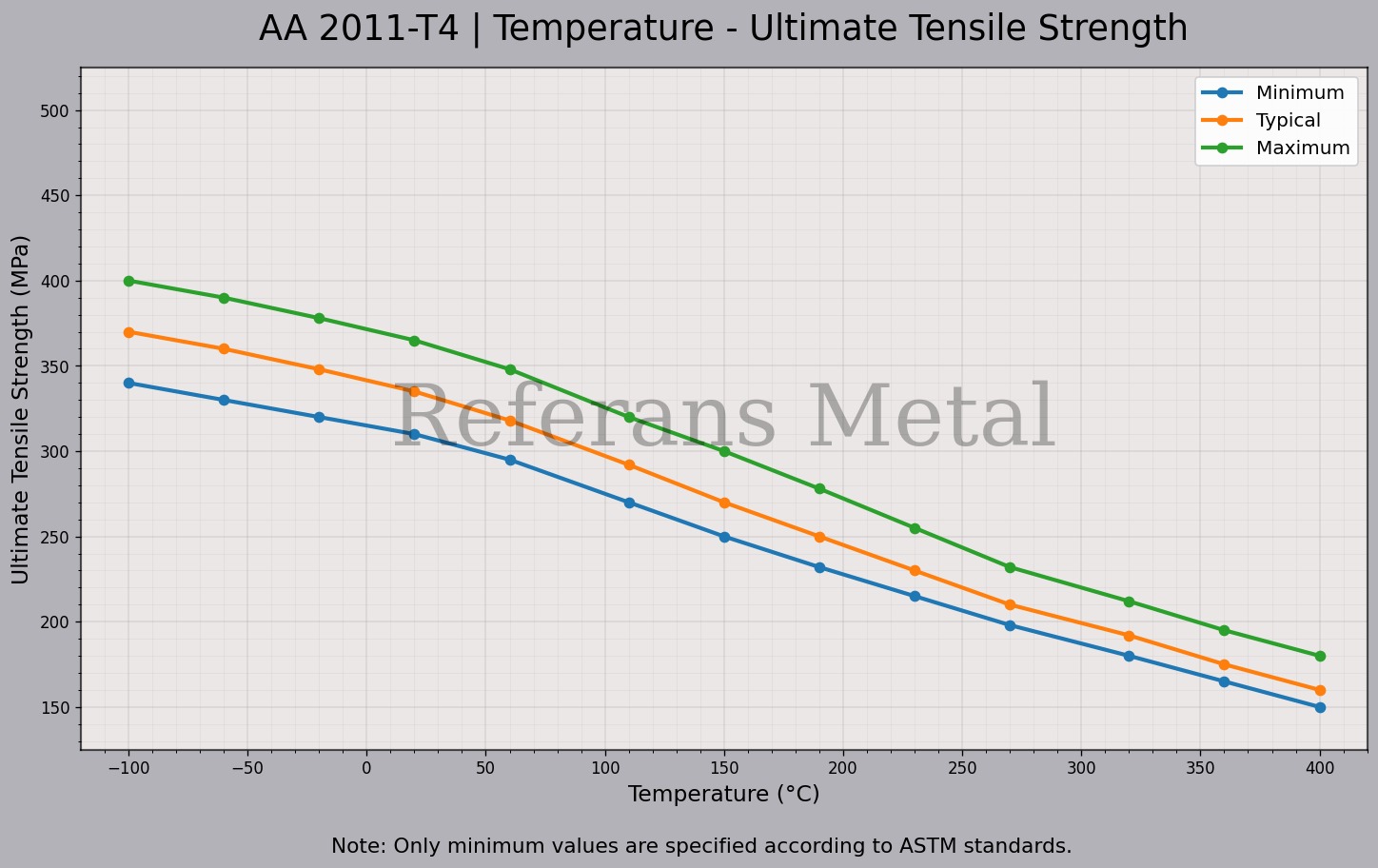
| 2011 T4 Temperature – Ultimate Tensile Strength Graph |
 |
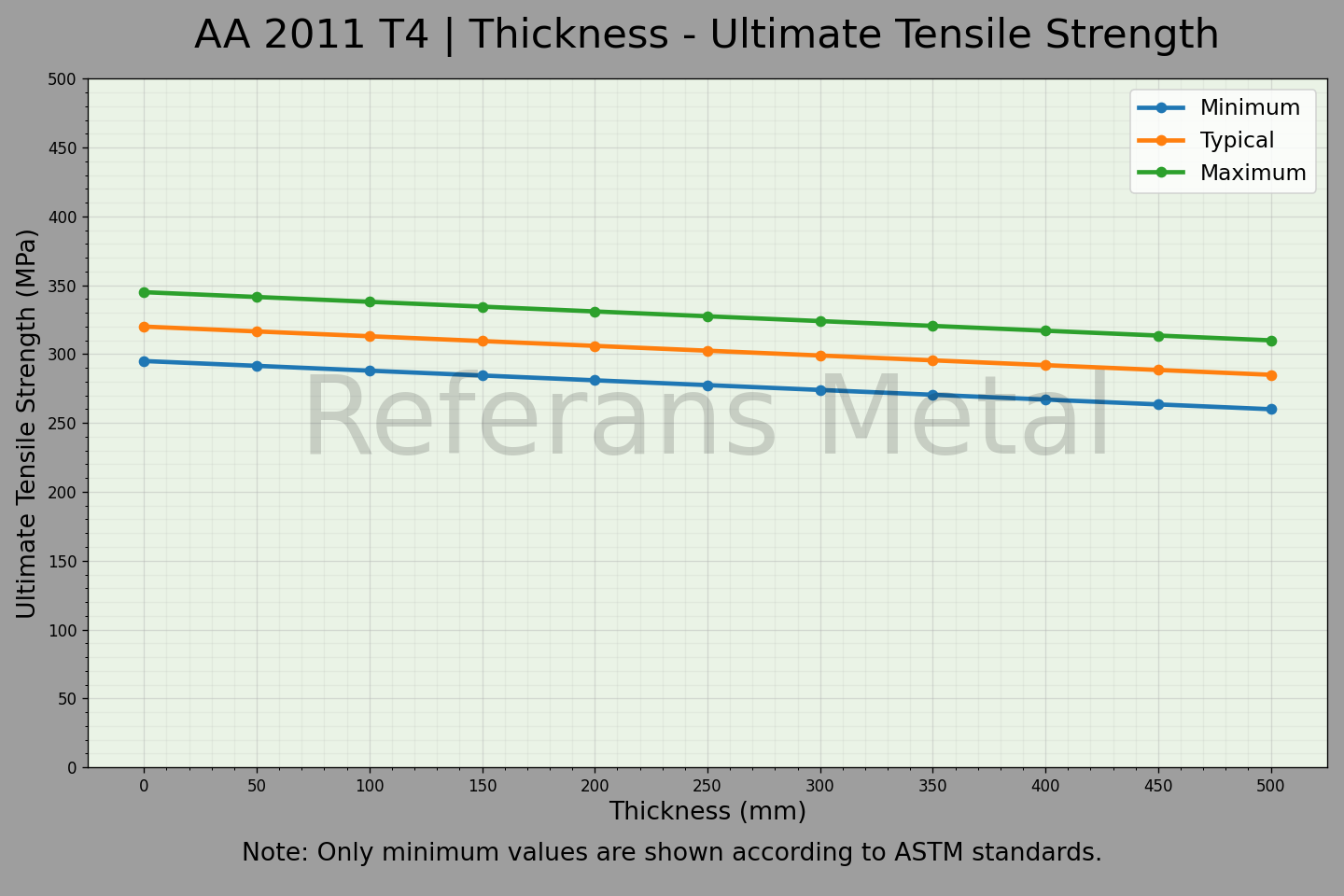
| 2011 T4 Thickness – Ultimate Tensile Strength Graph |
 |
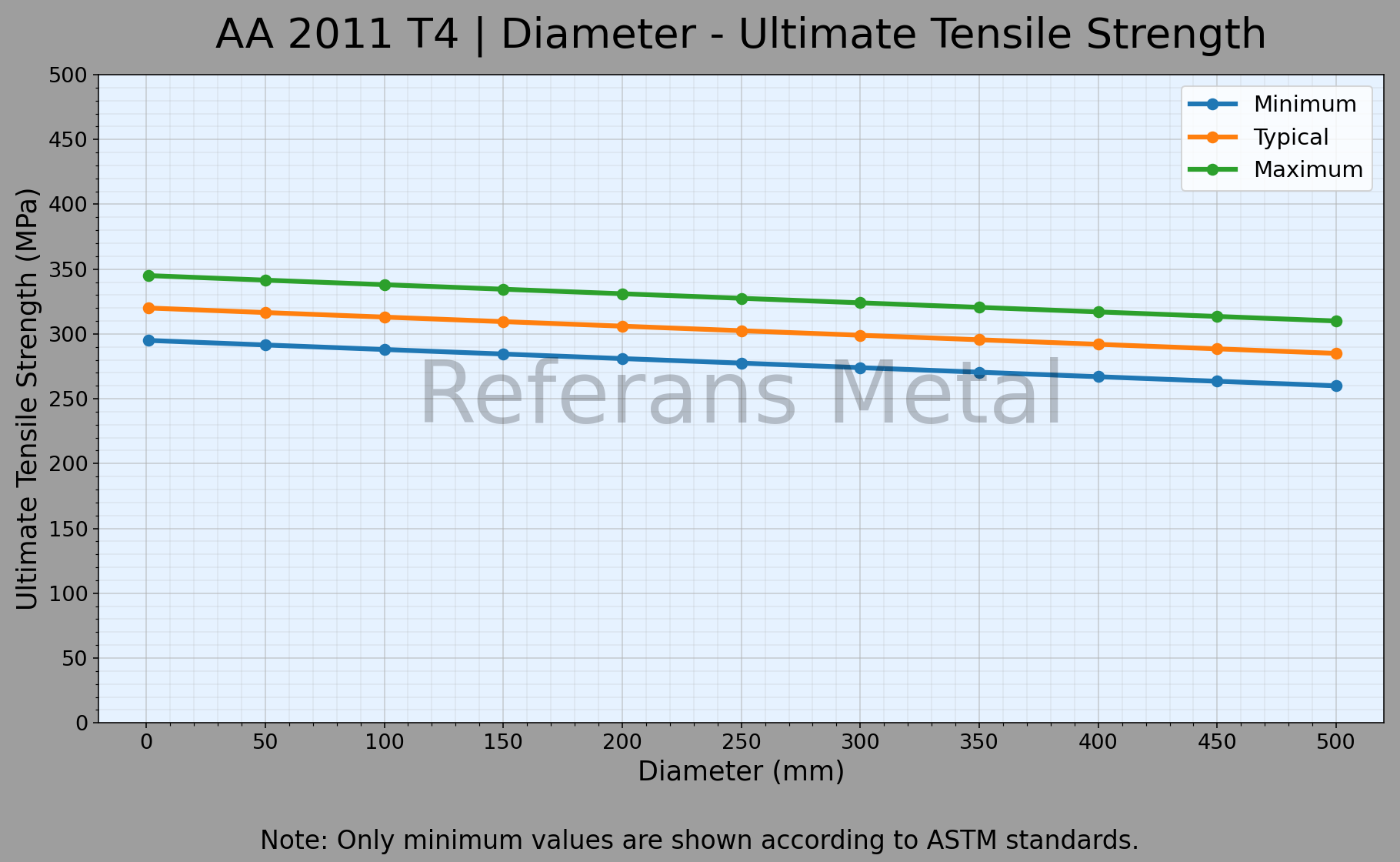
| 2011 T4 Diameter – Ultimate Tensile Strength Graph |
 |
2011 T4 aluminum alloy is an aluminum alloy with a relatively high copper content that has been developed particularly for applications requiring excellent machinability. It belongs to the 2000 series aluminum alloys and is widely used in the production of automotive components, machinery parts, precision turned parts, and fasteners. The T4 temper condition is obtained by solution heat treatment followed by natural aging, providing the alloy with a balanced combination of strength and formability.
In terms of strength and corrosion resistance, 2011 T4 alloy provides moderate mechanical strength. Compared with the 2024 alloy, its strength is slightly lower but its machinability is significantly higher. When compared to the 6061 alloy, the 2011 alloy generally offers better machinability but slightly lower corrosion resistance. The 7075 alloy, on the other hand, provides much higher strength but differs from 2011 alloy in terms of machinability and cost considerations.
From a machinability perspective, 2011 T4 aluminum alloy has one of the highest machinability ratings among aluminum alloys. This characteristic allows the production of clean and smooth surfaces during machining processes. For this reason, it is frequently preferred in sectors where high production speed is required, such as automatic lathe parts, screws, fasteners, and precision machine components. In addition, its chip-breaking characteristics are very good, improving efficiency in manufacturing operations.
In terms of formability and surface properties, the 2011 T4 alloy shows limited bending capability. Therefore, it is generally not preferred for complex cold forming operations. However, it is quite suitable for coating processes, and its surface durability can be improved through anodizing or other surface treatments. Its weldability is limited, and mechanical fastening methods are generally preferred in most applications.
Regarding vibration response and applications, the 2011 T4 alloy exhibits good vibration damping characteristics, which provides advantages in the production of precision mechanical parts. It is widely used in the automotive sector, certain auxiliary components of aerospace equipment, electronic components, and machinery manufacturing. Particularly in applications where high production speed and excellent machinability are important, the 2011 alloy is considered an important engineering material alongside alloys such as 2024, 6061, and 7075.
Material Composition Standards
2011 T4 can comply with the following standards:
• 2011 T4 Round Bar; ASTM B221, UNS A92011, WNR 3.1655, ISO AlCu6BiPb, AFNOR A-U5PbBi, UNE L-3192, UNI 9002/5
• 2011 T4 Sheet; ASTM B221, UNS A92011, WNR 3.1655, ISO AlCu6BiPb, AFNOR A-U5PbBi, UNE L-3192, UNI 9002/5
• 2011 T4 Wire; ASTM B221, UNS A92011, WNR 3.1655, ISO AlCu6BiPb, AFNOR A-U5PbBi, UNE L-3192, UNI 9002/5
• 2011 T4 Tube; ASTM B221, UNS A92011, WNR 3.1655, ISO AlCu6BiPb, AFNOR A-U5PbBi, UNE L-3192, UNI 9002/5
Key Characteristics of 2011 T4:
- Strength: Moderate
- Machinability: Very good
- Weldability: Poor
- Formability: Good
- Corrosion Resistance: Low
- Heat Treatment: Yes
Some Common Applications of 2011 T4:
Precision machinery parts,
Automotive exterior trim,
And pipe connection elements.
Stock
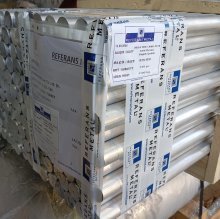
We produce and supply 2011 T4 in rod/sheet and tube/profile forms.
- Rod / Sheet
- Tube / Profile
| Mechanical Properties | |||
| Thickness (mm) | Yield Strength (Min.) | Ultimate Strength (Min.) | Elongation A50 mm % |
| Up to & incl. 60 | 125 | 275 | %14 |
 Weight Calculator