
 AS 9100
 SPACE 2009
 AS 9120


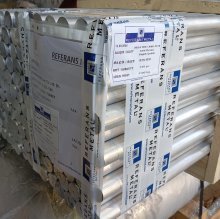


Cold Drawn Round Bar
Cold Drawn Tube
2017
Cold Drawn/Finished (CF) / AlCu4MgSi (Soğuk Çekim) / 2017 / T351
| Chemical Properties | % Value |
| Silicon (Si) | 0,20 - 0,80 |
| Chromium (Cr) | 0,00 - 0,10 |
| Manganese (Mn) | 0,40 - 1,0 |
| Magnesium (Mg) | 0,40 - 1,00 |
| Copper (Cu) | 3,50 - 4,50 |
| Titanium (Ti) | 0,00 - 0,25 |
| Iron (Fe) | 0,00 - 0,70 |
| Zinc (Zn) | 0,00 - 0,25 |
| Aluminium (Al) | Balance |
| Physical Properties | Value |
| Density | 2.79 g/cm³ |
| Melting Point | 513 °C |
| Thermal Expansion | 23.6 µm/m.°C |
| Modulus of Elasticity | 72 GPa |
| Thermal Conductivity | 134 W/m.K |
| Electrical Resistivity | 38 % IACS |
| Mechanical Properties | Value |
| Proof Strength | 270 MPa |
| Yield Strength | 390 MPa |
| Shear Strength | 262 MPa |
| Elongation A50 mm | 16% |
| Hardness | 105 HB |
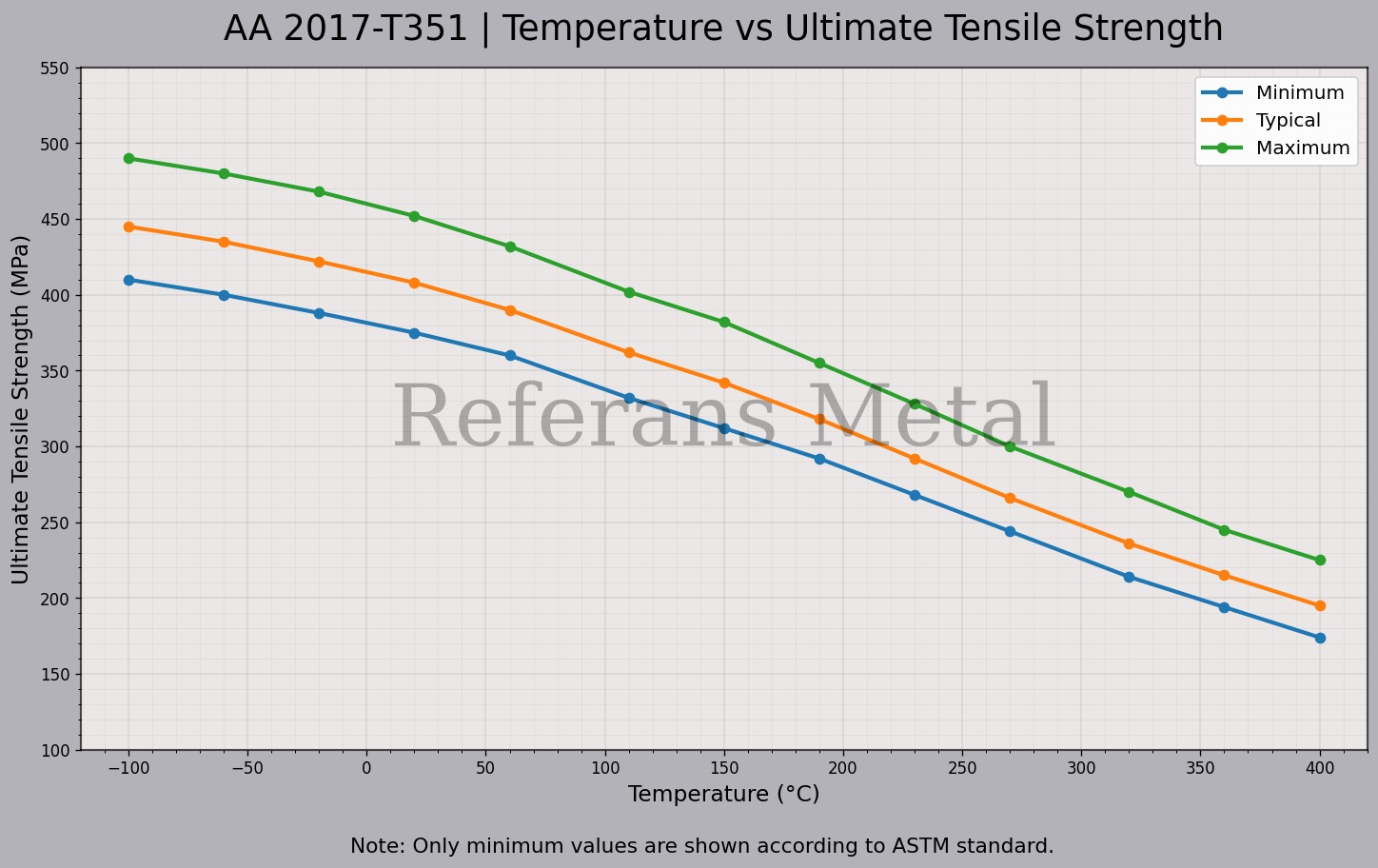
| 2017 T351 Temperature – Ultimate Tensile Strength Graph |
 |
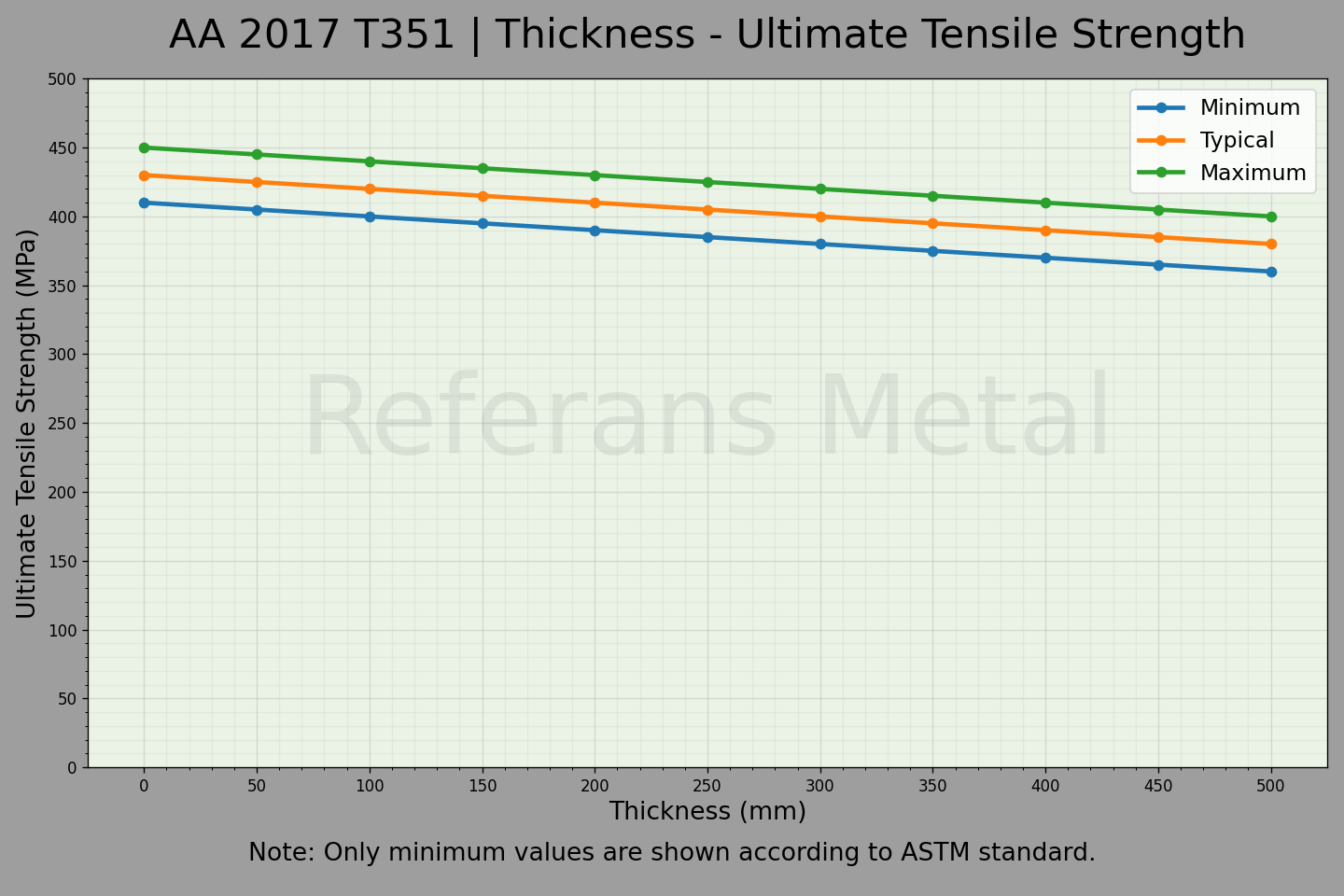
| 2017 T351 Thickness – Ultimate Tensile Strength Graph |
 |
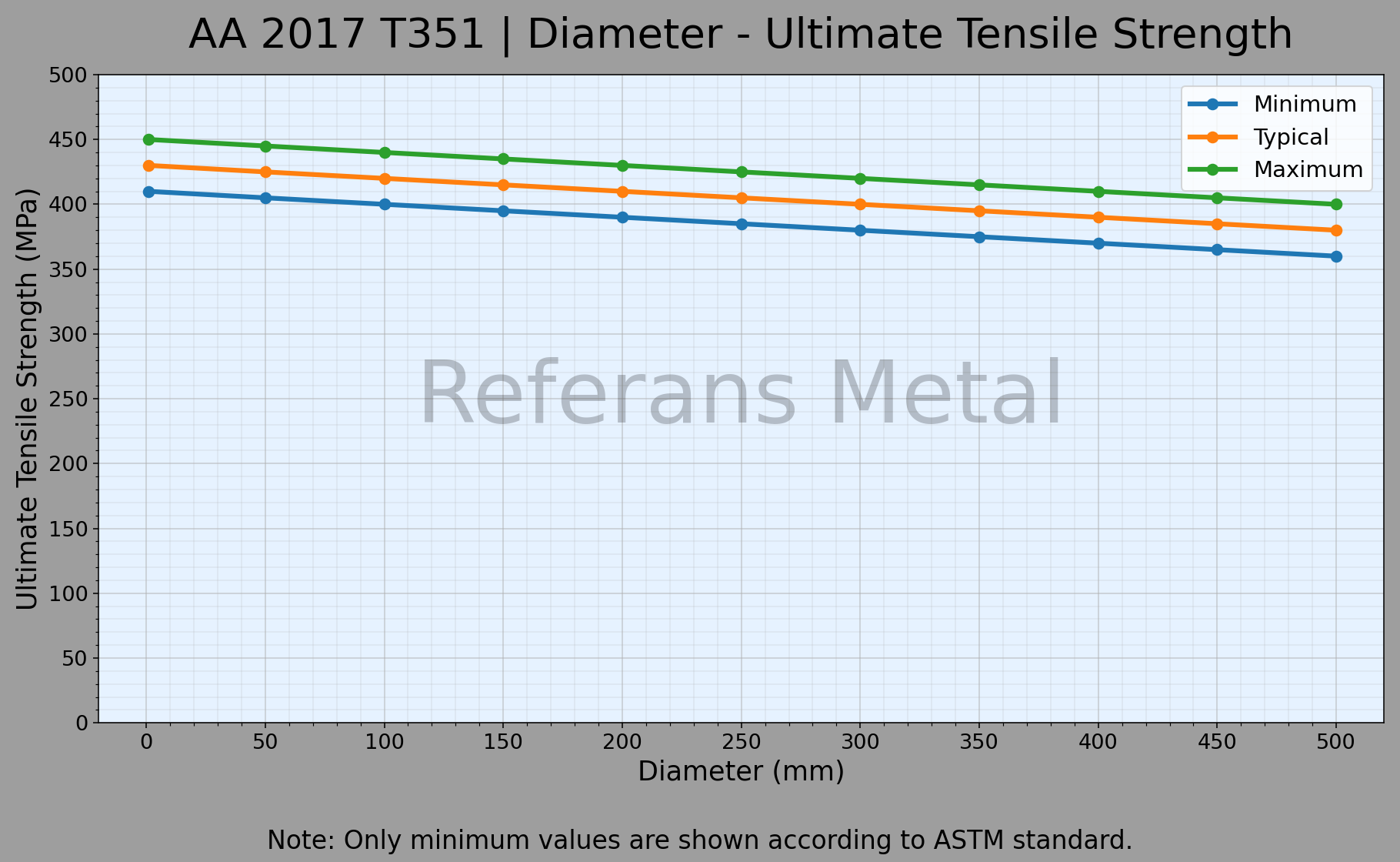
| 2017 T351 Diameter – Ultimate Tensile Strength Graph |
 |
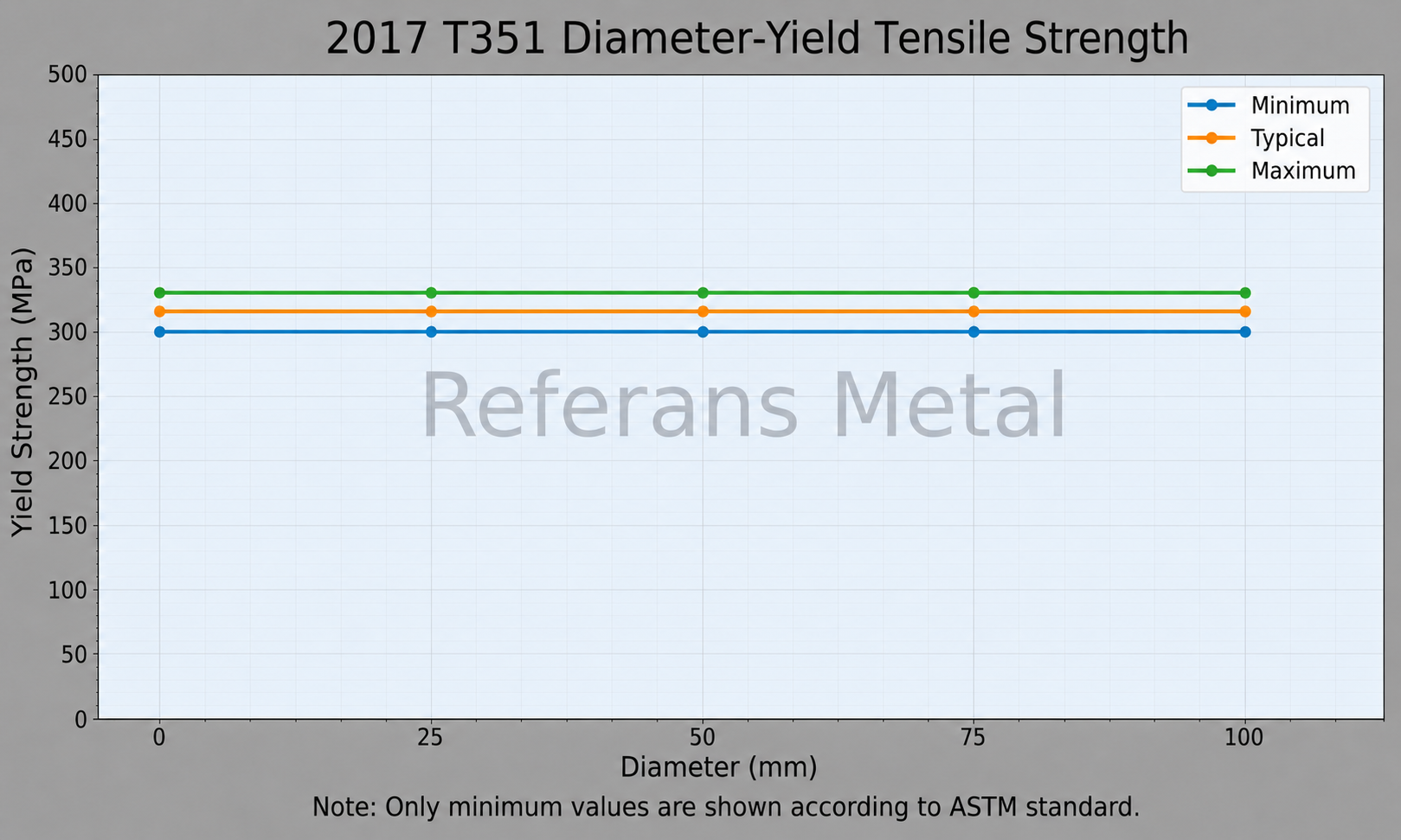
| 2017 T351 Diameter-Yield Tensile Strength |
 |
2017 T351 aluminum alloy is a copper-based (Al-Cu) alloy developed for applications requiring high strength. This alloy stands out with its high tensile strength and fatigue resistance. The T351 temper includes solution heat treatment, stress relieving, and natural aging processes, providing both stability and high performance. However, due to its high copper content, its corrosion resistance is lower than 6xxx series alloys and often requires surface protection.
In terms of strength, 2017 T351 offers significantly higher strength than 6061-T6, while being comparable to 2024-T3. However, although 7075-T6 has higher strength values, 2017 alloy provides better machinability. Therefore, 2017 T351 offers an ideal balance for load-bearing parts and precision-machined components. It is widely used in aerospace, automotive, and machinery industries.
In terms of machinability, 2017 T351 alloy performs very well among aluminum alloys. It provides good surface finish in machining and minimizes tool wear. This makes it advantageous for high-precision component manufacturing. However, its bending and forming capabilities are more limited compared to 5xxx and 6xxx series alloys; therefore, it is generally preferred for machined parts.
In terms of coatability and surface treatment, 2017 alloy is suitable for anodizing and coating processes, but color variations may occur due to copper content. To improve corrosion resistance, anodizing, painting, or coating processes are commonly applied. It performs well under vibration and dynamic loads, making it reliable for mechanical systems exposed to vibration.
In terms of weldability, 2017 T351 has limited performance, and mechanical fastening is generally preferred over welding. This alloy shows similar weldability to 2024, lower than 6061, but better than 7075. Applications include aircraft structural parts, fasteners, gears, and high-strength machine components. Overall, 2017 T351 stands out as a technical material combining high strength and good machinability.
MATERIAL COMPOSITION STANDARDS
2017 T351 is available according to the following standards:
• 2017 T351 Plate; AMS QQ-A-225/5, ASTM B209, ISO AlCu4MgSi, UNS A92017, WNR 3.1325, DIN AlCuMg1, BS H14
• 2017 T351 Sheet; AMS QQ-A-225/5, ASTM B209, ISO AlCu4MgSi, UNS A92017, WNR 3.1325, DIN AlCuMg1, BS H14
• 2017 T351 Cold Drawn Round Bar; AMS QQ-A-225/5, ASTM B211, UNS A92017, WNR 3.1325, DIN AlCuMg1, ASTM B565, ASTM B316
• 2017 T351 Cold Drawn Tube; AMS QQ-A-225/5, ASTM B211, UNS A92017, WNR 3.1325, DIN AlCuMg1, ASTM B565, ASTM B316
• 2017 T351 Cold Drawn Flat Bar; AMS QQ-A-225/5, ASTM B211, UNS A92017, WNR 3.1325, DIN AlCuMg1, ASTM B565, ASTM B316
• 2017 T351 Cold Drawn Wire; AMS QQ-A-225/5, ASTM B211, UNS A92017, WNR 3.1325, DIN AlCuMg1, ASTM B565, ASTM B316
Key Properties of 2017 T351:
- Strength: Excellent
- Machinability: Very Good
- Weldability: Fair (Filler welding and brazing are preferred)
- Formability: Very Good
- Corrosion Resistance: Moderate (Improves with coating)
- Heat Treatable: Yes
Common Applications of 2017 T351:
Used as fasteners, rivets,
In aerospace industry as aircraft material,
In military equipment and other structural applications requiring high strength.
STOCK
We supply 2017 T351 in plate/sheet, sheet, rod/flat bar, and tube/profile forms.
- Plate / Sheet
- Sheet
- Rod / Flat Bar
- Tube / Profile
| Mechanical Properties | |||
| Thickness (mm) | Proof Strength (Min.) | Yield Strength (Min.) | Elongation A50 mm % |
| Over 25 up to & incl. 75 | 270 MPa | 400 MPa | %10 |
| Over 75 up to & incl. 150 | 260 MPa | 390 MPa | %9 |
| Over 150 up to & incl. 200 | 240 MPa | 370 MPa | %8 |
| Over 200 up to & incl. 250 | 220 MPa | 360 MPa | %7 |
 Weight Calculator