
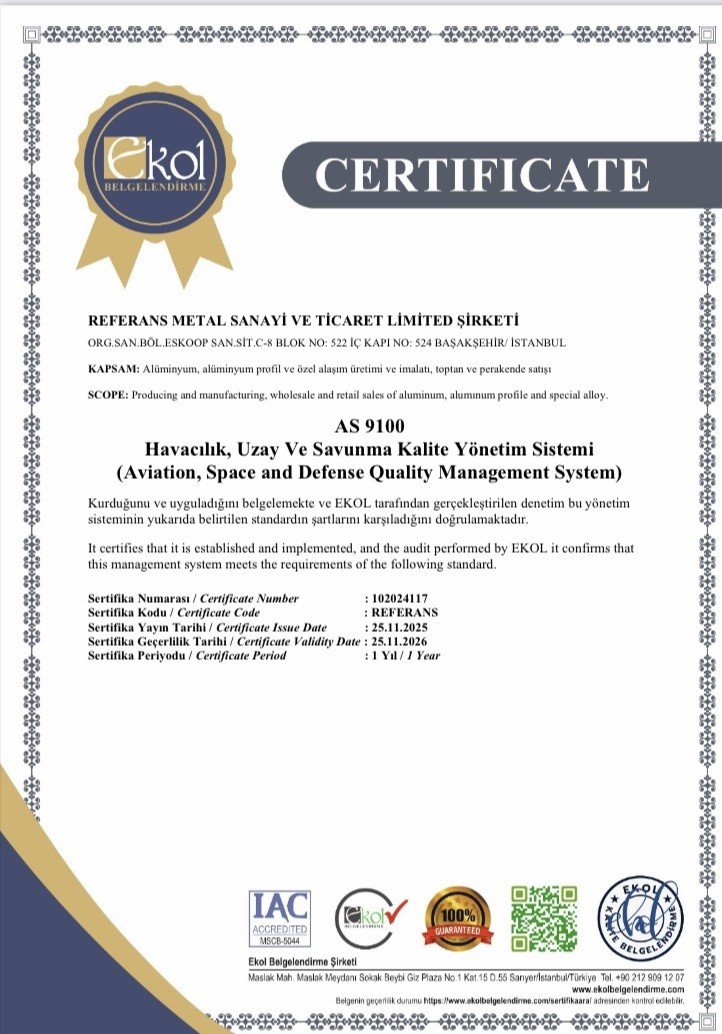
 AS 9100
 SPACE 2009
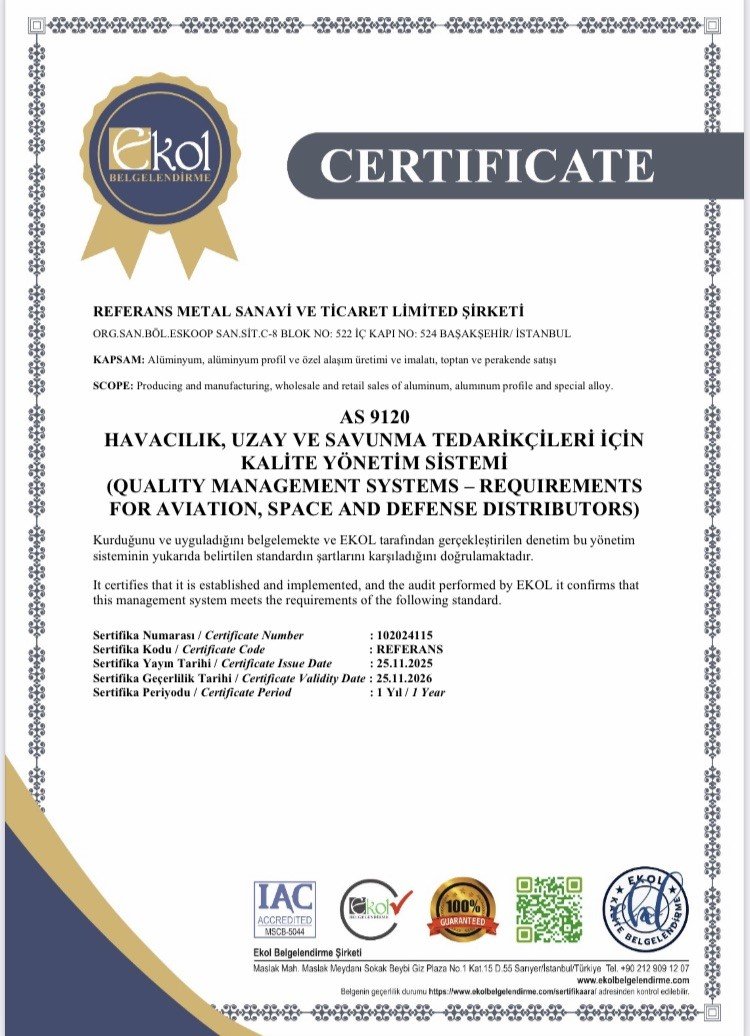 AS 9120




Cold Drawn Round Bar
Cold Drawn Tube
7075
Cold Drawn/Finished (CF) / AlZn5.5MgCu (Soğuk Çekim) / 7075 / T73510
| Chemical Properties | % Value |
| Silicon (Si) | 0,00 - 0,40 |
| Chromium (Cr) | 0,18 - 0,28 |
| Manganese (Mn) | 0,00 - 0,30 |
| Magnesium (Mg) | 2,10 - 2,90 |
| Copper (Cu) | 1,20 - 2,00 |
| Titanium (Ti) | 0,00 - 0,20 |
| Iron (Fe) | 0,00 - 0,50 |
| Zinc (Zn) | 5,10 - 6,10 |
| Aluminium (Al) | Balance |
| Physical Properties | Value |
| Density | 2.81 g/cm³ |
| Melting Point | 477°C |
| Thermal Expansion | 23 µm/m.°C |
| Modulus of Elasticity | 72 GPa |
| Thermal Conductivity | 155 W/m.K |
| Electrical Resistivity | 33% IACS |
| Mechanical Properties | Value |
| Proof Strength | 420 MPa |
| Yield Strength | 515 MPa |
| Shear Strength | 292 MPa |
| Elongation A50 mm | %8 |
| Hardness | 135 HB |
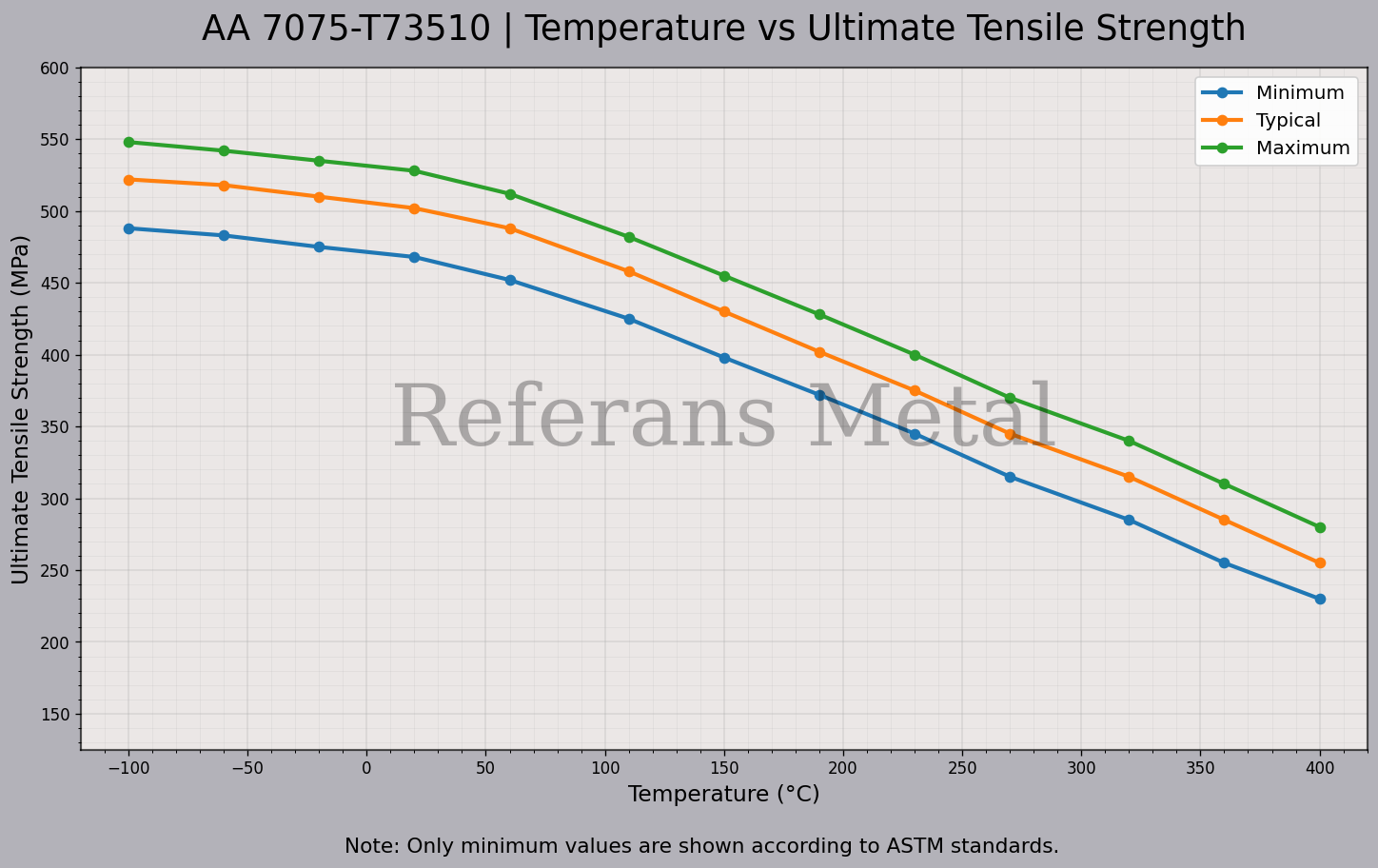
| 7075 T73510 Temperature – Ultimate Tensile Strength Graph |
 |
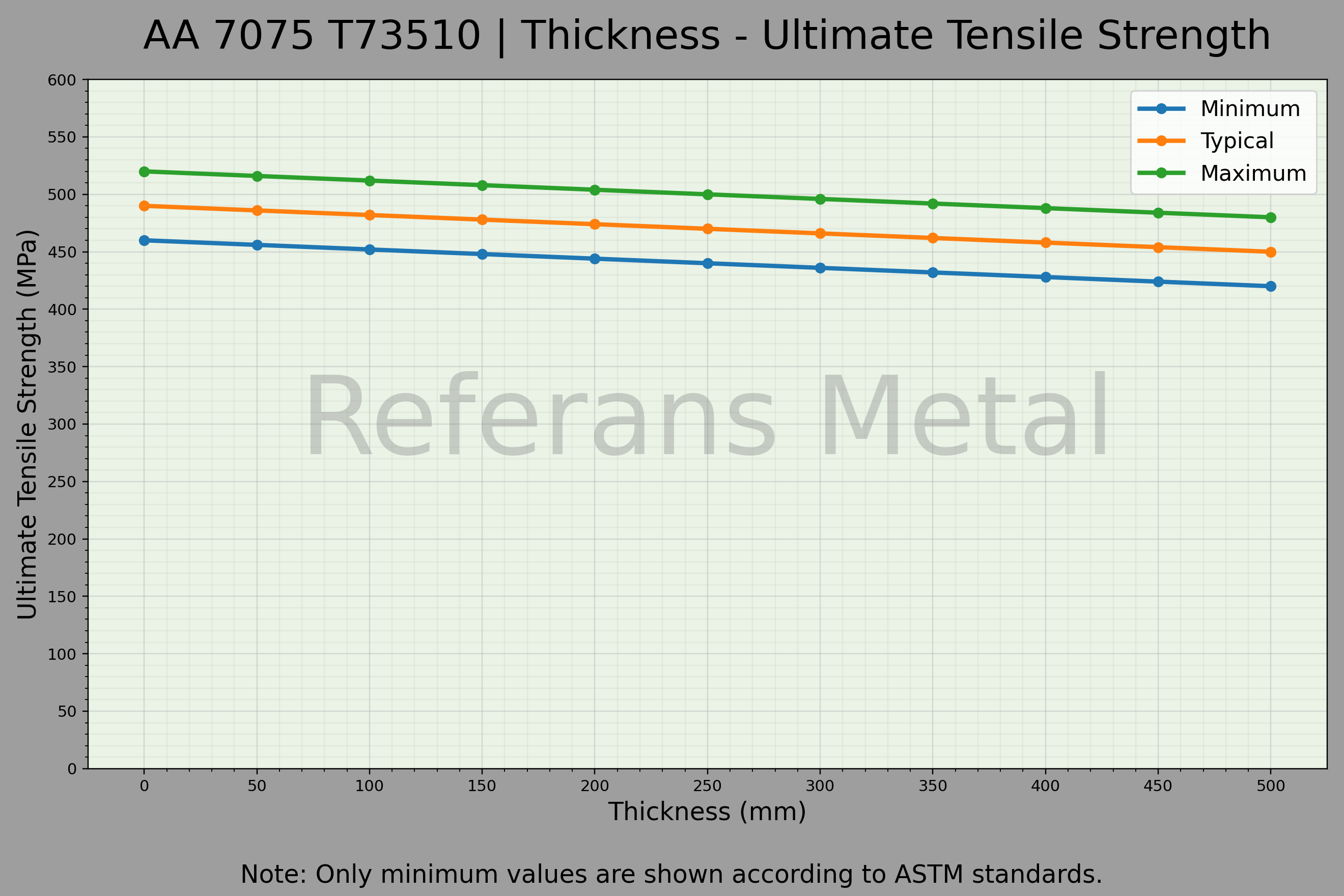
| 7075 T73510 Thickness – Ultimate Tensile Strength Graph |
 |
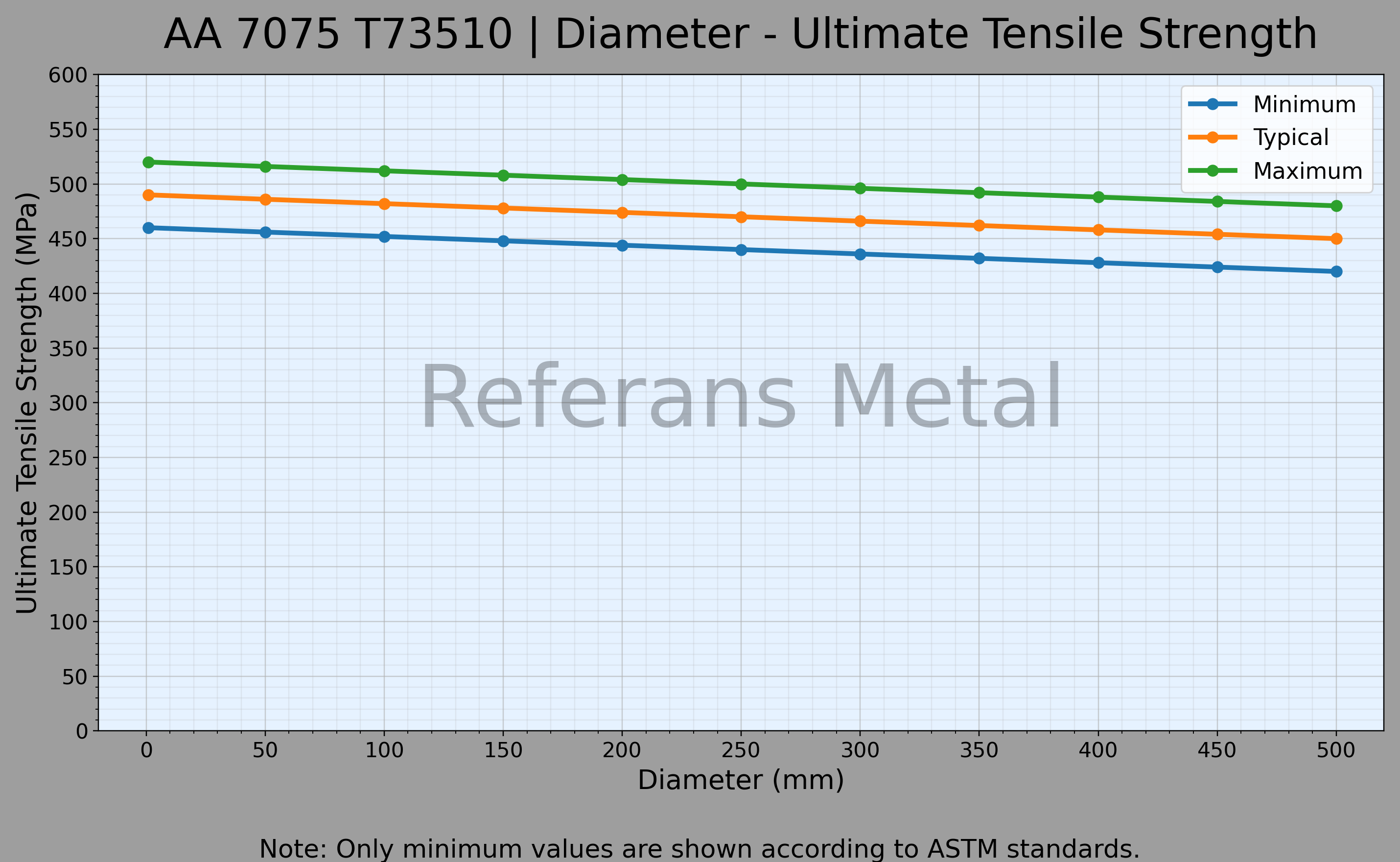
| 7075 T73510 Diameter – Ultimate Tensile Strength Graph |
 |
7075-T73510 aluminum alloy belongs to the 7xxx series aluminum alloys and is a zinc (Zn)-based high-strength alloy, representing an overaged temper condition. Compared to T6, the T73510 temper provides lower strength but significantly improved resistance to stress corrosion cracking (SCC). This temper is preferred in applications where reliability and long service life are critical.
In terms of strength and mechanical properties, 7075-T73510 has lower yield and tensile strength than T6 and T6510 tempers, but it still offers significantly higher strength than 6xxx series alloys (such as 6061-T6). The overaging process alters the precipitate structure, reducing strength slightly while improving material stability.
In terms of corrosion resistance, this temper shows its main advantage. 7075-T73510 exhibits high resistance to stress corrosion cracking, making it much safer than the T6 condition. Compared to 2024 alloy, it provides better SCC resistance, although it does not reach the general corrosion resistance level of 5xxx series alloys (such as 5083). Surface protection such as anodizing or coating is commonly applied.
Regarding machinability, bending, and weldability, 7075-T73510 offers good machinability but lower formability compared to the O temper. Care must be taken during bending operations, as the hardened structure increases the risk of cracking. Weldability is generally poor, and in this respect, 6061 alloy is much more advantageous. Therefore, mechanical fastening methods are usually preferred.
In terms of vibration response and applications, due to its high specific strength and improved corrosion resistance, 7075-T73510 is widely used in aerospace, defense industry, tooling, high-performance machinery parts, and critical load-bearing structures. This temper is especially preferred for thick sections and provides reliable performance under long-term loading. While 7075-T6 is used where maximum strength is required, T73510 is preferred in applications where safety and durability are prioritized.
MATERIAL COMPOSITION STANDARDS
7075 T73510 is available in the following standards:
• 7075 T73510 Cold Drawn Rod; AMS QQ-A-225/9, ASTM B211
• 7075 T73510 Cold Drawn Bar; AMS QQ-A-225/9, ASTM B211
• 7075 T73510 Cold Drawn Profile; AMS QQ-A-225/9, ASTM B211
Characteristic Properties for 7075 T73510:
- Strength: Significant
- Machinability: Above average
- Weldability: Low
- Formability: Above normal
- Corrosion Resistance: Good
- Heat Treatment: Yes
Some Well-Known Applications for 7075 T73510:
Rifle manufacturing,
Bicycle industry,
Production of gears operating at high temperatures and frequencies.
STOCK
7075 T73510 is supplied in Rod/Bar form.
- Rod / Bar
 Weight Calculator