
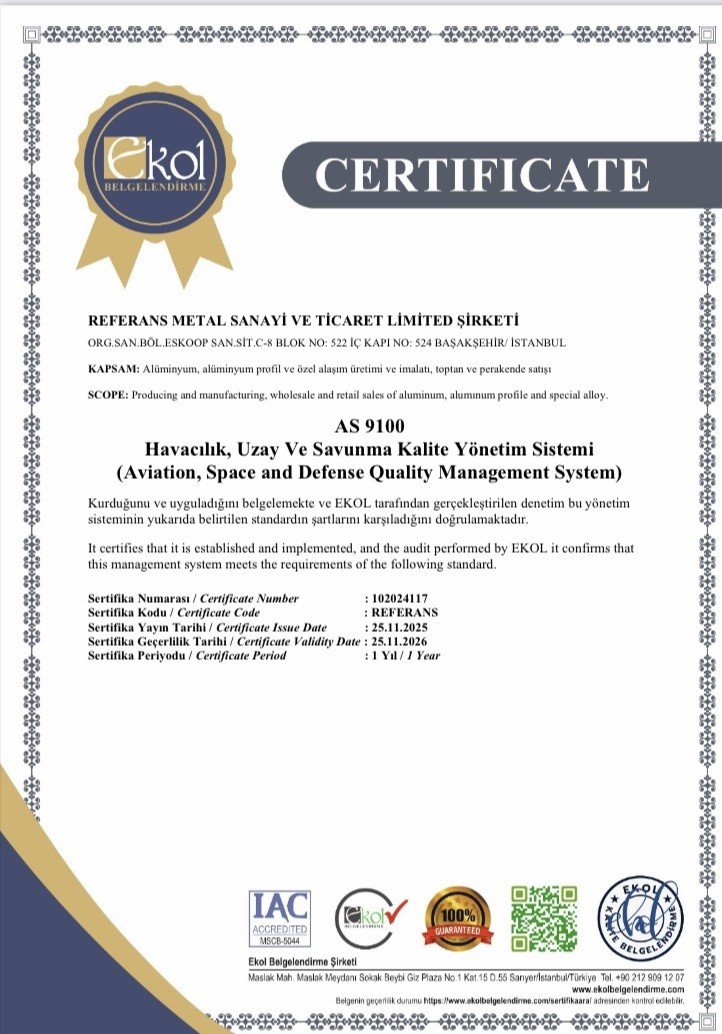
 AS 9100
 SPACE 2009
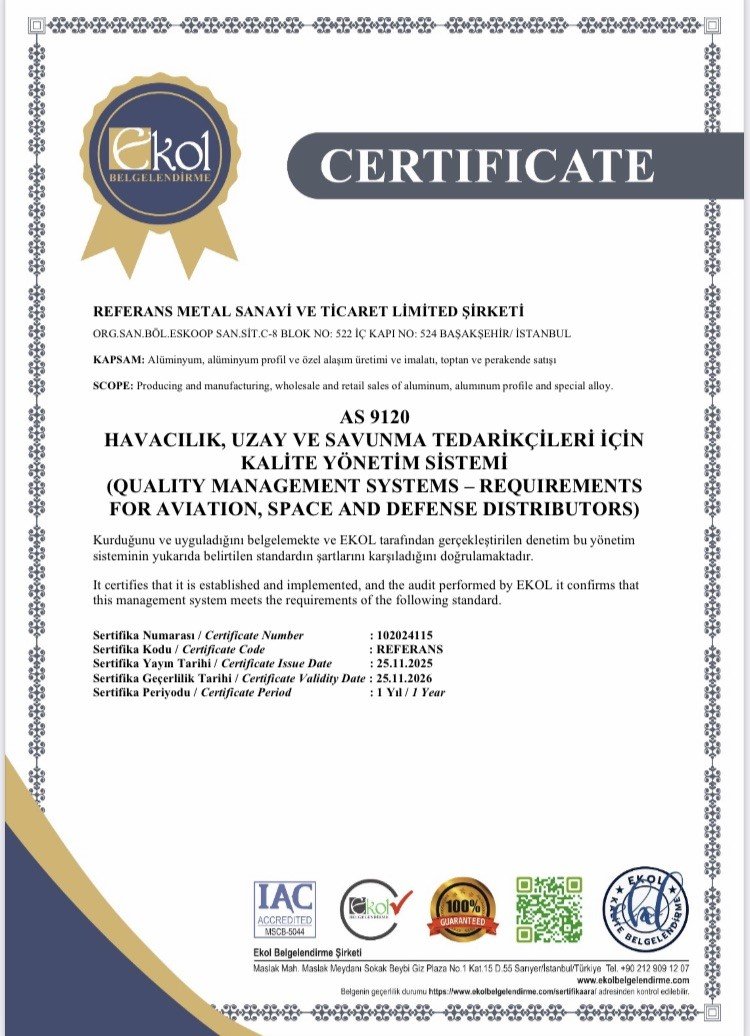 AS 9120




Plates
Sheets
Rod/Round Bar/Flat Bar
Tube/Extrusions/Profile
1200
BS 6L16 / Al99.0 / 1200 / H14
| Chemical Properties | % Value |
| Silicon (Si) | 0,00 - 1,00 |
| Manganese (Mn) | 0,00 - 0,05 |
| Copper (Cu) | 0,00 - 0,05 |
| Lead (Pb) | 0,00 - 0,05 |
| Titanium (Ti) | 0,00 - 0,05 |
| Iron (Fe) | 0,00 - 0,50 |
| Zinc (Zn) | 0,00 - 0,10 |
| Aluminium (Al) | Balance |
| Physical Properties | Value |
| Density | 2.59 g/cm³ |
| Melting Point | 657 °C |
| Thermal Expansion | 23.4 µm/m.°C |
| Modulus of Elasticity | 69 GPa |
| Thermal Conductivity | 225 W/m.K |
| Electrical Resistivity | 58.5 % IACS |
| Mechanical Properties | Value |
| Proof Strength | 100 MPa |
| Yield Strength | 130 MPa |
| Shear Strength | 74 MPa |
| Elongation A50 mm | 5.1 % |
| Hardness | 37 HB |
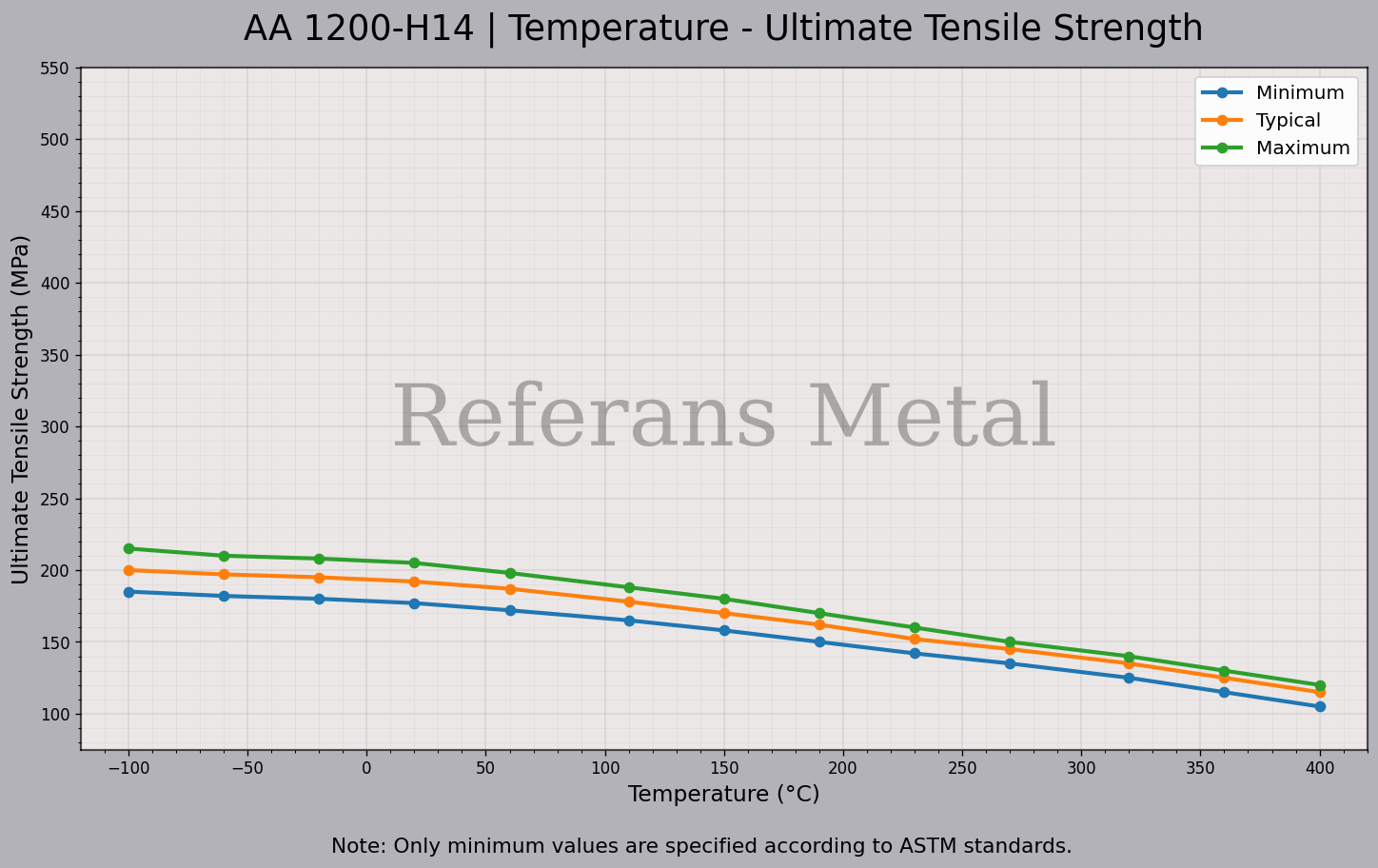
| 1200 H14 Temperature – Ultimate Tensile Strength Graph |
 |
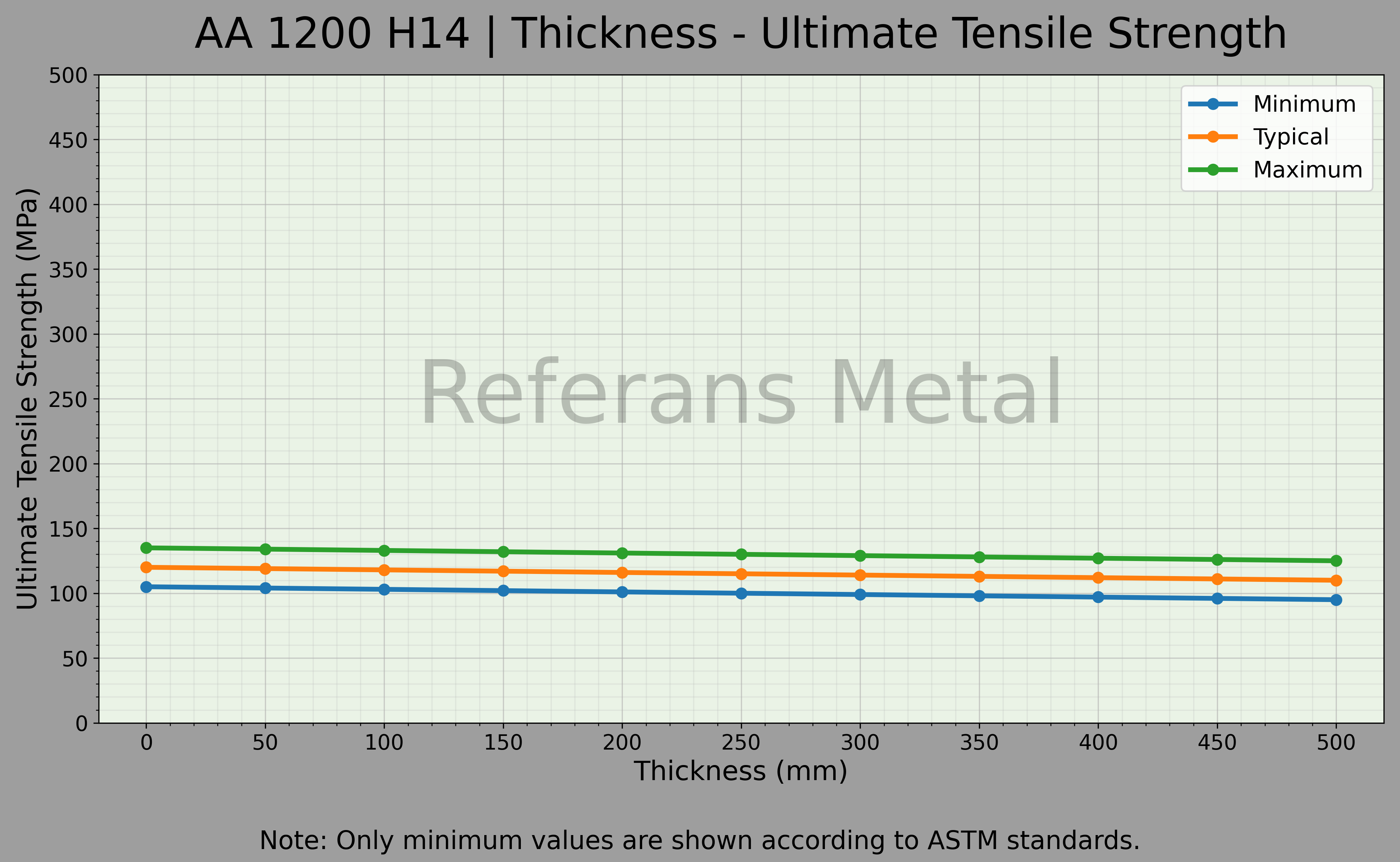
| 1200 H14 Thickness – Ultimate Tensile Strength Graph |
 |
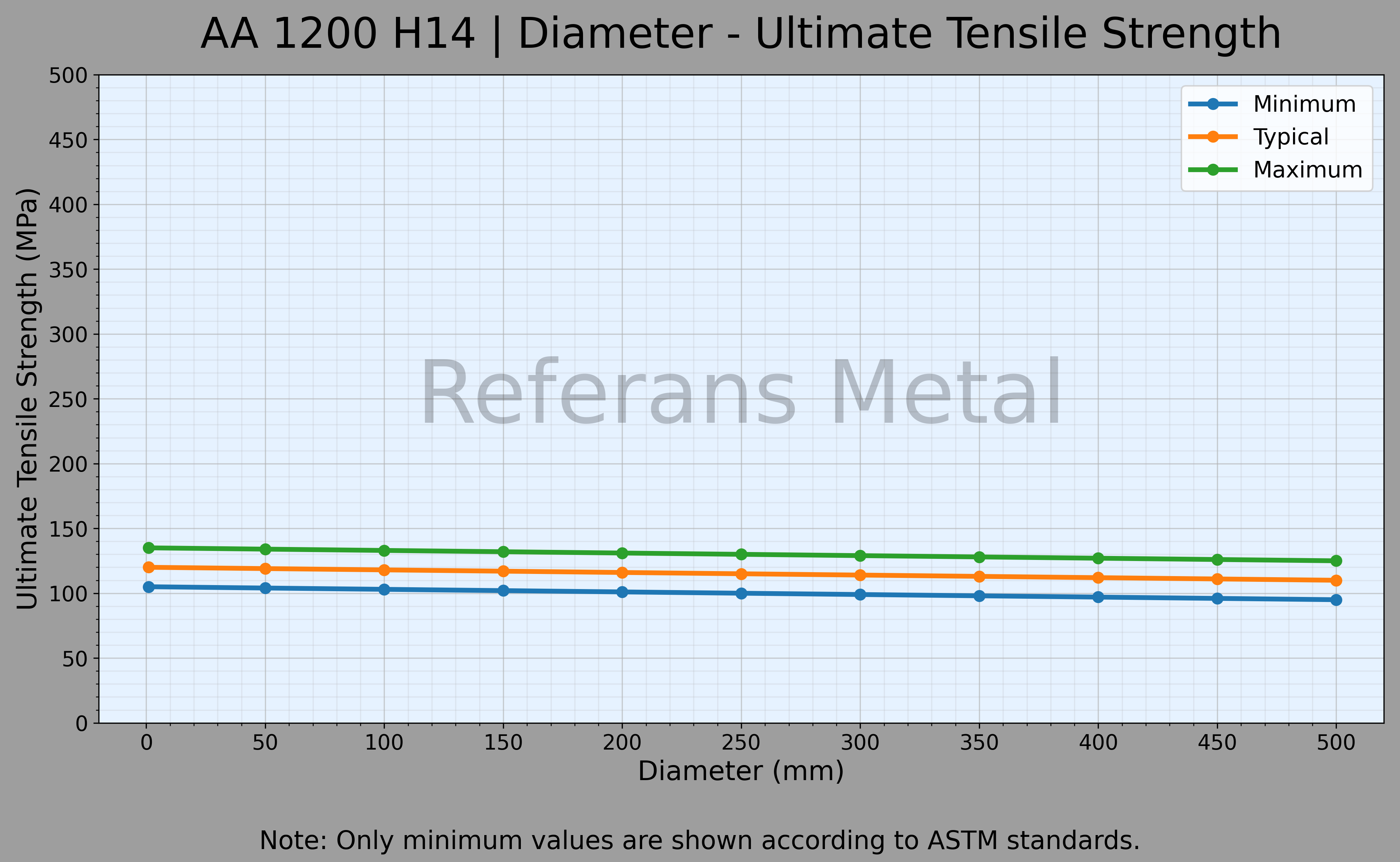
| 1200 H14 Diameter – Ultimate Tensile Strength Graph |
 |
1200 H14 aluminum alloy belongs to the commercially pure aluminum family and contains approximately 99% or more aluminum content. The H14 temper indicates a strain-hardened, half-hard condition that provides improved mechanical strength compared with fully annealed aluminum. This alloy is particularly preferred in applications requiring high corrosion resistance, excellent thermal and electrical conductivity, and good surface finish quality. Due to its chemical stability, it performs reliably under atmospheric exposure and is widely used in outdoor environments.
The strength of 1200 H14 aluminum is considered moderate when compared with high-strength aluminum alloys, but this characteristic gives it advantages in formability and bending capability. For example, 6061-T6 aluminum alloy offers significantly higher mechanical strength, whereas 1200 H14 provides superior formability and bending performance. Compared with 3003 aluminum alloy, which contains manganese and therefore has slightly higher strength, the 1200 alloy often provides better electrical conductivity and corrosion resistance. Similarly, 5052 aluminum alloy delivers better strength and fatigue resistance in marine environments, while 1200 alloy is generally more economical and easier to form.
This alloy is known for its excellent workability and formability. It performs well in cold forming, deep drawing, and bending operations. The H14 temper provides sufficient hardness while still allowing the material to be easily shaped during manufacturing. In addition, the alloy is highly suitable for surface coating and anodizing processes, making it an excellent base material for decorative or protective finishes. Because of these characteristics, it is frequently used in electrical components, reflectors, and decorative panels.
In terms of vibration response and fatigue behavior, 1200 H14 aluminum does not reach the structural strength levels of aerospace alloys; however, it provides adequate vibration damping and stable performance in many lightweight structural applications. The alloy also has excellent weldability and can be easily joined using TIG and MIG welding processes. These features make it suitable for thin sheet fabrication and lightweight structural assemblies.
Today, 1200 H14 aluminum alloy is widely used in industries such as electrical and electronics, chemical processing equipment, food processing machinery, architectural decoration, and packaging. Typical applications include heat exchangers, reflector panels, sheet and foil products, cable coverings, and lightweight structural components. Its high purity ensures reliable performance in applications where corrosion resistance and surface quality are critical.
• 1200 H14 Sheet; ASTM B209, BS 6 L16, UNS A91200, BS 1C, ISO Al99.0, DIN Al99, WNR 3.0205
• 1200 H14 Cold Drawn Rod; ASTM B211, BS 1C, UNS A91200, ISO Al99.0, DIN Al99, WNR 3.0205
• 1200 H14 Cold Drawn Bar; ASTM B211, BS 1C, UNS A91200, ISO Al99.0, DIN Al99, WNR 3.0205
• 1200 H14 Cold Drawn Wire; ASTM B211, BS 1C, UNS A91200, ISO Al99.0, DIN Al99, WNR 3.0205
• 1200 H14 Cold Drawn Tube; BS L116, ASTM B210, UNS A91200, BS 1C, ISO Al99.0, DIN Al99, WNR 3.0205
Selection Criteria for 1200 H14
- Strength: Medium
- Machinability: Poor
- Weldability: Excellent
- Formability: Very Good
- Corrosion Resistance: Excellent
- Heat Treatment: None
Common Applications for 1200 H14
Roof cladding applications, food industry containers,
Shipbuilding industry, and
Chemical industry.
1200 H14 is produced and supplied in sheet, round/bar, and tube/profile forms.
- Sheet
- Round/Bar
- Tube/Profile
 Weight Calculator