
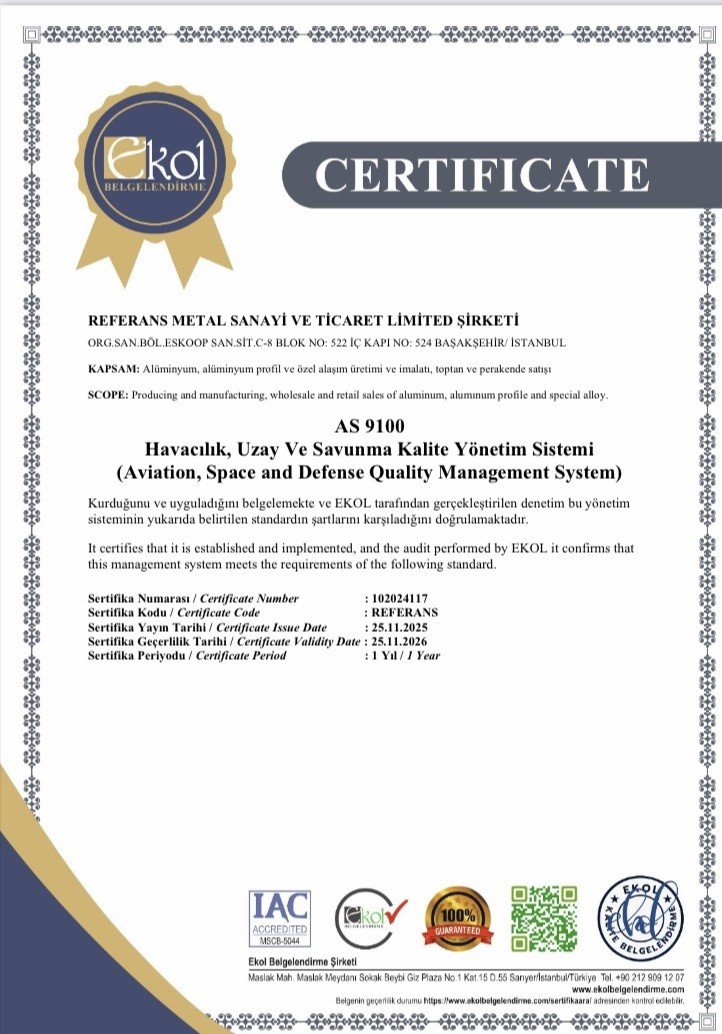
 AS 9100
 SPACE 2009
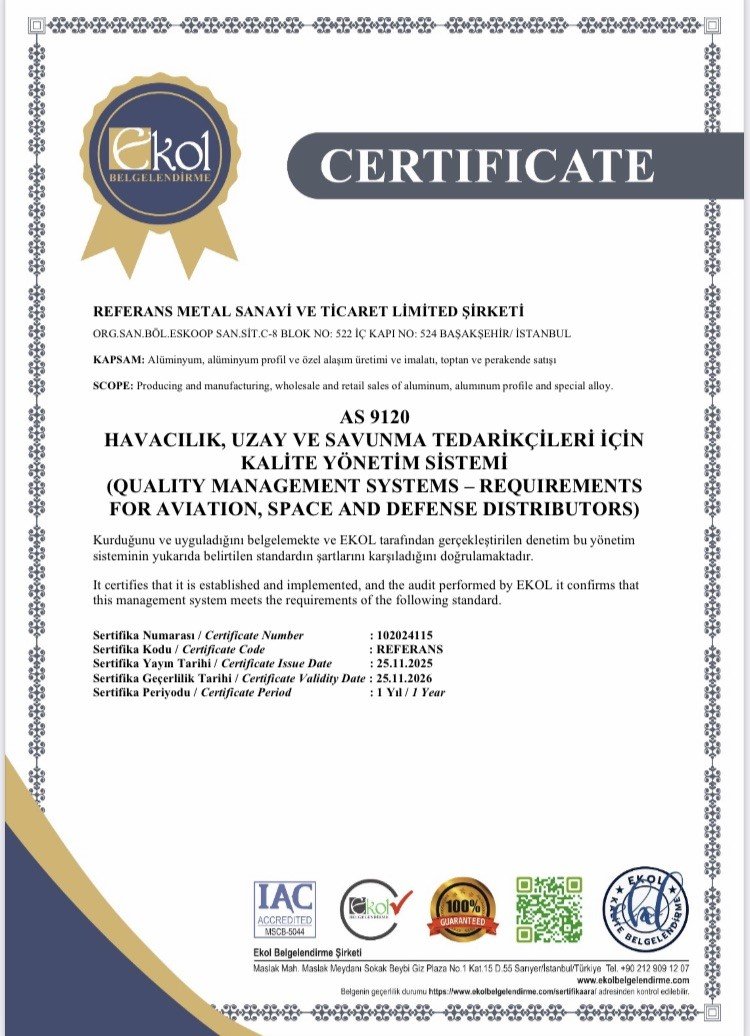 AS 9120




Plates
Sheets
Rod/Round Bar/Flat Bar
Tube/Extrusions/Profile
7020
ASTM B209 / AlZn4,5Mg1 / 7020 / T7351
| Chemical Properties | % Value |
| Chromium (Cr) | 0,10 - 0,35 |
| Manganese (Mn) | 0,05 - 0,50 |
| Magnesium (Mg) | 1,00 - 1,40 |
| Copper (Cu) | 0,00 - 0,20 |
| Titanium (Ti) | 0,00 - 0,17 |
| Iron (Fe) | 0,00 - 0,40 |
| Zinc (Zn) | 4,00 - 5,00 |
| Aluminium (Al) | Balance |
| Titanium + Zirconium (Ti+Zr) | 0,08 - 0,20 |
| Physical Properties | Value |
| Density | 2.78 g/cm³ |
| Melting Point | 605 °C |
| Thermal Expansion | 23,3 µm/m.°C |
| Modulus of Elasticity | 71 GPa |
| Thermal Conductivity | 151 W/m-K |
| Electrical Resistivity | %38 IACS |
| Mechanical Properties | Value |
| Yield Strength | 300 MPa |
| Ultimate Strength | 390 MPa |
| Shear Strength | 230 MPa |
| Elongation A50 mm | %12 |
| Hardness | 100 HB |
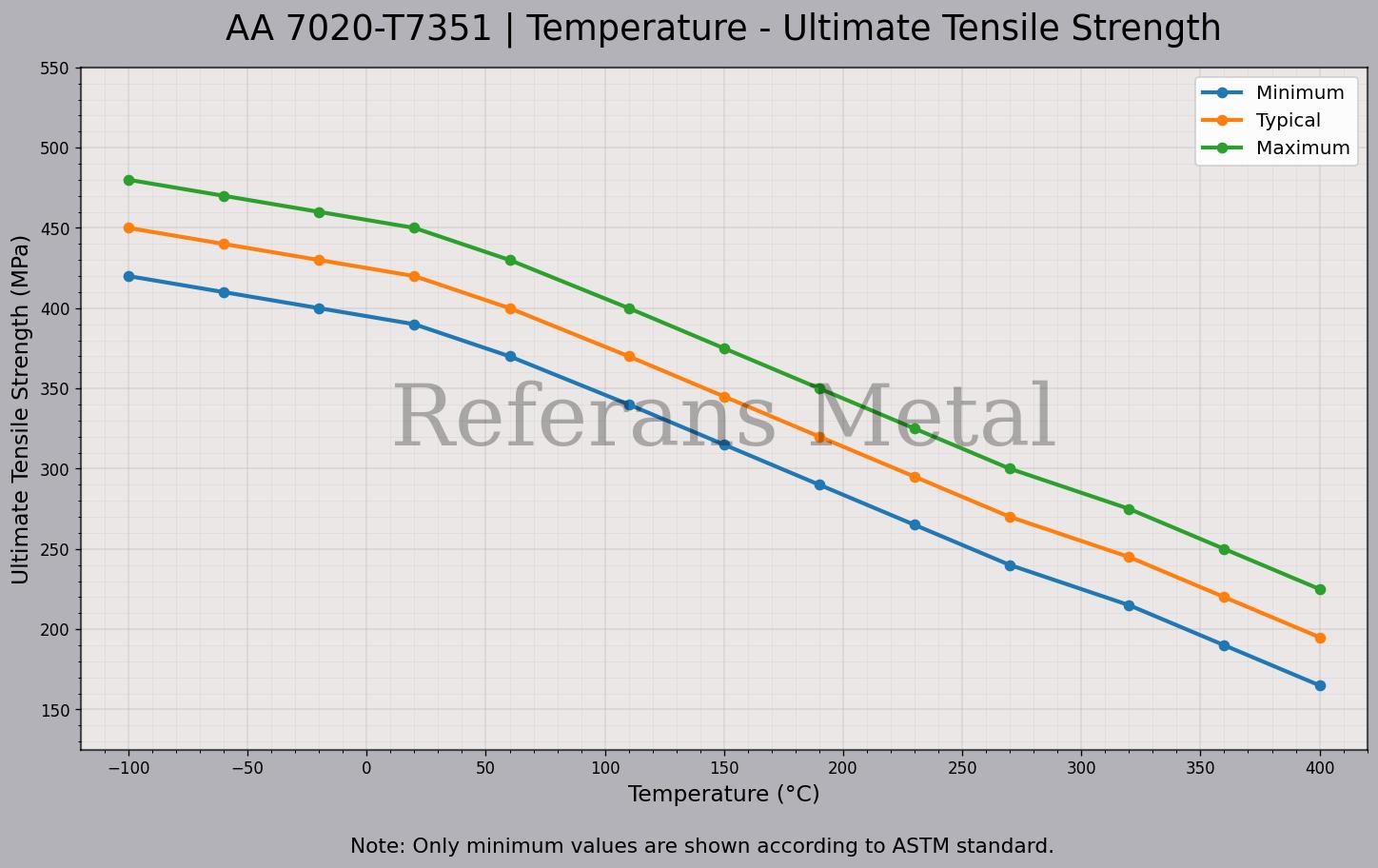
| 7020 T7351 Temperature – Ultimate Tensile Strength Graph |
 |
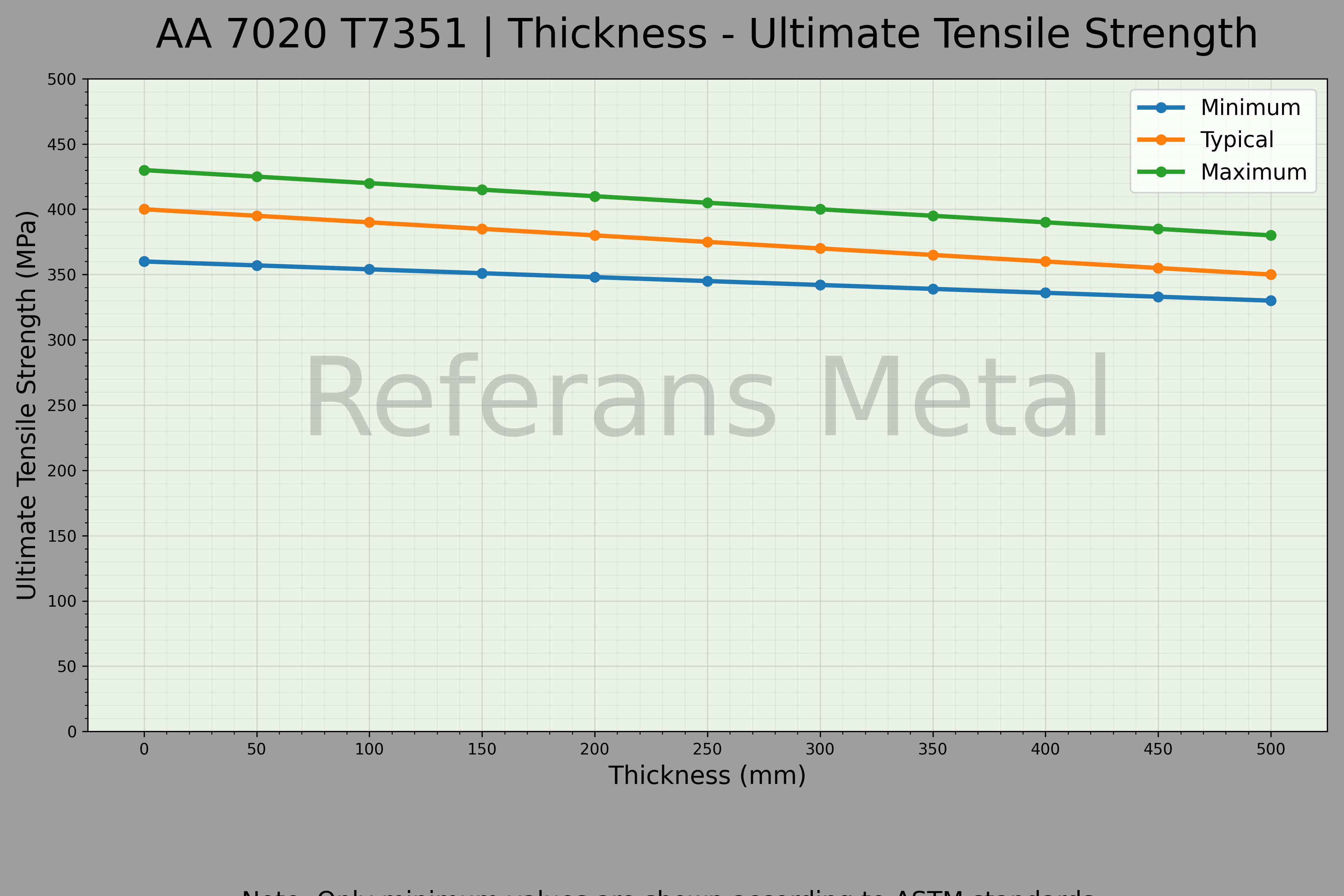
| 7020 T7351 Thickness – Ultimate Tensile Strength Graph |
 |
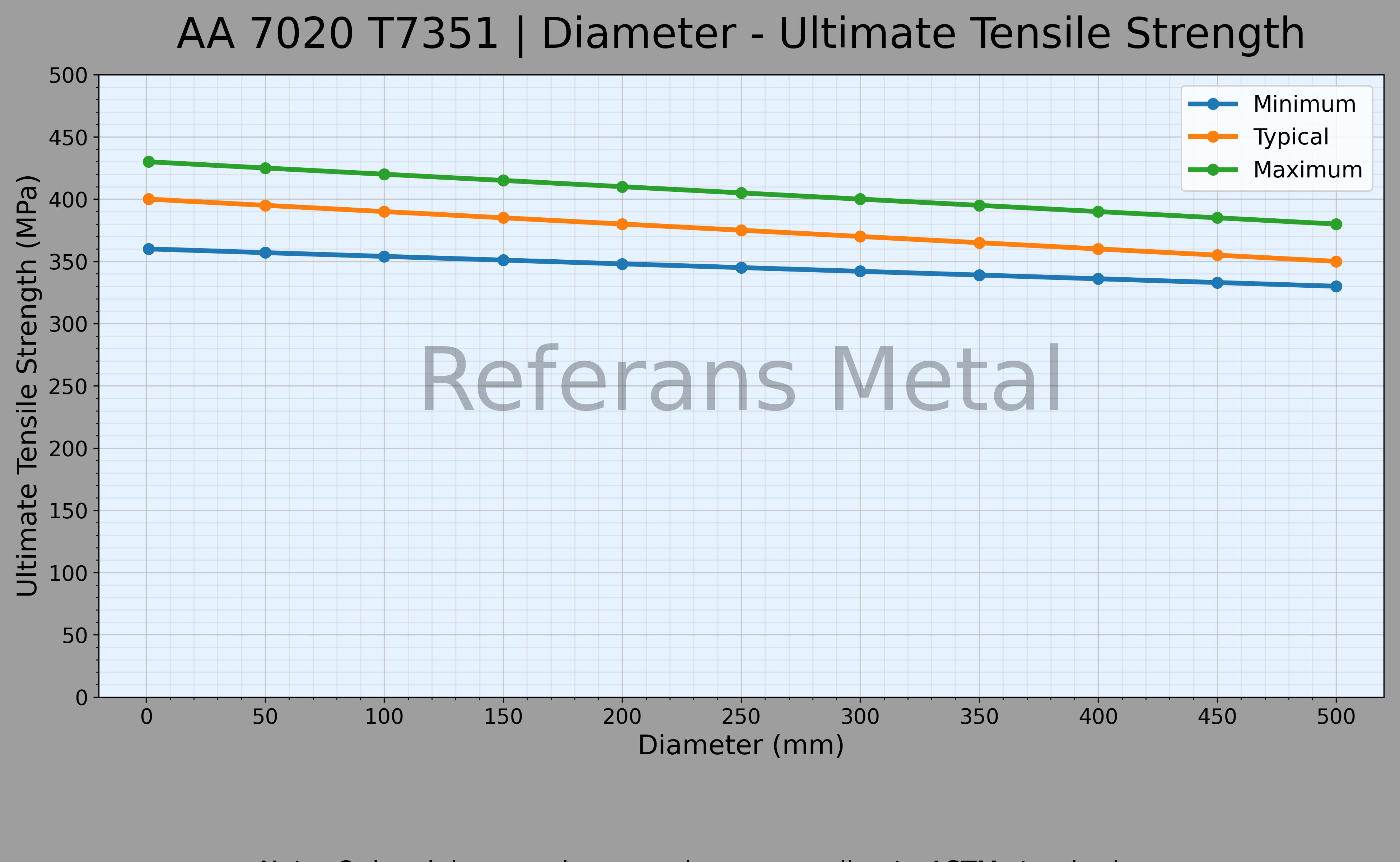
| 7020 T7351 Diameter – Ultimate Tensile Strength Graph |
 |
7020 T7351 aluminum alloy belongs to the Al-Zn-Mg based 7000 series and is developed for applications requiring high strength along with good weldability. Compared to high-copper alloys like 7010 and 7075, it offers better welding performance due to its lower Cu content. The T7351 temper refers to solution heat treatment, stress relieving, and overaging, which improves resistance to stress corrosion cracking (SCC).
In terms of corrosion resistance, 7020 T7351 performs quite well within the 7000 series. Its SCC resistance is significantly higher than that of 7075-T6, making it a safer choice for structural applications. It can also exhibit corrosion resistance close to 6000 series alloys in atmospheric conditions and shows better general corrosion behavior than alloys like 7010.
Regarding strength and mechanical properties, 7020 T7351 offers high strength, although slightly lower than 7075 and 7010. In return, it provides better toughness and impact resistance. Compared to 6082-T6, it offers higher strength, while providing a more balanced performance and better corrosion resistance than 2024.
In terms of machinability, bendability, and weldability, 7020’s key advantage within the 7000 series is its good weldability. It can be welded using MIG and TIG methods, with limited strength loss after welding. Its machinability is moderate and not as high as 7012 or 7075. Its bending capability is limited in the T7351 temper but improves in softer tempers such as T4.
Regarding coating ability, vibration behavior, and applications, 7020 alloy is suitable for anodizing and protective coatings. Its decorative surface quality is moderate. Its vibration damping capacity is slightly better than typical 7000 series alloys. Main application areas include railway vehicles, automotive chassis, defense industry, welded structures, and heavy-duty equipment. 7020 T7351 is an ideal alloy especially for high-strength welded structures.
MATERIAL COMPOSITION STANDARDS
7020 T7351 can be produced according to the following standards:
• 7020 T7351 Sheet/Plate; ISO AlZn4.5Mg1, WNR 3.4335, UNS A97020, ASTM B209, BS H17
Characteristic Properties of 7020 T7351:
- Strength: Very Good
- Machinability: Moderate
- Weldability: Good
- Formability: Reasonable
- Corrosion Resistance: Reasonable
- Heat Treatment: Yes
Common Applications of 7020 T7351:
Primarily in the aerospace industry,
Motorcycle and bicycle components,
Parts exposed to high loads.
STOCK
We supply 7020 T7351 in sheet form.
- Sheet/Plate
 Weight Calculator