
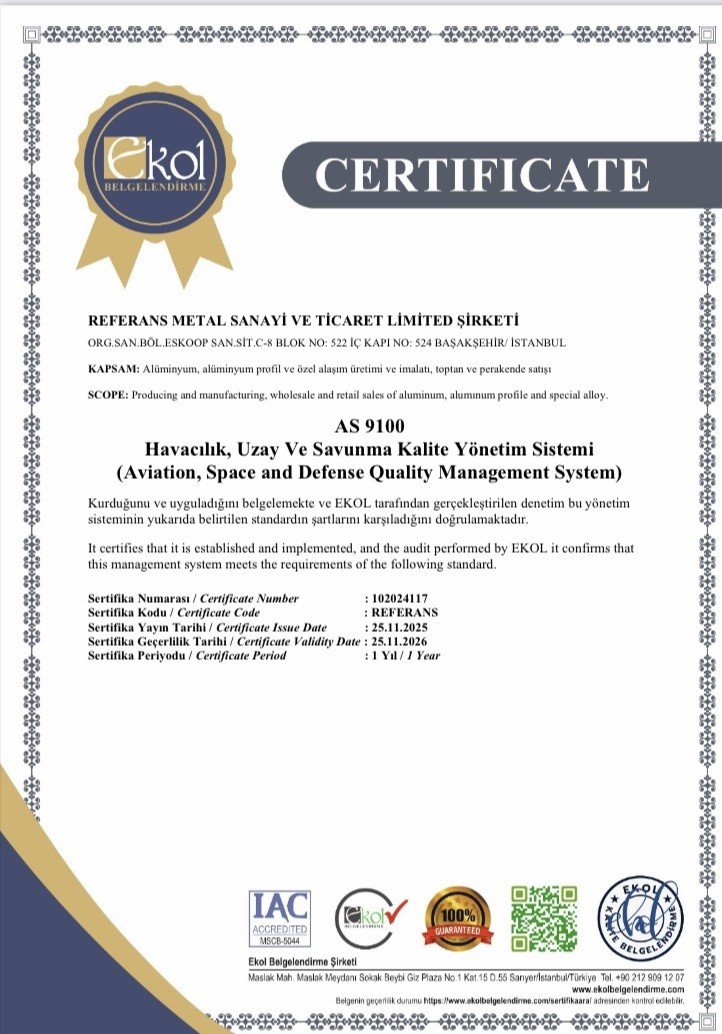
 AS 9100
 SPACE 2009
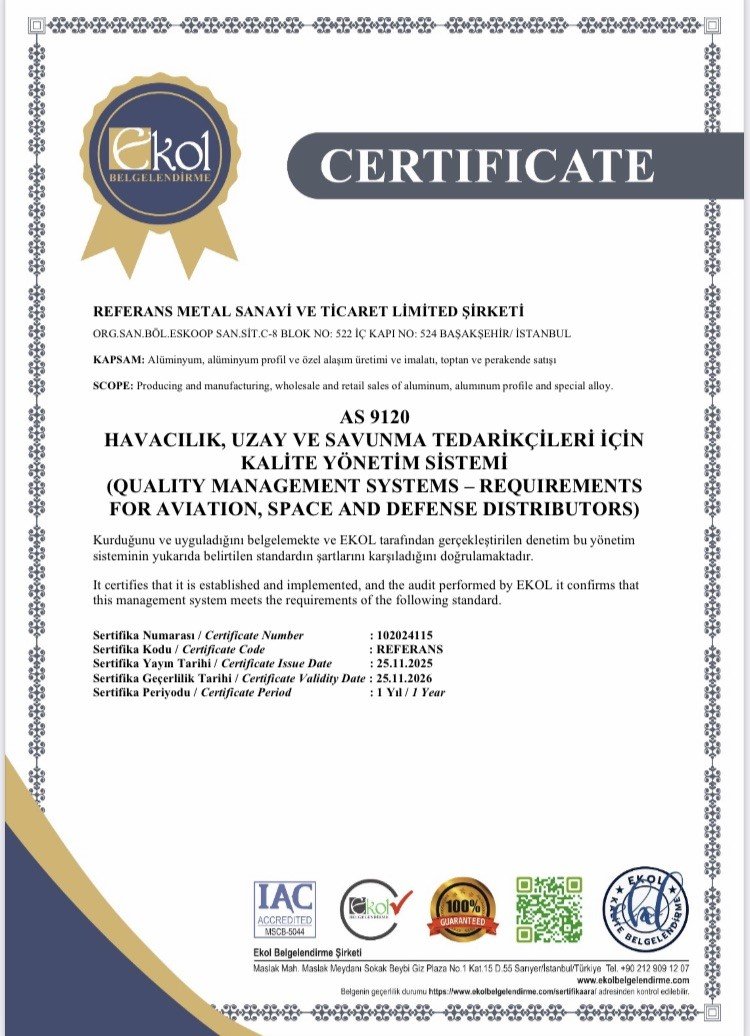 AS 9120




Plates
Sheets
Rod/Round Bar/Flat Bar
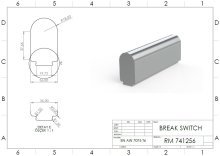
Tube/Extrusions/Profile
6061
AMS 4150 / AlMg1SiCu / 6061 / T6
| Chemical Properties | % Value |
| Silicon (Si) | 0,40 - 0,80 |
| Chromium (Cr) | 0,04 - 0,35 |
| Manganese (Mn) | 0,00 - 0,15 |
| Magnesium (Mg) | 0,80 - 1,20 |
| Copper (Cu) | 0,15 - 0,40 |
| Titanium (Ti) | 0,00 - 0,15 |
| Iron (Fe) | 0,00 - 0,70 |
| Zinc (Zn) | 0,00 - 0,25 |
| Aluminium (Al) | Balance |
| Physical Properties | Value |
| Density | 2.70 g/cm³ |
| Melting Point | 582 °C |
| Thermal Expansion | 23.6 µm/m.°C |
| Modulus of Elasticity | 69 GPa |
| Thermal Conductivity | 167 W/m.K |
| Electrical Resistivity | %43 IACS |
| Mechanical Properties | Value |
| Proof Strength | 276 MPa |
| Yield Strength | 310 MPa |
| Shear Strength | 207 MPa |
| Elongation A50 mm | 15% |
| Hardness | 95 HB |
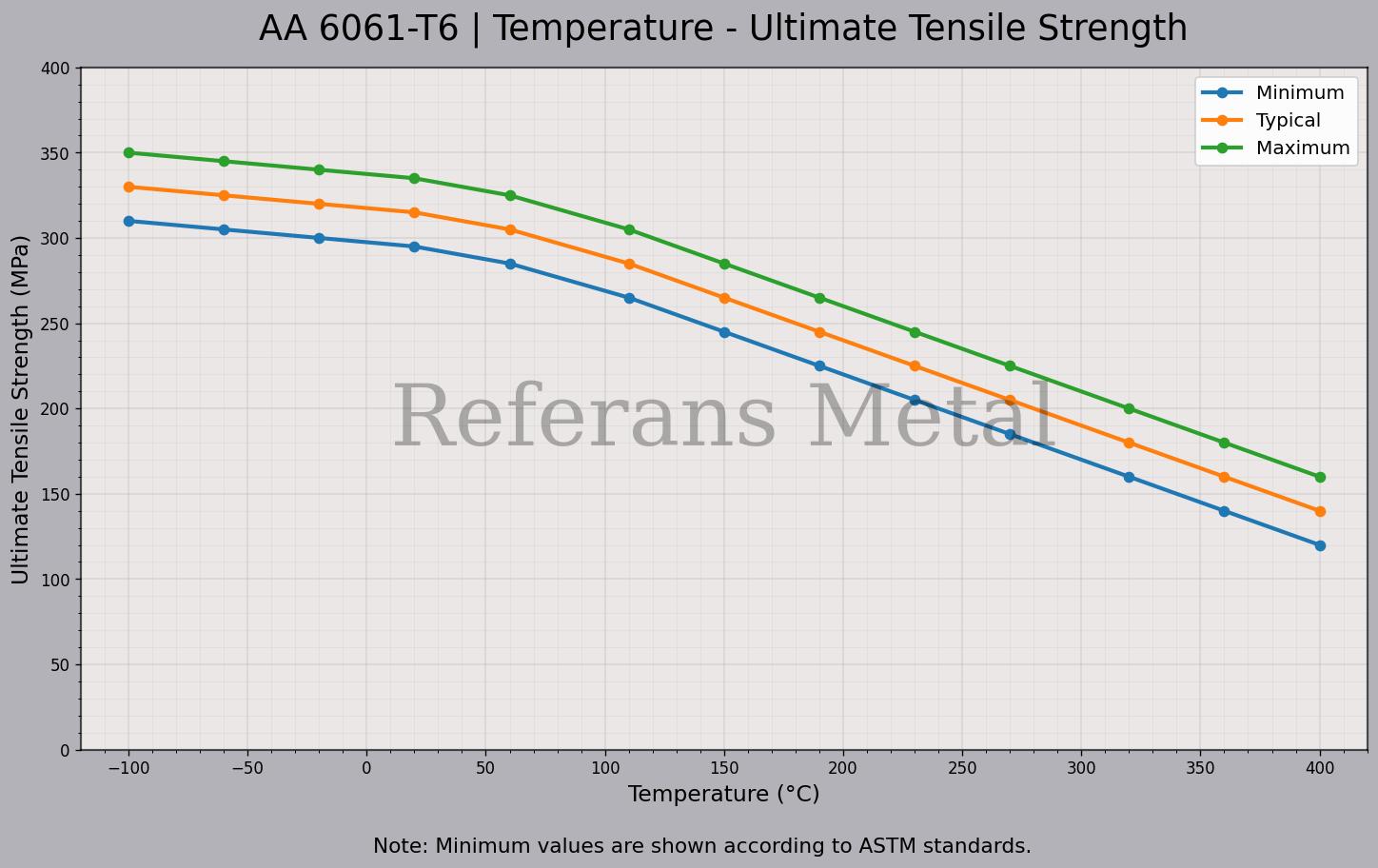
| 6061 T6 Temperature – Ultimate Tensile Strength Graph |
 |
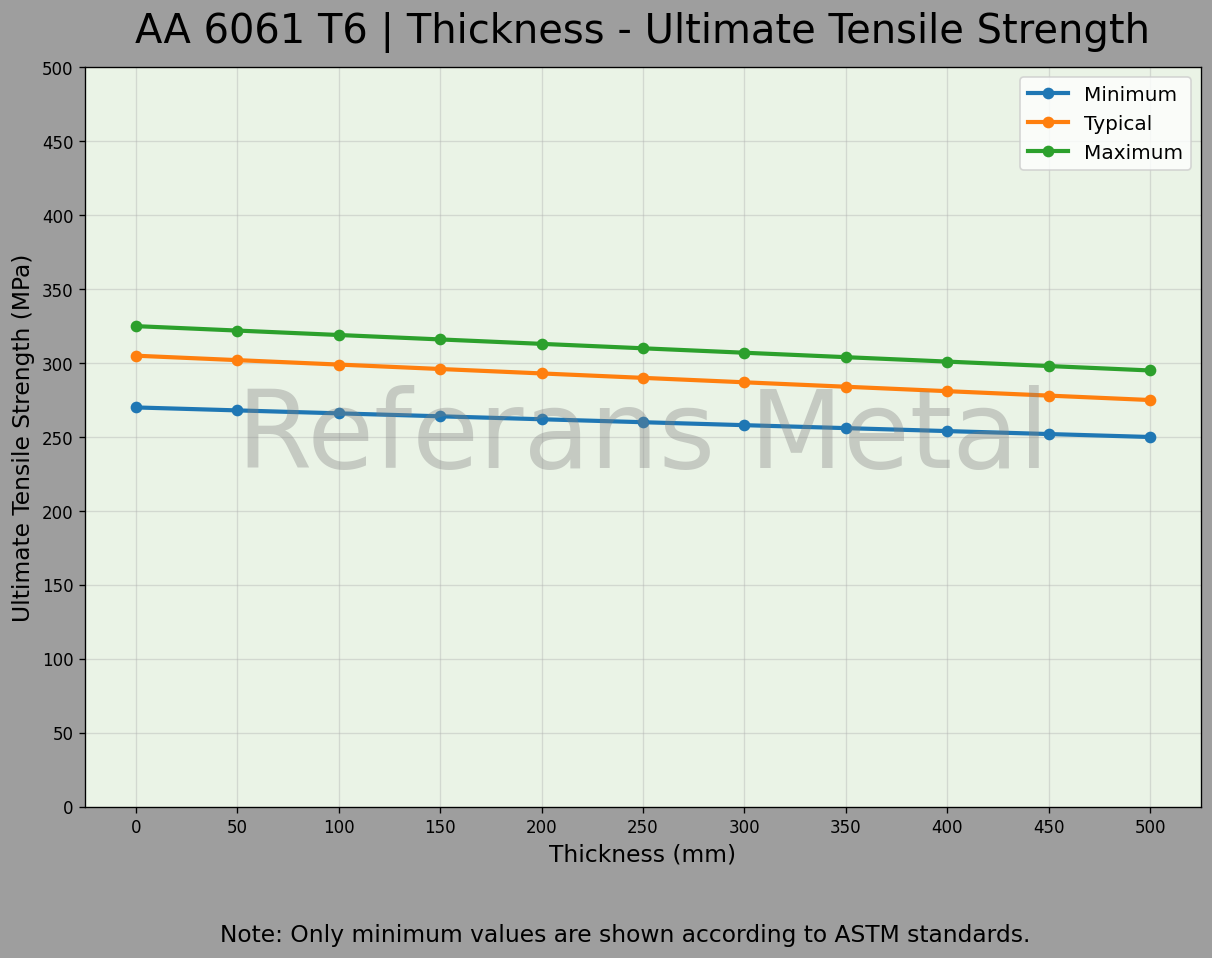
| 6061 T6 Thickness – Ultimate Tensile Strength Graph |
 |
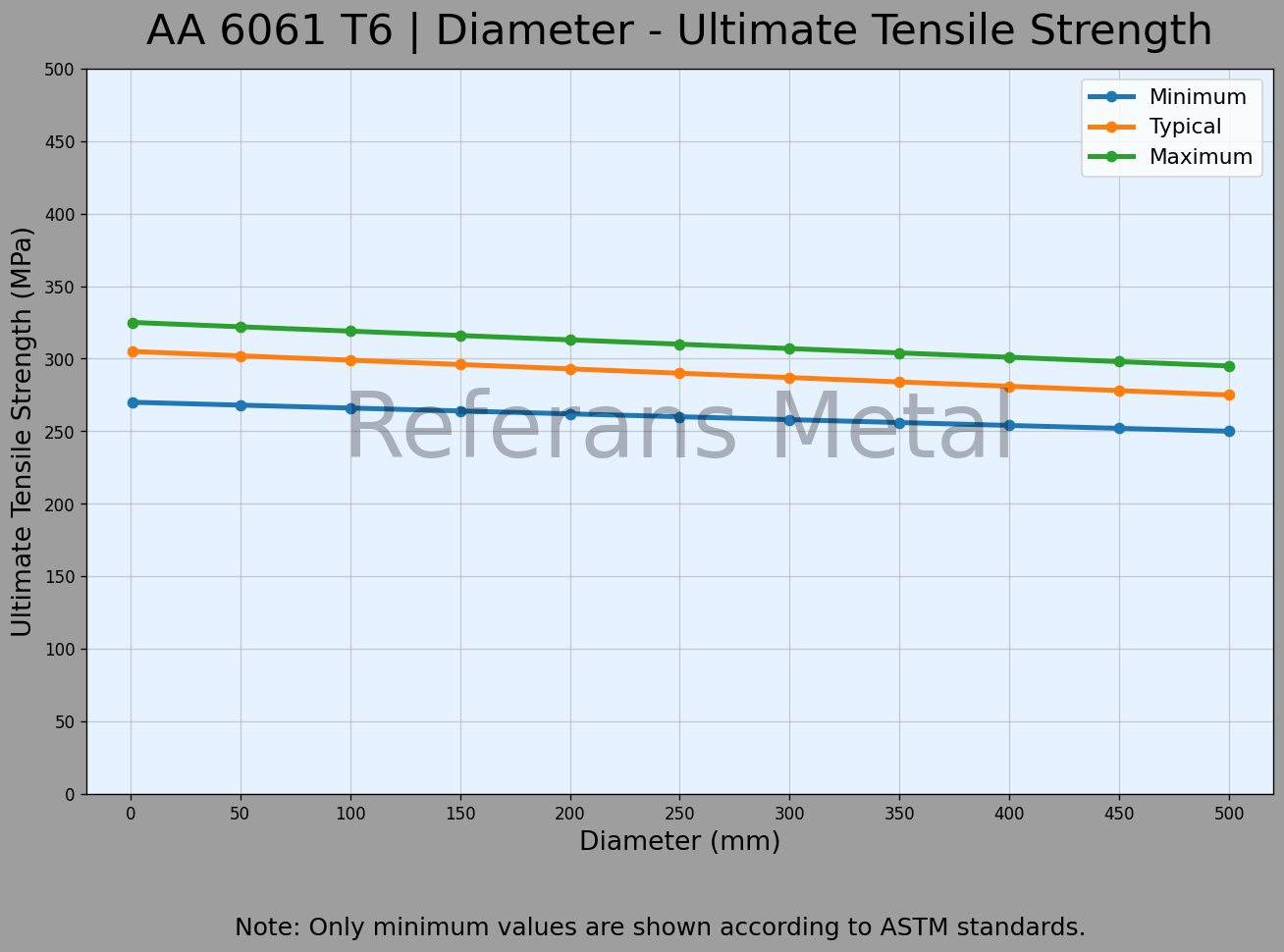
| 6061 T6 Diameter – Ultimate Tensile Strength Graph |
 |
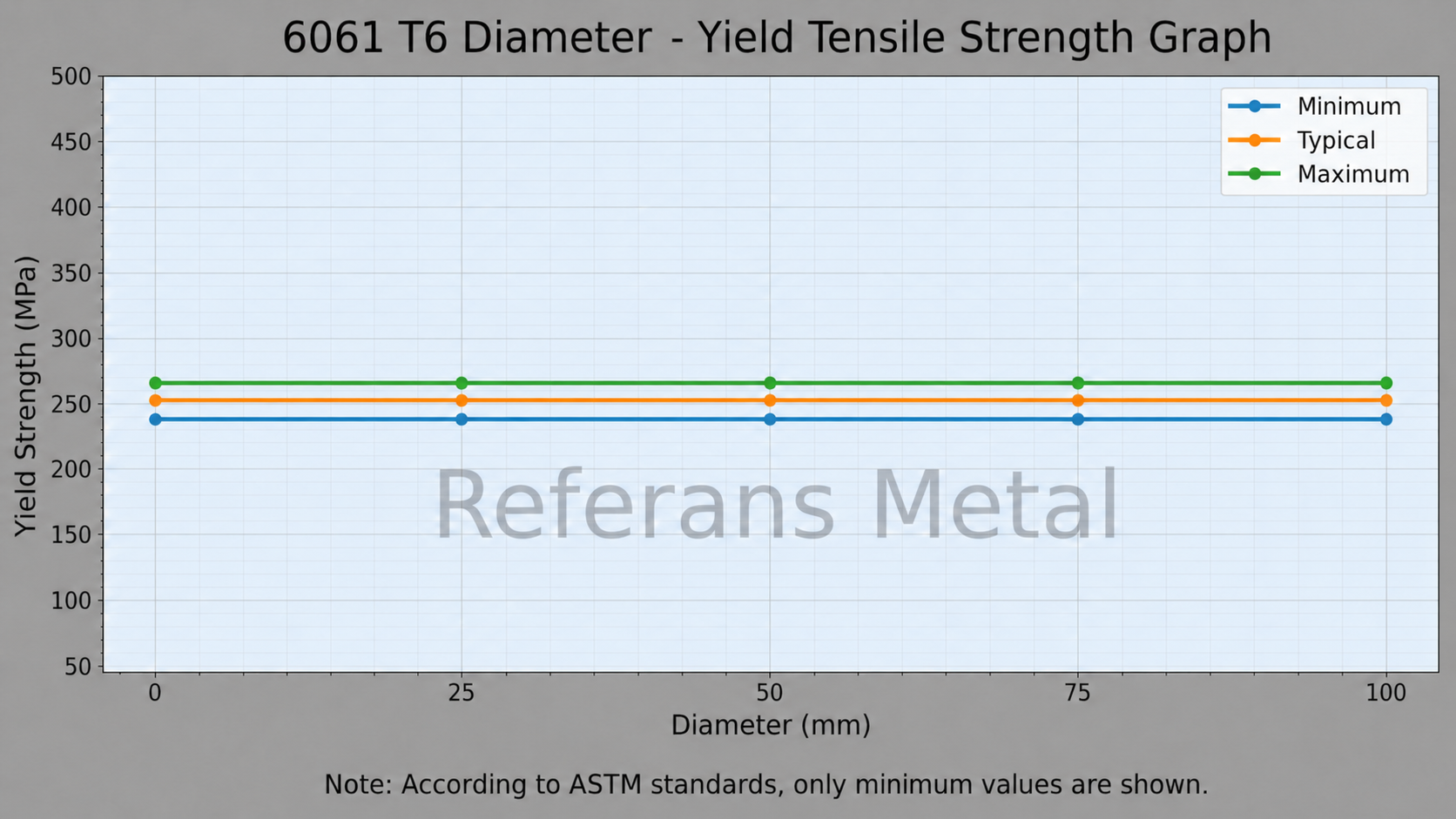
| 6061 T6 Diameter-Yield Tensile Strength |
 |
The 6061-T6 aluminum alloy is a precipitation-hardened alloy with medium-to-high strength and is widely used in engineering applications. This magnesium and silicon-based alloy is especially preferred due to its balanced mechanical properties. The T6 temper is obtained through solution heat treatment and artificial aging processes, and in this way the alloy gains high tensile strength and yield strength. Thanks to these properties, it can be safely used in both structural and semi-structural applications.
In terms of corrosion resistance, 6061-T6 shows very successful performance in many environments and is especially resistant to atmospheric conditions. Its.png) use in marine environments is possible, but it may show slightly lower performance compared to marine alloys such as 5083. However, corrosion resistance can be further increased with surface treatments and coatings. Its coatability is quite good, and aesthetic and protective surfaces can be obtained through anodizing.
use in marine environments is possible, but it may show slightly lower performance compared to marine alloys such as 5083. However, corrosion resistance can be further increased with surface treatments and coatings. Its coatability is quite good, and aesthetic and protective surfaces can be obtained through anodizing.
In terms of strength and machinability, 6061-T6 is a well-balanced alloy. Although it has lower strength compared to 7075-T6 alloy, it offers much better weldability and machinability. Compared to 2024 alloy, it provides better corrosion resistance and easier machinability. It gives good results in CNC machining, milling, and turning operations and is preferred in machining processes. For this reason, it is widely used in automotive, machinery, and mold industries.
Bending and forming properties are limited in the T6 temper, but they can be achieved with appropriate processes. Compared to T4 temper, it offers lower.png) formability. In terms of vibration behavior, 6061 alloy has a good damping capacity and therefore provides an advantage in structural applications in terms of vibration control. This feature is an important advantage especially in aerospace and transportation sectors.
formability. In terms of vibration behavior, 6061 alloy has a good damping capacity and therefore provides an advantage in structural applications in terms of vibration control. This feature is an important advantage especially in aerospace and transportation sectors.
In terms of weldability, 6061-T6 is quite superior compared to many aluminum alloys. It can be easily joined with MIG and TIG welding methods. Although there is a loss of strength after welding, this situation can be partially compensated with appropriate heat treatments. Its areas of use include aerospace, automotive, bicycle manufacturing, construction sector, marine equipment, and general engineering applications. Compared to alloys such as 5083, 7075, and 2024, 6061-T6 stands out with its versatile use and balanced properties.
6061 T6 is available according to the following standards:
• 6061 T6 Plate; AMS4027, AMSQQ-A-250/11, EN2694, AIR9048.240, UNSA96061, WNR3.3211, ASTM B209
• 6061 T6 Sheet; AMS4027, AMSQQ-A-250/11, EN2694, AIR9048.240, UNSA96061, WNR3.3211, ASTM B209
• 6061 T6 Cold Drawn Round Bar; EN2694, AIR9048.240, UNSA96061, WNR3.3211, ASTM B209
• 6061 T6 Cold Drawn Flat Bar; EN2694, AIR9048.240, UNSA96061, WNR3.3211, ASTM B209
• 6061 T6 Cold Drawn Wire; EN2694, AIR9048.240, UNSA96061, WNR3.3211, ASTM B209
• 6061 T6 Cold Drawn Tube; AMS4117, AMSQQ-A-225/8, EN2392, BSL117, UNSA96061, WNR3.3211, ASTM B211
• 6061 T6 Extruded Round Bar; AMS4113, AMS4127, AMS4150, AMSQQ-A-200/16 (For Structural Shapes), AMSQQ-A-200/8, ASTM B221
• 6061 T6 Extruded Flat Bar; AMS4113, AMS4127, AMS4150, AMSQQ-A-200/16 (For Structural Shapes), AMSQQ-A-200/8, ASTM B221
• 6061 T6 Extruded Wire; AMS4113, AMS4127, AMS4150, AMSQQ-A-200/16 (For Structural Shapes), AMSQQ-A-200/8, ASTM B221
• 6061 T6 Extruded Tube; AMS4113, AMS4127, AMS4150, AMSQQ-A-200/16 (For Structural Shapes), AMSQQ-A-200/8, ASTM B221
• 6061 T6 Extruded Forging; AMS4113, AMS4127, AMS4150, AMSQQ-A-200/16 (For Structural Shapes), AMSQQ-A-200/8, ASTM B221
• 6061 T6 Seamless Cold Drawn Tube; AMS4082, AMS4083 (Hydraulic Tube), WW-T-700/6, MIL-T-7081 (Hydraulic Tube), ASTM B241
Selection Factors for 6061 T6
- Strength: Medium
- Machinability: Good
- Weldability: Excellent
- Formability: Good
- Corrosion Resistance: Excellent
- Heat Treatment: Yes
Some Known Applications for 6061 T6
Pipe lines, tank components,
Structural parts of durable consumer goods,
Including motorboats, among many other applications.
6061 T6 is produced and supplied in plate/sheet, round/flat bar, and tube/profile forms.
- Rod / Round Bar / Flat Bar
- Plate
- Sheet
- Tube/Profile
| Mechanical Properties | |||
| Thickness (mm) | Yield Strength (Min.) | Ultimate Strength (Min.) | Elongation A50 mm % |
| Over 0.2 up to & incl. 0.5 | 241 | 290 | %8 |
| Over 0.5 up to & incl. 6.5 | 241 | 290 | %10 |
 Weight Calculator