
 AS 9100
 SPACE 2009
 AS 9120




Plates
Sheets
Rod/Round Bar/Flat Bar
Tube/Extrusions/Profile
7075 clad with 7011
AMS QQ-A-250/26 / AlZn5.5MgCu / 7075 clad with 7011 / T76
| Chemical Properties | % Value |
| Silicon (Si) | 0,00 - 0,40 |
| Chromium (Cr) | 0,18 - 0,28 |
| Manganese (Mn) | 0,00 - 0,30 |
| Magnesium (Mg) | 2,10 - 2,90 |
| Copper (Cu) | 1,20 - 2,00 |
| Titanium (Ti) | 0,00 - 0,20 |
| Iron (Fe) | 0,00 - 0,50 |
| Zinc (Zn) | 5,10 - 6,10 |
| Aluminium (Al) | Balance |
| Physical Properties | Value |
| Density | 2.81 g/cm³ |
| Melting Point | 477°C |
| Thermal Expansion | 23 x 10^-6 /K |
| Modulus of Elasticity | 71 GPa |
| Thermal Conductivity | 150 W/m.K |
| Electrical Resistivity | %33 IACS |
| Mechanical Properties | Value |
| Proof Strength | 503 Mpa |
| Yield Strength | 572 Mpa |
| Shear Strength | 330 MPa |
| Elongation A50 mm | 11% |
| Hardness | 160 HB |
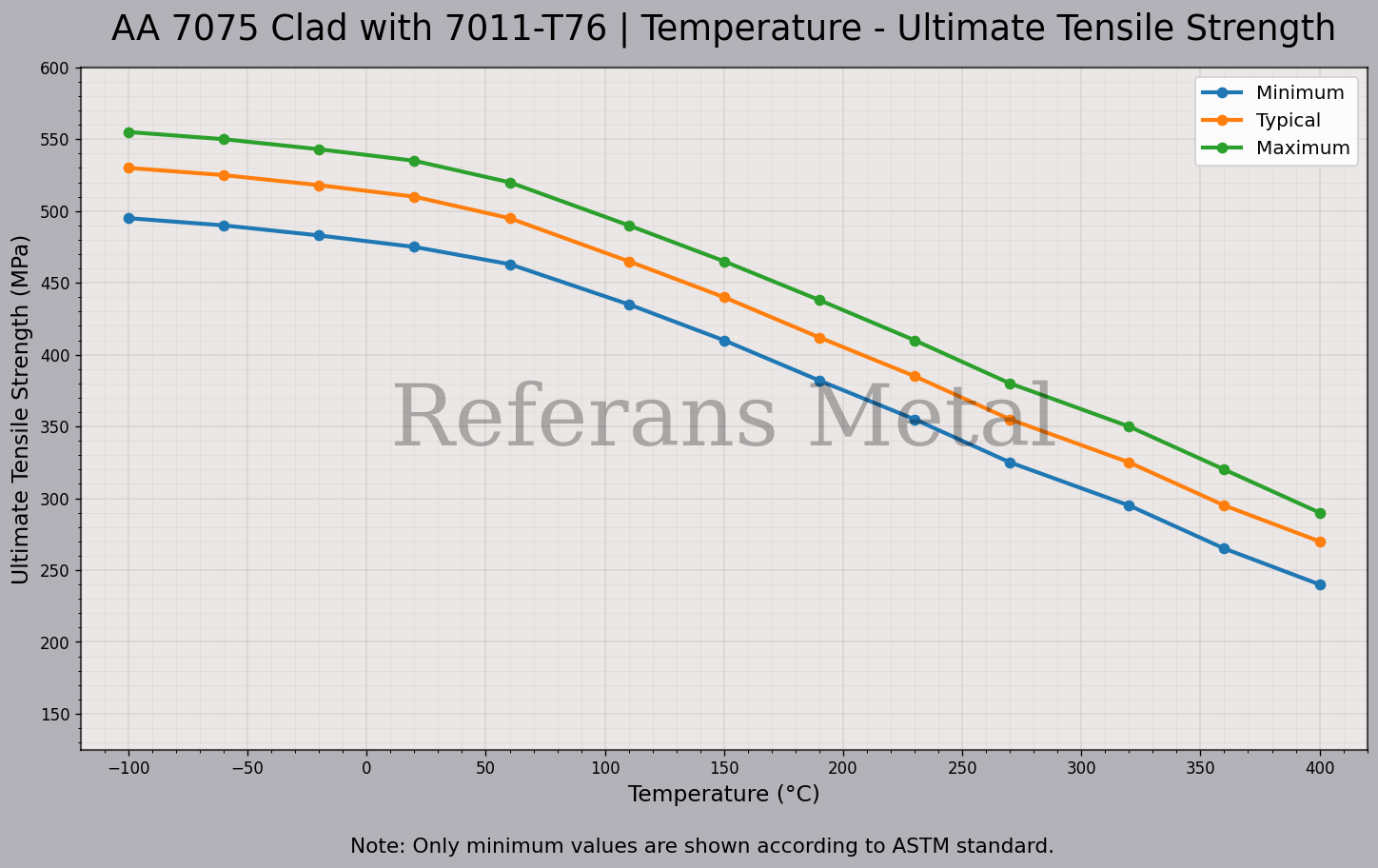
| 7075 clad with 7011 T76 Temperature – Ultimate Tensile Strength Graph |
 |
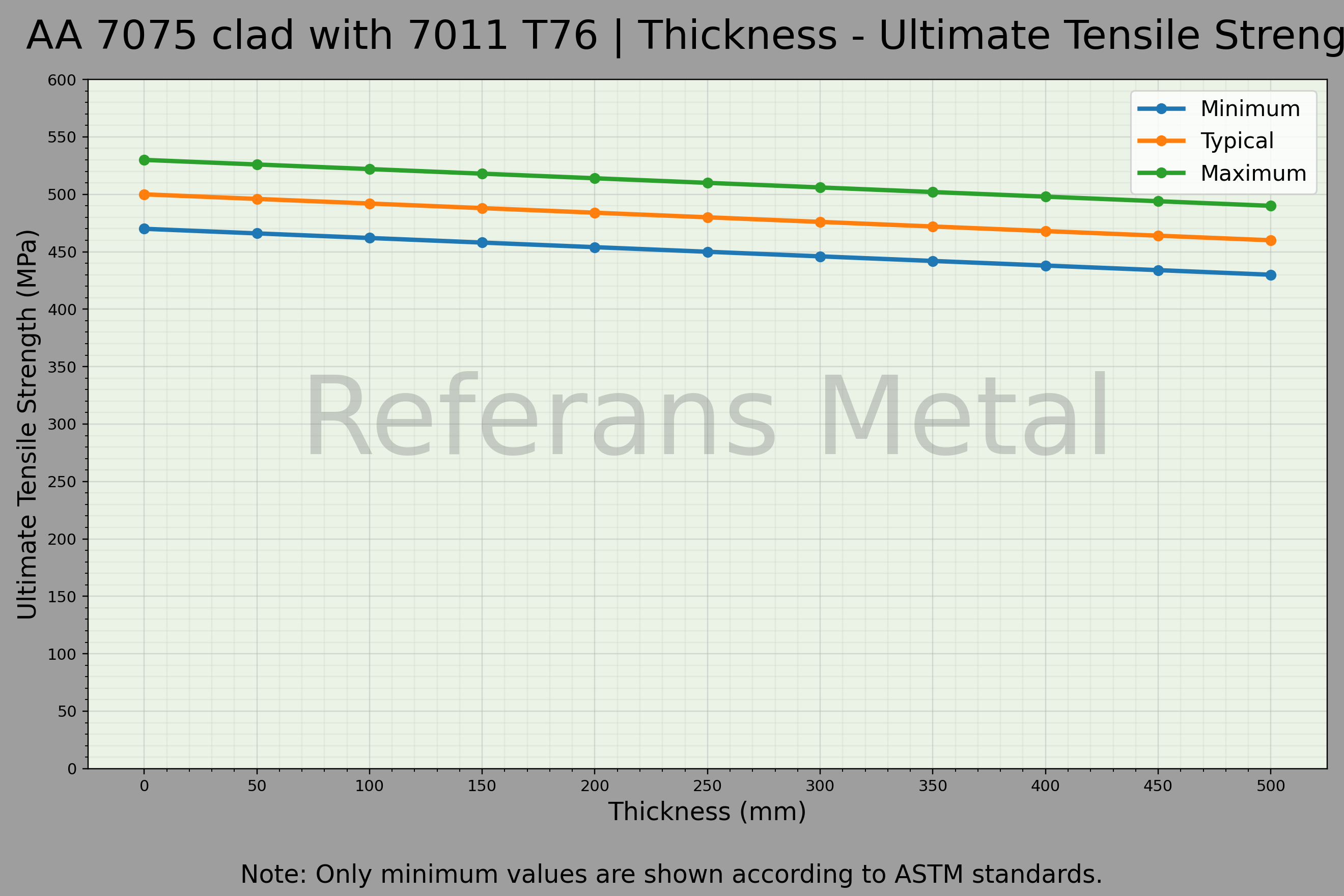
| 7075 clad with 7011 T76 Thickness – Ultimate Tensile Strength Graph |
 |
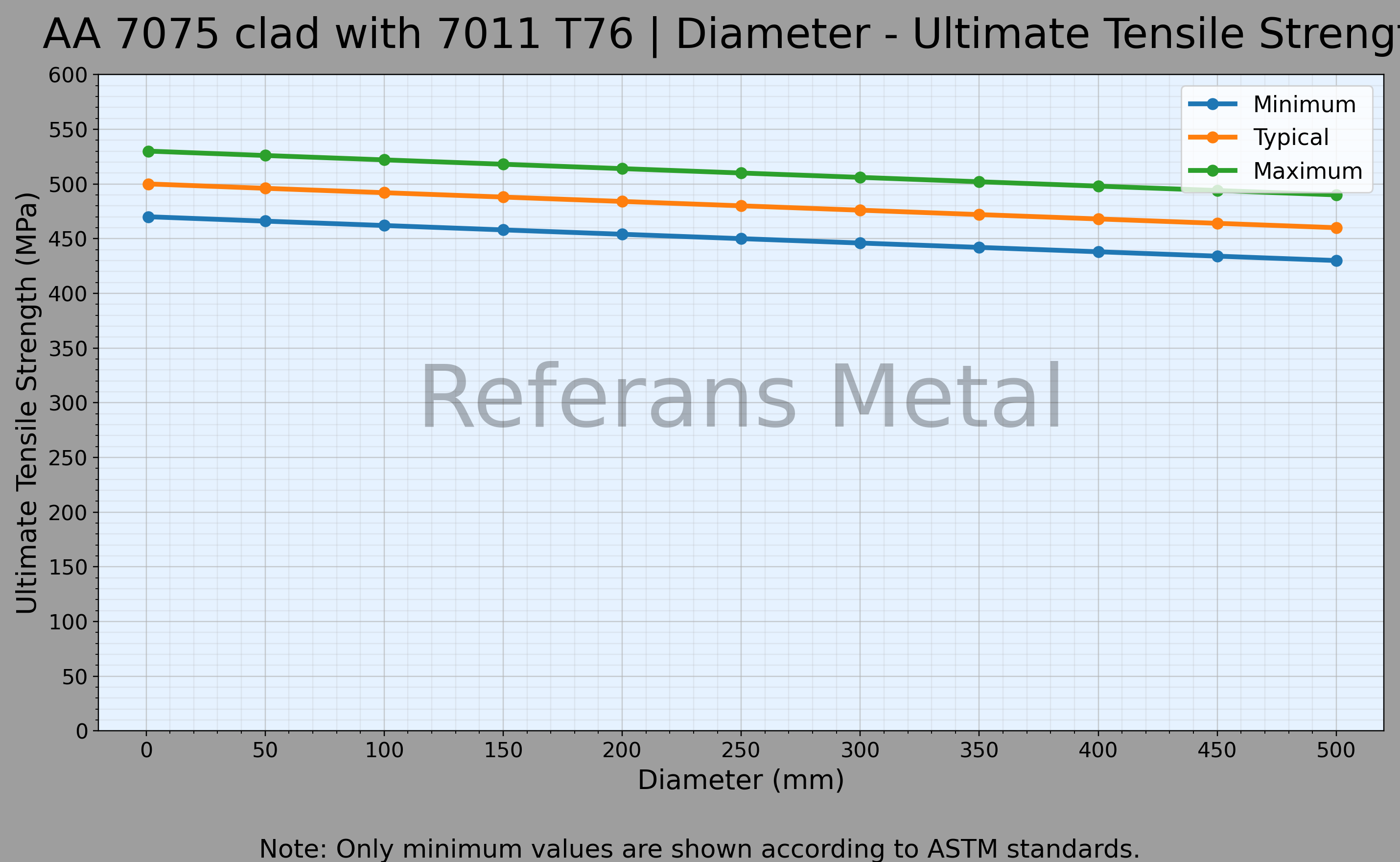
| 7075 clad with 7011 T76 Diameter – Ultimate Tensile Strength Graph |
 |
7075 clad with 7011 – T76 aluminum alloy is a specialized form of a high-strength 7xxx series aluminum alloy, where a 7075 core is clad with a 7011 alloy layer and processed to the T76 temper. This structure combines the high strength of the 7075 core with improved corrosion resistance and surface performance provided by the 7011 cladding. The T76 temper represents an aging process optimized specifically to improve resistance to stress corrosion cracking (SCC).
In terms of corrosion resistance, this combination provides significant advantages. Standard 7075-T6 alloy, while very strong, is susceptible to SCC. However, when combined with T76 temper and 7011 cladding, both galvanic surface protection and improved resistance to stress corrosion cracking are achieved. It offers a protection concept similar to 2024 Alclad, although alloys like 5083 still provide superior natural corrosion resistance in many environments.
Regarding strength and mechanical properties, 7075 T76 offers slightly lower strength than T6 but significantly improved SCC resistance. Compared to 6061-T6, it provides substantially higher strength. Compared to 2024-T3, it generally offers higher yield and tensile strength, although fatigue performance may vary depending on application. Therefore, it is often selected for safety-critical structures.
In terms of machinability, bending, and weldability, 7075 clad 7011 T76 offers moderate machinability. Due to its high strength, bending operations are limited and require caution. The T76 temper provides slightly better ductility than T6, but it is still not as formable as 5xxx or 6xxx series alloys. Weldability is generally poor; in this respect, 6061 performs much better. Coatability is inherently provided by the clad structure.
Regarding vibration behavior and applications, this alloy is widely used in aerospace and defense industries due to its high specific strength and improved corrosion resistance. Typical applications include aircraft structural components, wing elements, and parts operating under high stress. While 2024 clad offers better fatigue resistance, 7075 clad T76 provides higher static strength and improved SCC resistance. 6061 is often used as a more economical alternative for general-purpose applications.
MATERIAL COMPOSITION STANDARDS
7075 T76 is available according to the following standards:
• 7075 T76 Alclad 7011 Sheet; AMS QQ-A-250/26, ASTM B209, DTD 5110
Characteristic Properties of 7075 T76 with clad 7011:
- Strength: Very good
- Machinability: Reasonable
- Weldability: Poor
- Formability: Poor
- Corrosion Resistance: Very good
- Heat Treatment: Yes
Some Well-Known Applications of 7075 T76 clad with 7011:
Aircraft wing projects
Production of composite materials and parts in highly specialized projects
Exhaust system design
STOCK
7075 T76 clad 7011 is supplied in sheet form.
- Sheet
 Weight Calculator