
 AS 9100
 SPACE 2009
 AS 9120




Plates
Sheets
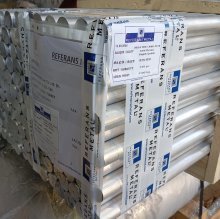
Rod/Round Bar/Flat Bar
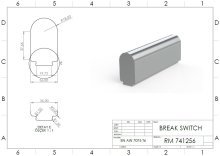
Tube/Extrusions/Profile
7475 alclad
AMS 4207 / AlZn5.5MgCu / 7475 alclad / T61
| Chemical Properties | % Value |
| Silicon (Si) | 0,00 - 0,10 |
| Chromium (Cr) | 0,18 - 0,25 |
| Manganese (Mn) | 0,00 - 0,06 |
| Magnesium (Mg) | 1,90 - 2,60 |
| Copper (Cu) | 1,20 - 1,90 |
| Titanium (Ti) | 0,00 - 0,06 |
| Iron (Fe) | 0,00 - 0,12 |
| Zinc (Zn) | 5,10 - 6,20 |
| Aluminium (Al) | Balance |
| Physical Properties | Value |
| Density | 2,81 g/cm³ |
| Melting Point | 477 °C |
| Thermal Expansion | 24,3 µm/m.°C |
| Modulus of Elasticity | 71,7 GPa |
| Thermal Conductivity | 138 W/m.K |
| Electrical Resistivity | %34 IACS |
| Mechanical Properties | Value |
| Proof Strength | 490 MPa |
| Yield Strength | 517 MPa |
| Shear Strength | 340 MPa |
| Elongation A50 mm | %11 |
| Hardness | 70.3 GPa |
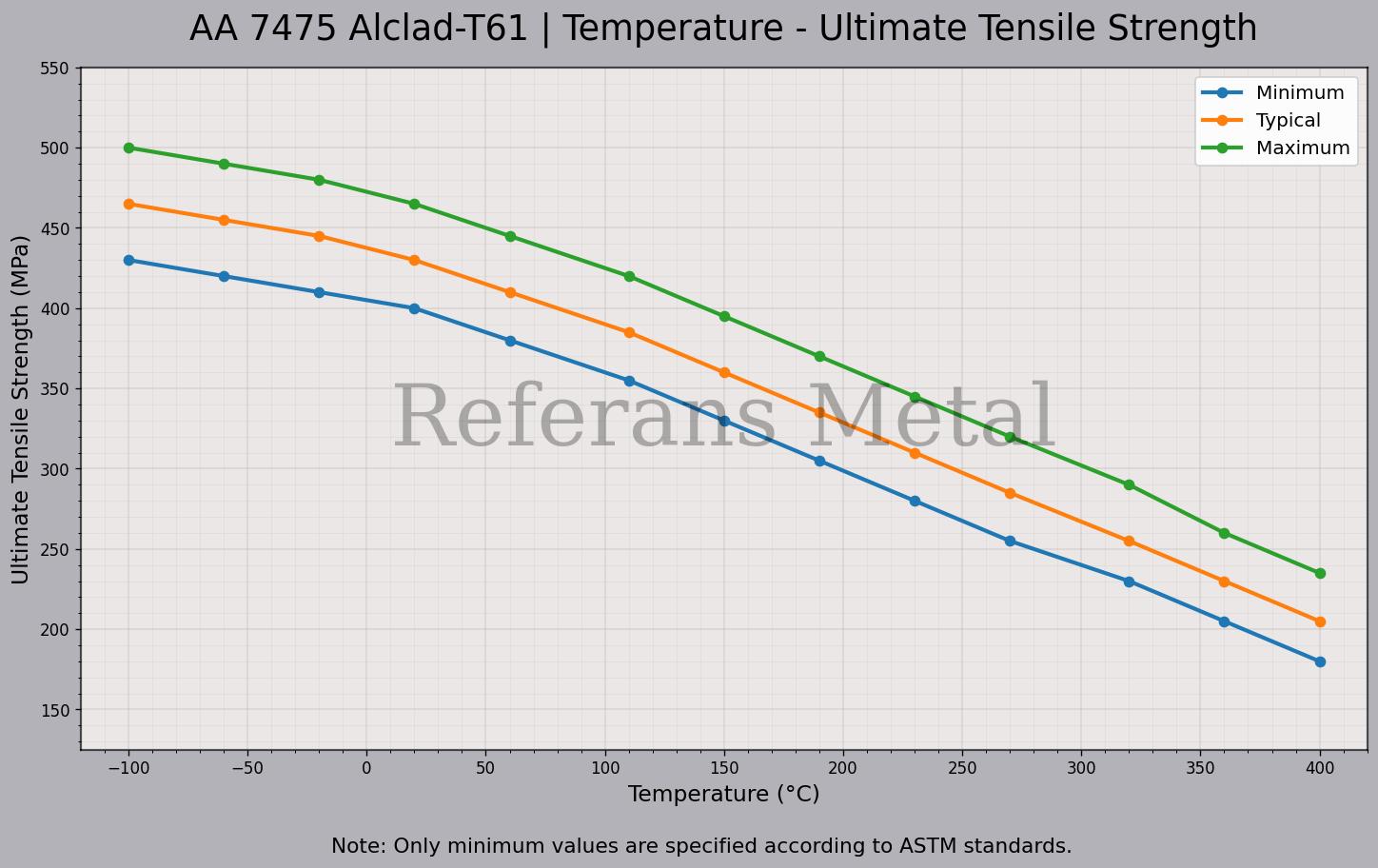
| 7475 Alclad T61 Temperature – Ultimate Tensile Strength Graph |
 |
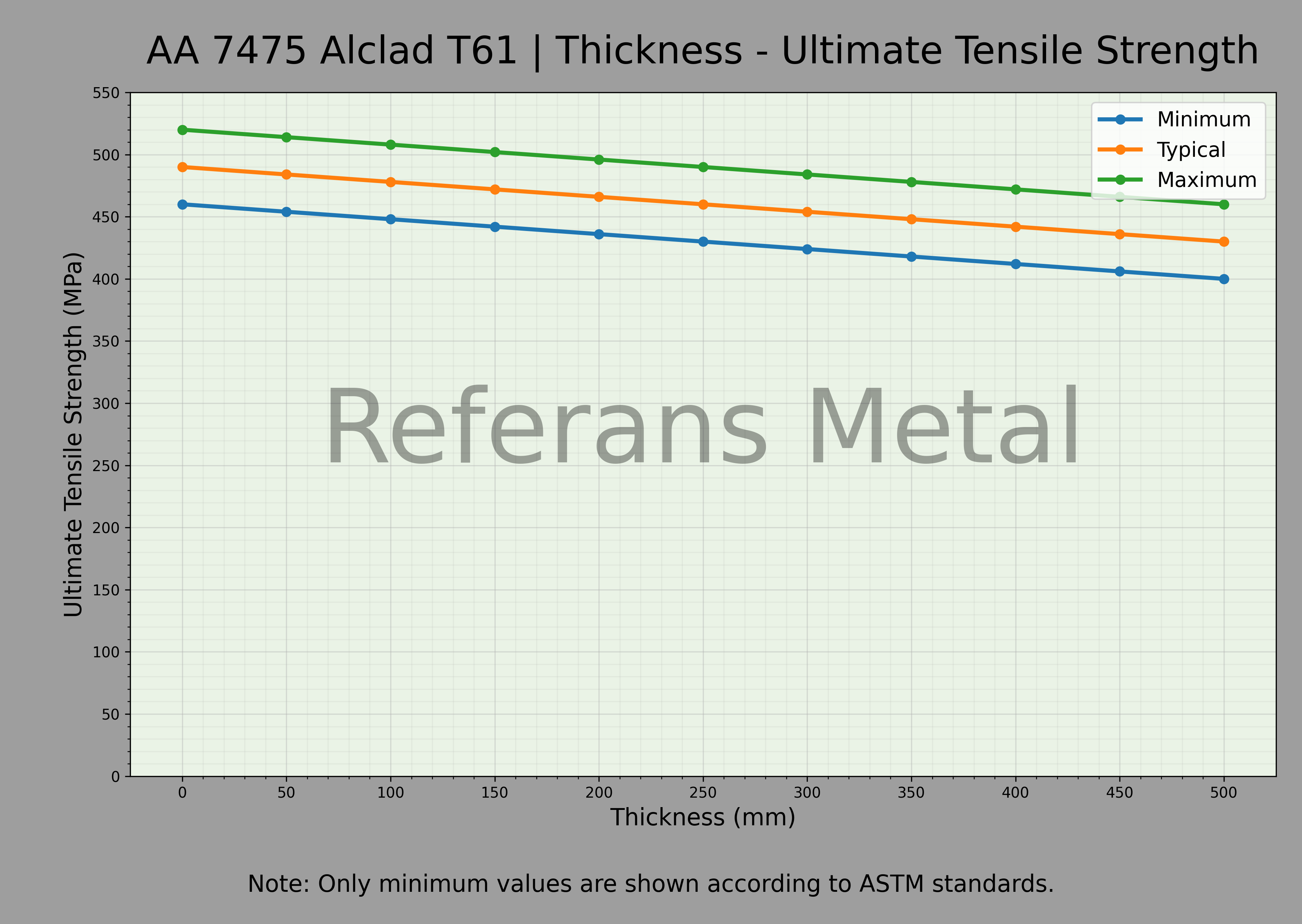
| 7475 Alclad T61 Thickness – Ultimate Tensile Strength Graph |
 |
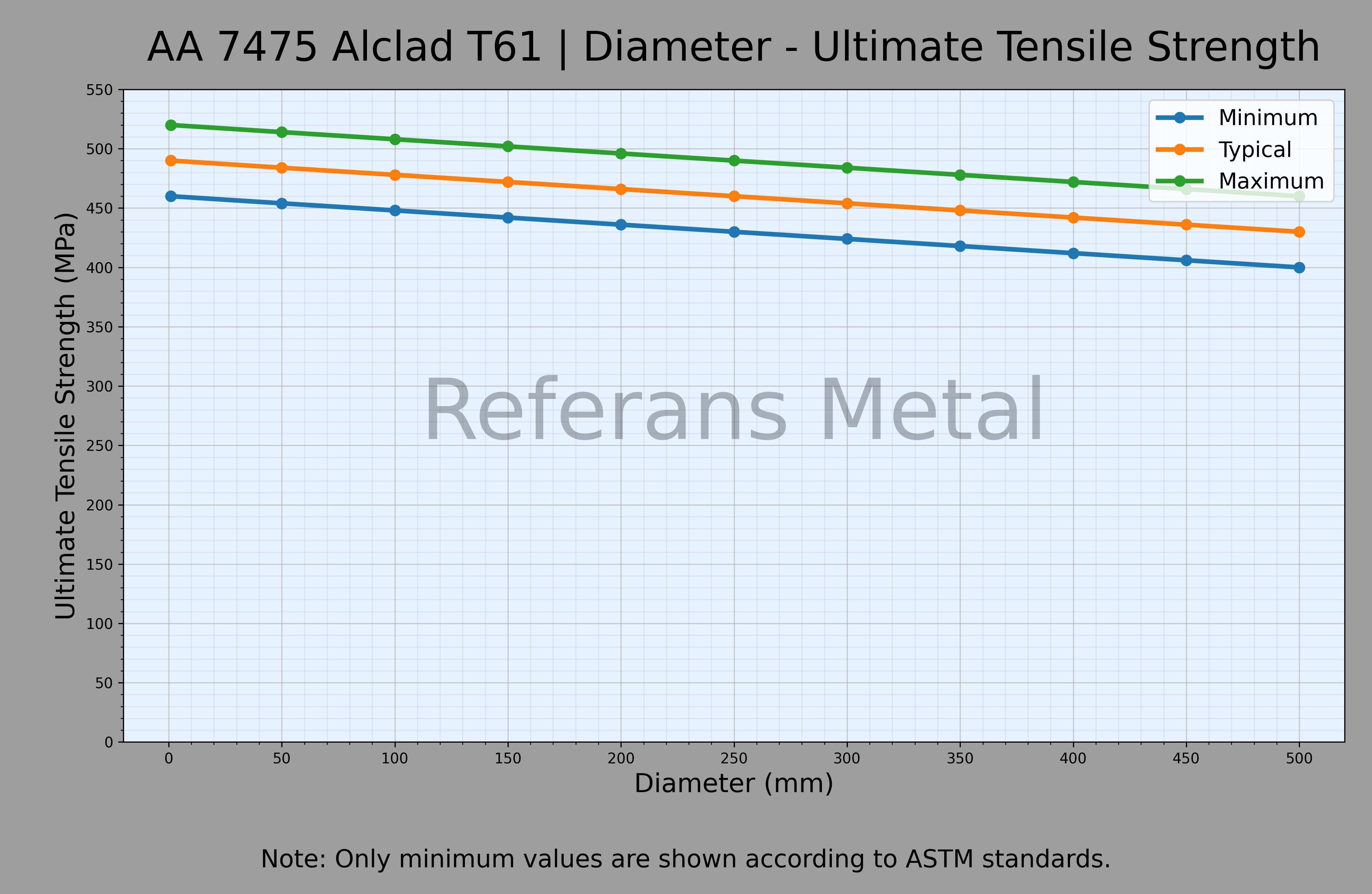
| 7475 Alclad T61 Diameter – Ultimate Tensile Strength Graph |
 |
7475 Alclad T61 aluminum alloy is a high-strength material belonging to the 7xxx series aluminum alloys and is specifically developed for aerospace applications. This alloy is strengthened with zinc (Zn), magnesium (Mg), and copper (Cu) elements and is known for its high tensile strength, fatigue resistance, and fracture toughness. The Alclad coating is produced by applying a thin layer of high-purity aluminum on the core alloy, significantly improving the corrosion resistance of the material. The T61 temper is achieved through a specific heat treatment and aging process, providing a balanced combination of strength and ductility.
One of the most important characteristics of this alloy is its high mechanical strength. 7475 Alclad T61 is commonly preferred in structural applications that require high tensile strength and fatigue resistance. It also provides good formability and acceptable machinability under appropriate temper conditions. However, like many 7xxx series alloys, its weldability is limited, and mechanical fastening methods such as riveting are generally preferred instead of welding. In terms of coating and surface treatment, performance can be improved through anodizing and protective coatings. Additionally, this alloy performs well under vibration and dynamic loads, providing excellent fatigue performance.
7475 Alclad T61 alloy is widely used in the aerospace industry. It is commonly applied in aircraft wing panels, fuselage skins, load-bearing structural components, and various wing structures. Thanks to its high strength and low density, it provides weight savings while maintaining structural integrity. It is also used in certain defense industry applications, including transport aircraft, military aircraft, and various aerospace structural components.
Compared with other high-strength aluminum alloys, this alloy has several advantages. For example, although 7075 aluminum alloy offers very high strength, it may exhibit lower fracture toughness compared with 7475. 2024 aluminum alloy provides good fatigue resistance and machinability, but generally has lower strength levels than 7475. On the other hand, 7050 aluminum alloy provides better stress corrosion resistance in thick sections, while 7475 may show better damage tolerance and fracture toughness in thin sheet applications.
In conclusion, 7475 Alclad T61 is considered an important material in modern aerospace structures due to its high strength, excellent fatigue resistance, improved corrosion protection, and balanced mechanical properties. When used with proper design and manufacturing techniques, this alloy can provide reliable and long-lasting structural performance. Therefore, it continues to be widely used in aircraft structural sheets, load-bearing panels, and various critical aerospace components.
MATERIAL COMPOSITION STANDARDS
7475 T61 can be available according to the following standards:
• 7475 T61 Alclad Sheet; AMS 4207, DMS 2234
• 7475 T61 Bare Sheet; AMS 4084 Alloy 7475, UNS A97475 AlZn5.5MgCu
Additionally;
7475 T61 Alclad Sheet is known as EN 3332.
7475 T61 Bare Sheet is known as EN 3333.
MINIMUM BASIC MECHANICAL VALUES FOR 7475 T61
Bare Alclad
Thickness: in. 0.040–0.249 0.063–0.187
(mm) (1.016–6.325) (1.60–4.75)
Tensile Strength, ksi (MPa) 563 520
Yield Strength, ksi (MPa) 491 455
Elongation, % 9 9
MINIMUM FRACTURE TOUGHNESS VALUES FOR 7475 T61
(Fracture Toughness)
KIc: ksi√in. (MPa√m)*
Temper Thickness T-L
T61 0.040–0.125 in. 74.0 (81.4)
Bare (1.02–3.18 mm)
0.126–0.249 in. 61.0 (66.9)
(3.20–6.32 mm)
T61 0.040–0.125 in. 75.0 (82.4)
Alclad (1.02–3.18 mm)
0.126–0.249 in. 62.0 (67.9)
(3.20–6.32 mm)
Characteristic Properties for 7475 T61:
- Strength: Excellent
- Machinability: Good
- Weldability: Poor
- Formability: Poor
- Corrosion Resistance: Moderate
- Heat Treatable: Yes
Some Well-Known Applications of 7475 T761:
In the production of bullet casings, in petroleum refining facilities.
For boilers storing high-pressure fluids with corrosion issues.
Aerospace and defense industries, and nuclear power facilities.
STOCK
7475 T61 is supplied in sheet form.
- Alclad Sheet
- Bare Sheet
| Mechanical Properties | |||
| Thickness (mm) | Proof Strength (Min.) | Yield Strength (Min.) | Elongation A50 mm % |
| over 1.60 up to & incl. 4.75 | 415 MPa | 485 MPa | 9 |
 Weight Calculator