
 AS 9100
 SPACE 2009
 AS 9120




Plates
Sheets
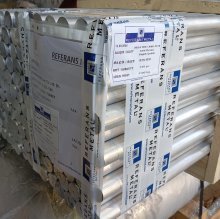
Rod/Round Bar/Flat Bar
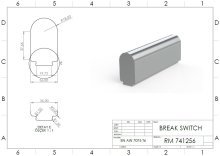
Tube/Extrusions/Profile
2124
AMS 4221 / AlCu4Mg1 / 2124 / T8151
| Chemical Properties | % Value |
| Silicon (Si) | 0,00 - 0,20 |
| Chromium (Cr) | 0,00 - 0,10 |
| Manganese (Mn) | 0,30 - 0,90 |
| Magnesium (Mg) | 1,20 - 1,80 |
| Copper (Cu) | 3,80 - 4,90 |
| Titanium (Ti) | 0,00 - 0,15 |
| Iron (Fe) | 0,00 - 0,30 |
| Zinc (Zn) | 0,00 - 0,25 |
| Aluminium (Al) | Balance |
| Physical Properties | Value |
| Density | 2.78 g/cm³ |
| Melting Point | 502 °C |
| Thermal Expansion | 21.1 µm/m-°C |
| Modulus of Elasticity | 71 GPa |
| Thermal Conductivity | 151 W/m.K |
| Electrical Resistivity | 38% IACS |
| Mechanical Properties | Value |
| Yield Strength | 430 MPa |
| Ultimate Strength | 490 MPa |
| Shear Strength | 280 MPa |
| Elongation A50 mm | 5.7% |
| Hardness | 128 HB |
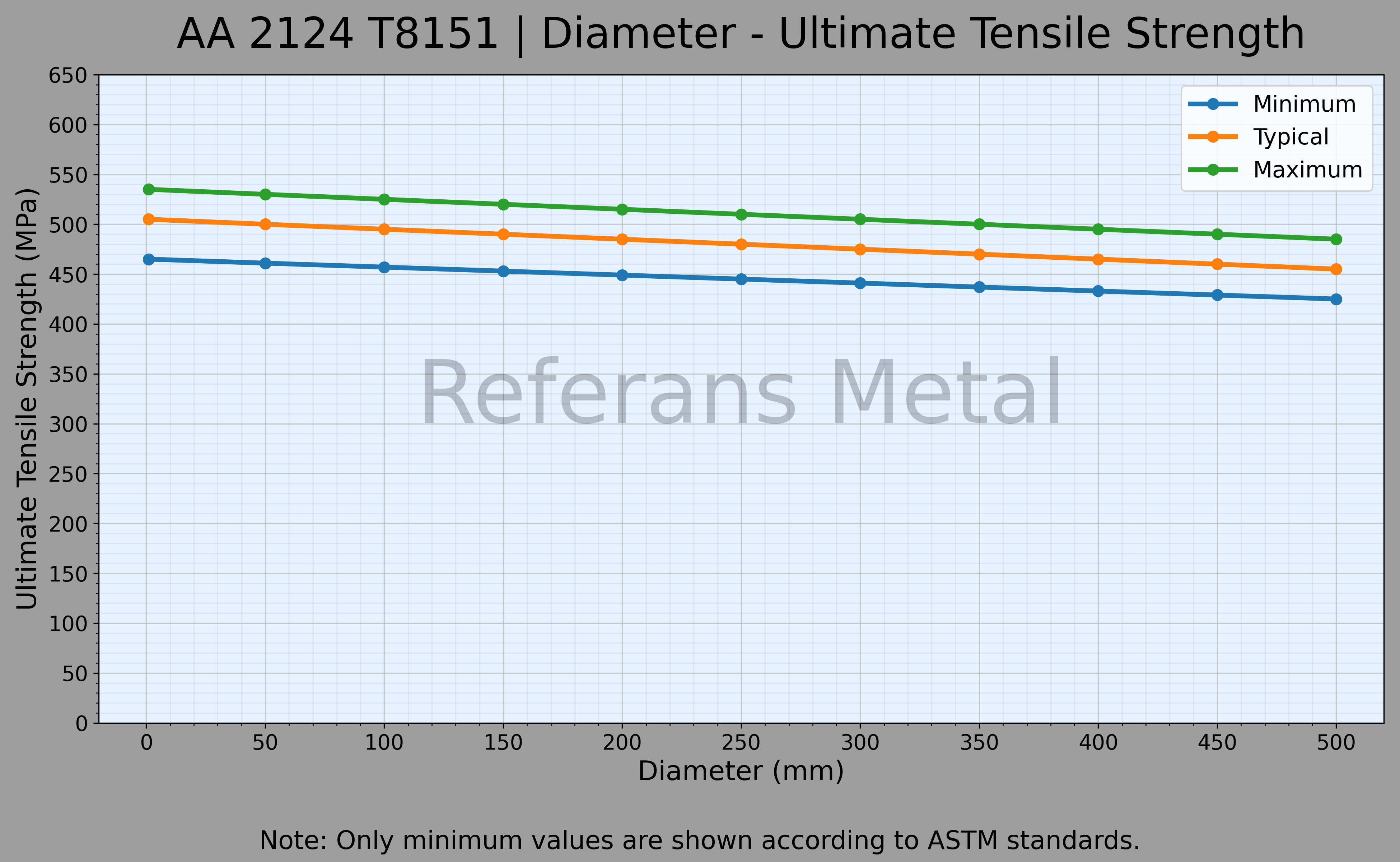
| 2124 T8151 Diameter – Ultimate Tensile Strength Graph |
 |
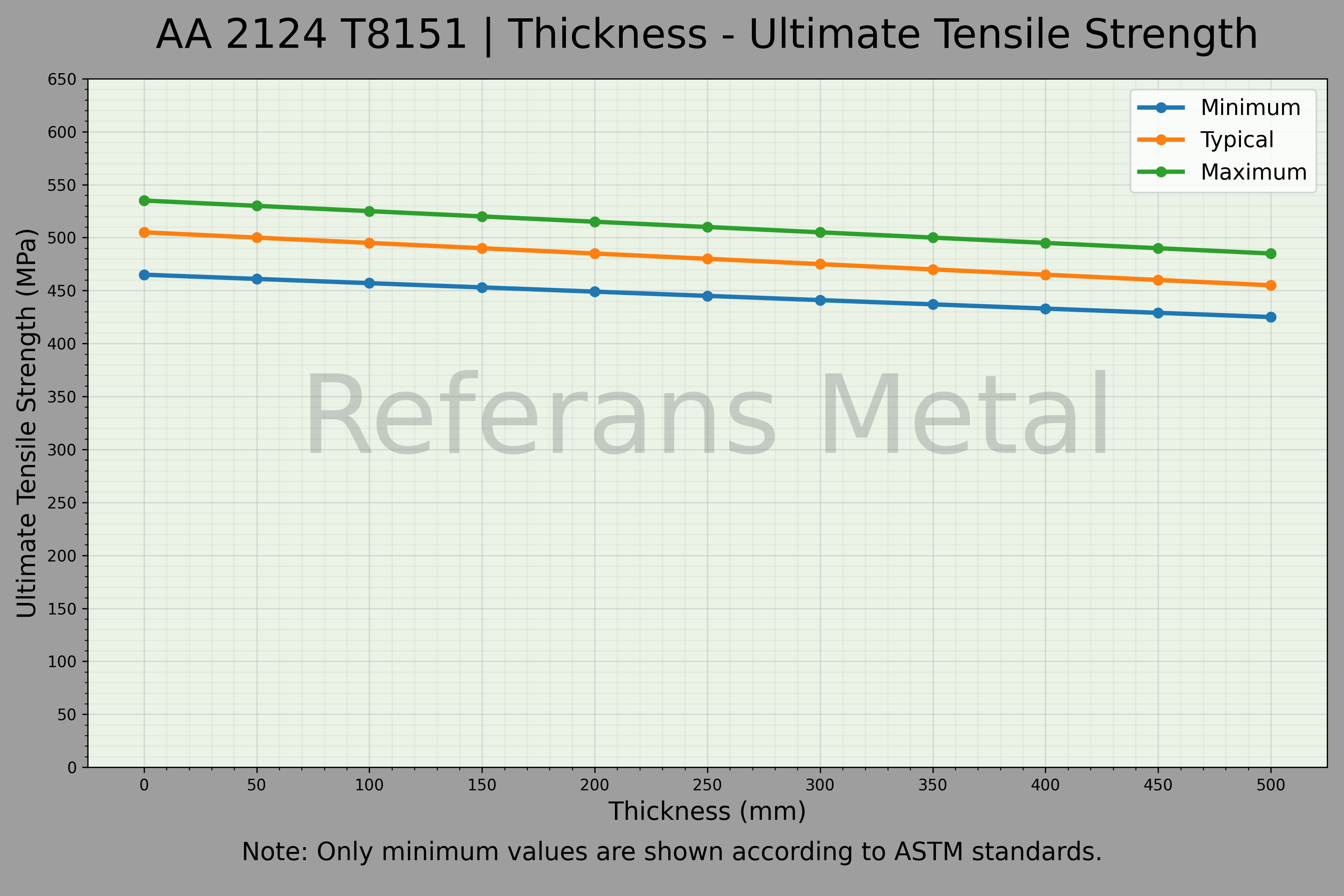
| 2124 T8151 Thickness – Ultimate Tensile Strength Graph |
 |
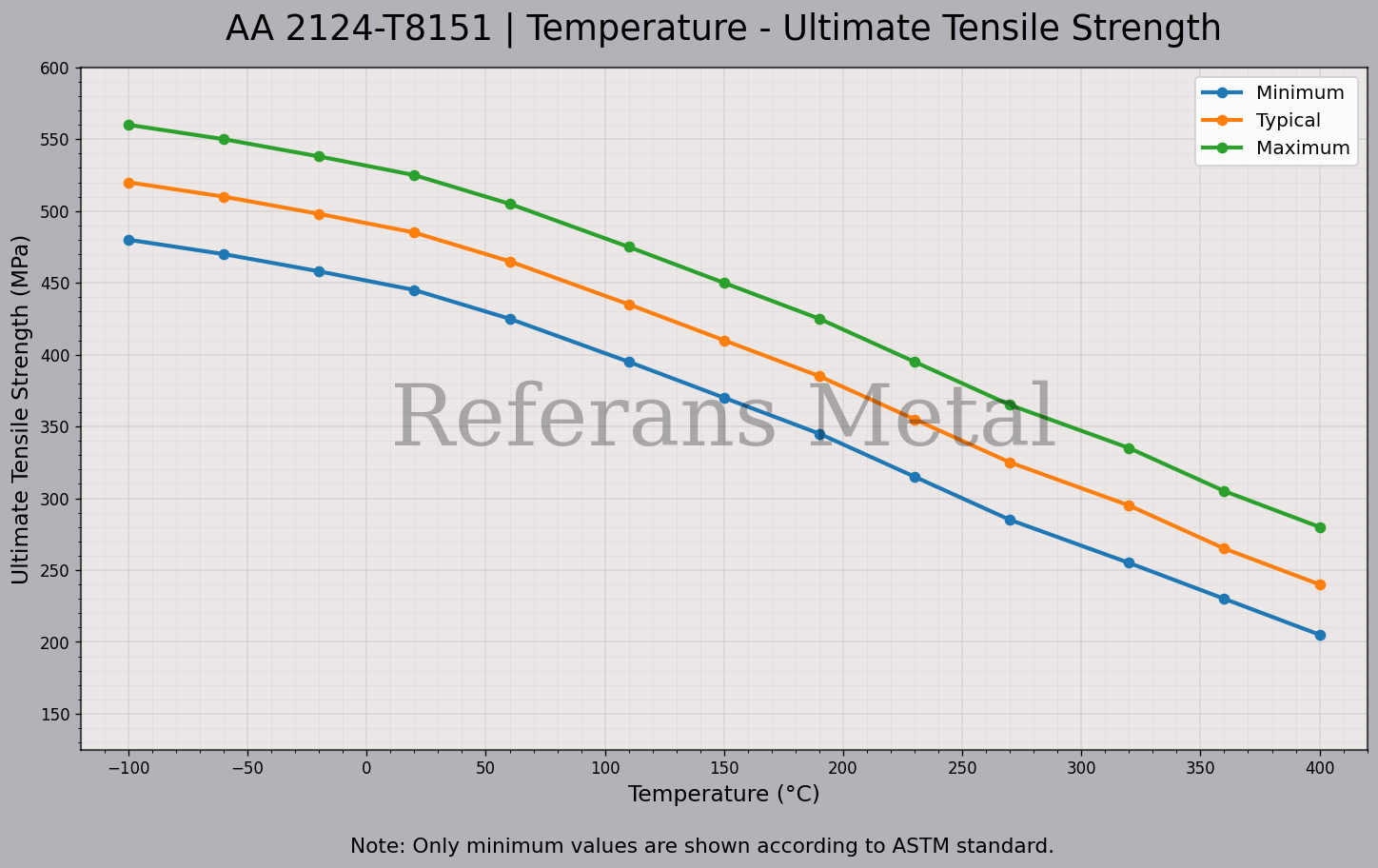
| 2124 T8151 Temperature – Ultimate Tensile Strength Graph |
 |
2124 T8151 aluminum alloy is a copper-based 2xxx series alloy developed for applications requiring high strength. This alloy is especially preferred in the aerospace industry because it can retain its mechanical properties even under high temperature and load conditions. The T8151 temper indicates that the material has been stress-relieved and mechanically straightened, improving dimensional stability. Compared to the conventional 2024 alloy, 2124 offers enhanced performance due to higher purity and a more controlled grain structure.
The corrosion resistance of this alloy is moderate, as is typical for 2xxx series alloys, and is usually improved through surface treatments such as coating or anodizing. Its natural resistance in saline environments is limited over long periods. Therefore, alclad coatings or protective surface treatments are commonly used in aerospace applications. In contrast, 6xxx series alloys (such as 6061) offer better natural corrosion resistance, while 2124 provides significantly higher strength.
In terms of strength, the 2124 T8151 alloy exhibits high yield and tensile strength, making it ideal for load-bearing structural components. When compared to 7075 alloy, it can approach similar strength levels and may offer better fracture toughness in certain conditions. Compared to 2024 alloy, its higher purity improves fatigue resistance and overall mechanical performance. For this reason, it is widely used in aircraft wings, fuselage panels, and critical fasteners.
Regarding machinability and bending properties, 2124 alloy provides good machinability, but due to its high strength, forming operations require careful handling. Its cold forming capability is limited, and hot working or pre-annealing may be necessary. Compared to 5xxx series alloys (such as 5083), which have excellent formability, 2124 offers superior strength. Additionally, its vibration response is excellent; its high fatigue resistance ensures reliable performance under dynamic loading.
In terms of weldability and coatability, 2124 alloy is not well suited for welding, and mechanical fastening methods are typically preferred due to the high risk of cracking. However, its performance can be enhanced through coating, anodizing, and protective treatments. It is widely used in aerospace, defense, and high-performance engineering applications, particularly in aircraft structural parts and high-stress components. Compared to 7075, 2024, and 6061 alloys, 2124 stands out in strength and fatigue resistance, while offering more limited corrosion resistance and weldability.
MATERIAL COMPOSITION STANDARDS
2124 T8151 may comply with the following standards.
• 2124 T8151 Plate; ASTM B209, UNS A92124, AMS 4221, ISO AlCu4Mg1
Characteristic Properties for 2124 T8151:
- Strength: Average
- Machinability: Above Average
- Weldability: Good
- Formability: Low
- Corrosion Resistance: Moderate
- Heat Treatment: Yes
Some Well-Known Applications for 2124 T8151:
Used in engine support structures in aircraft,
In parts requiring high transverse fracture toughness,
In pressurized separation frames in aircraft fuselages.
STOCK
2124 T8151 is supplied in plate form.
- Plate
| Mechanical Properties | |||
| Thickness (mm) | Yield Strength (Min.) | Ultimate Strength (Min.) | Elongation A50 mm % |
| Over 38.1 up to & incl. 50.8 | 393 MPa | 455 MPa | %5 |
| Over 50,8 up to & incl. 76,2 | 393 MPa | 448 MPa | %4 |
| Over 76,2 up to & incl. 101,6 | 386 MPa | 448 MPa | %4 |
| Over 101,6 up to & incl. 127 | 379 MPa | 441 MPa | %4 |
| Over 127 up to & incl. 152,4 | 372 MPa | 434 MPa | %4 |
 Weight Calculator