
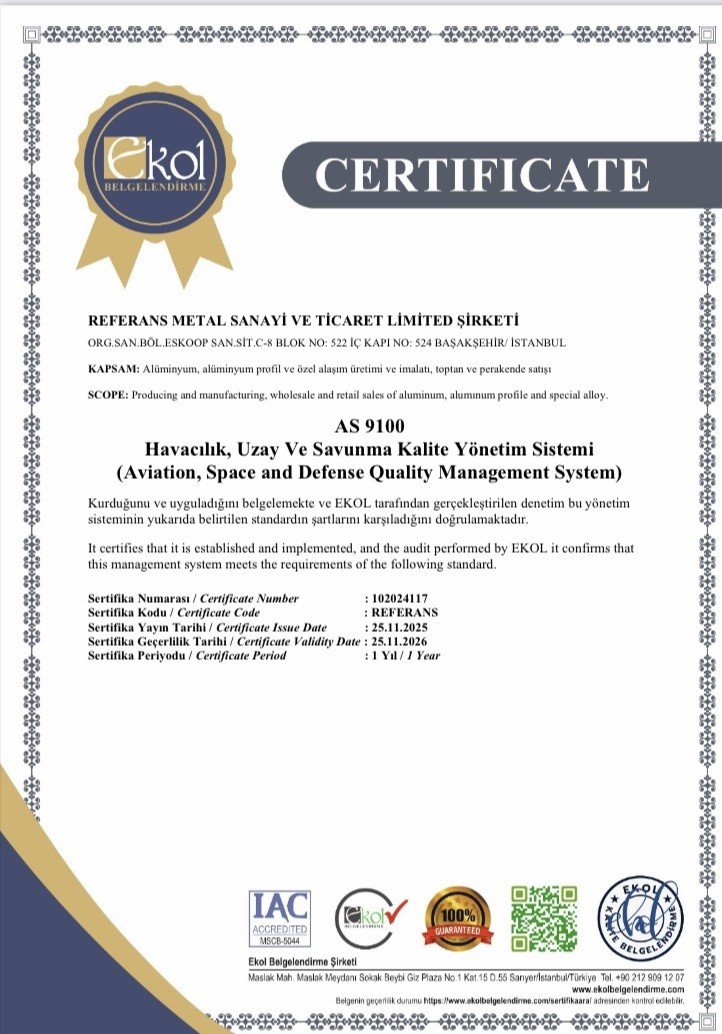
 AS 9100
 SPACE 2009
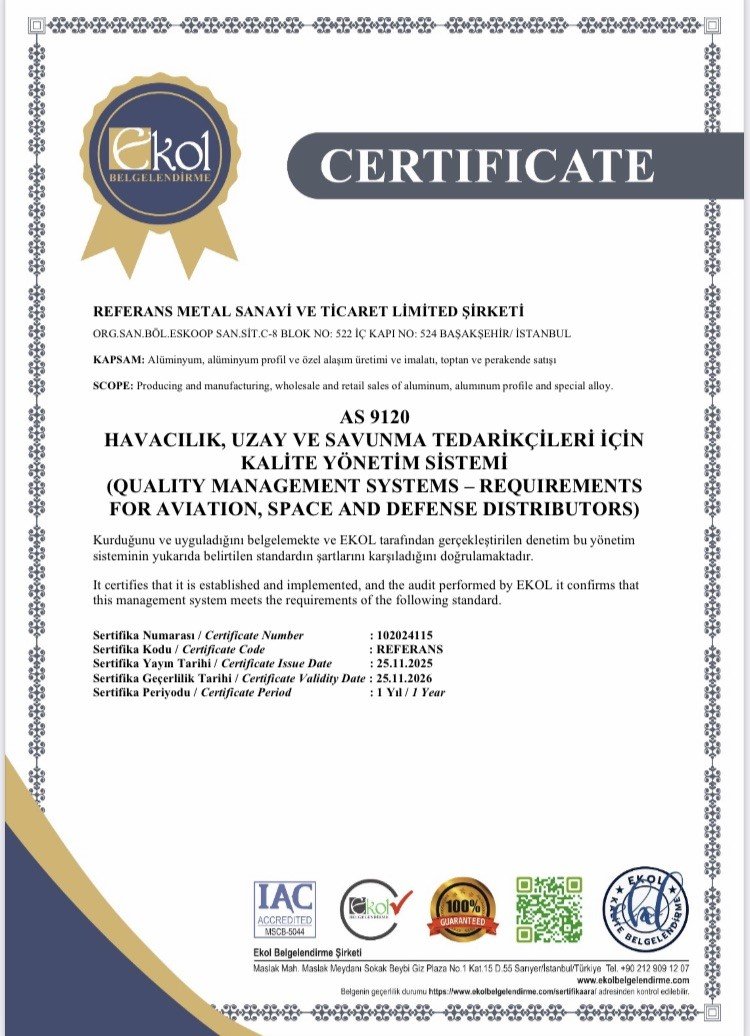 AS 9120




Plates
Sheets
Rod/Round Bar/Flat Bar
Tube/Extrusions/Profile
7079
AMS 4024 / AlZn4Mg3Cu / 7079 / T651
| Chemical Properties | % Value |
| Silicon (Si) | 0,00 - 0,30 |
| Chromium (Cr) | 0,10 - 0,25 |
| Manganese (Mn) | 0,10 - 0,30 |
| Magnesium (Mg) | 2,90 - 3,70 |
| Copper (Cu) | 0,40 - 0,80 |
| Titanium (Ti) | 0,00 - 0,10 |
| Iron (Fe) | 0,00 - 0,40 |
| Zinc (Zn) | 3,80 - 4,80 |
| Aluminium (Al) | Balance |
| Physical Properties | Value |
| Density | 2.81 g/cm³ |
| Melting Point | 635 °C |
| Thermal Expansion | 23.5 x 10^-6 /K |
| Modulus of Elasticity | 72 GPa |
| Thermal Conductivity | 134-160 W/m.K |
| Electrical Resistivity | %40 IACS |
| Mechanical Properties | Value |
| Proof Strength | 448 MPa |
| Yield Strength | 558 MPa |
| Shear Strength | 360 MPa |
| Elongation A50 mm | 11% |
| Hardness | 150 HB |
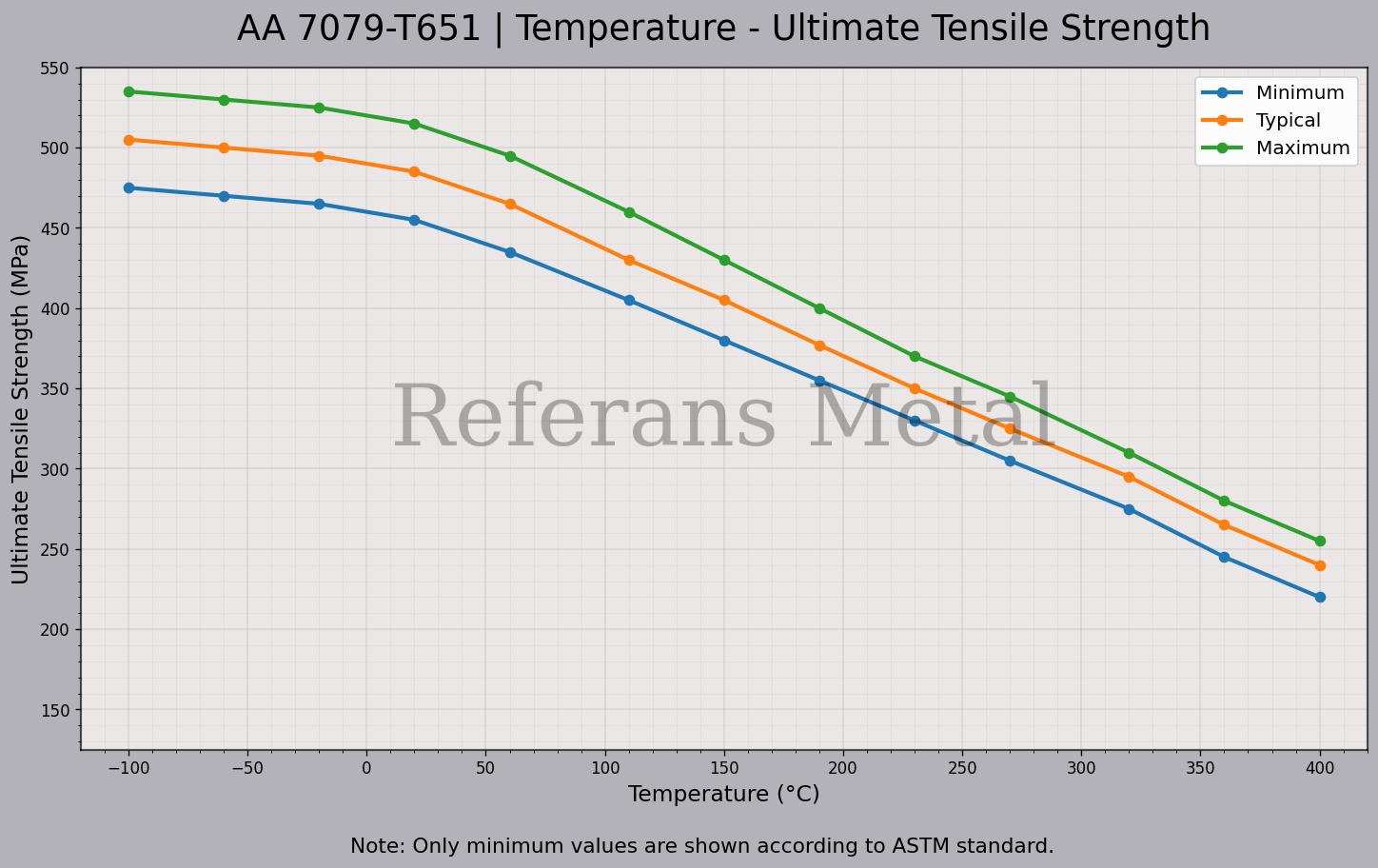
| 7079 T651 Temperature – Ultimate Tensile Strength Graph |
 |
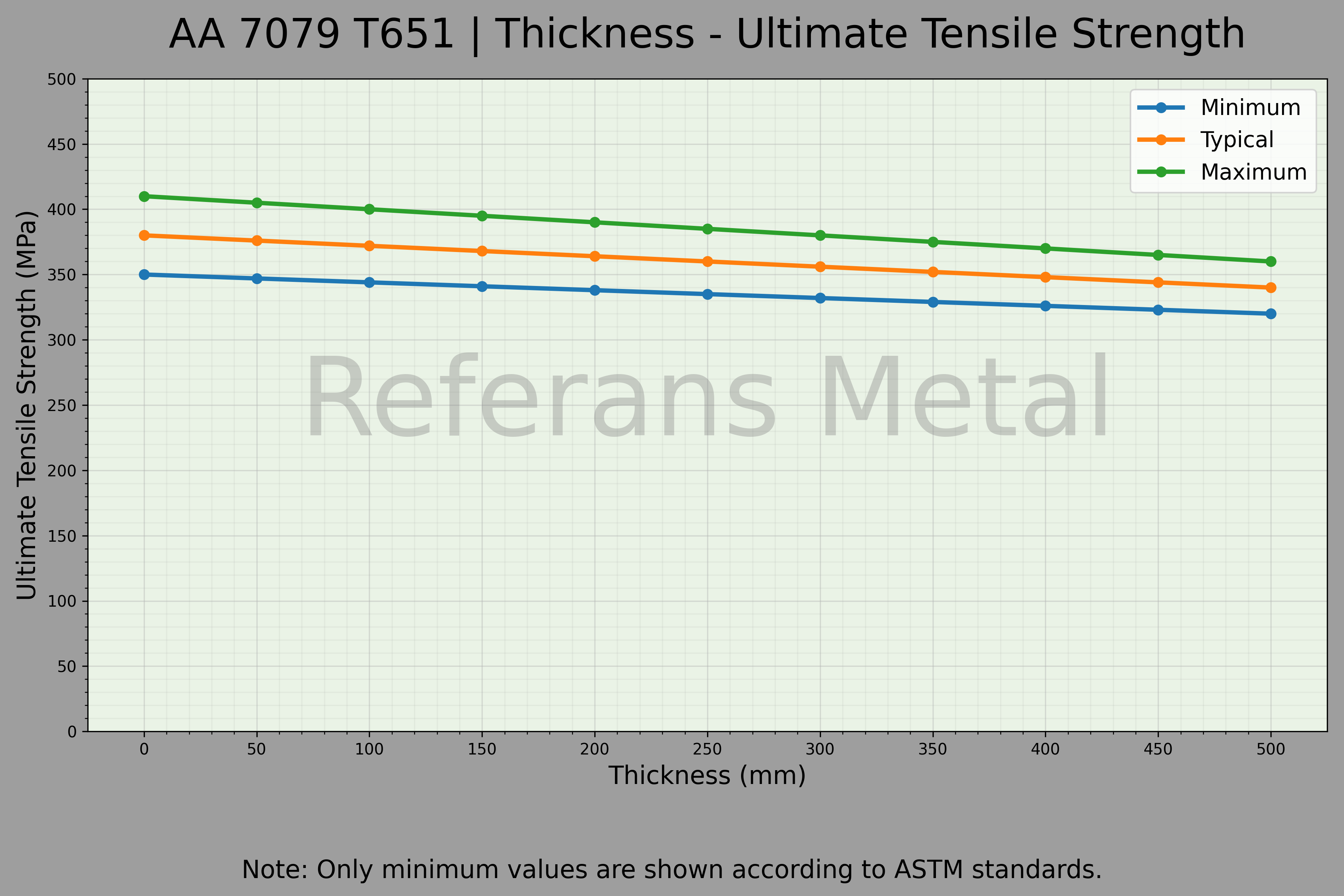
| 7079 T651 Thickness – Ultimate Tensile Strength Graph |
 |
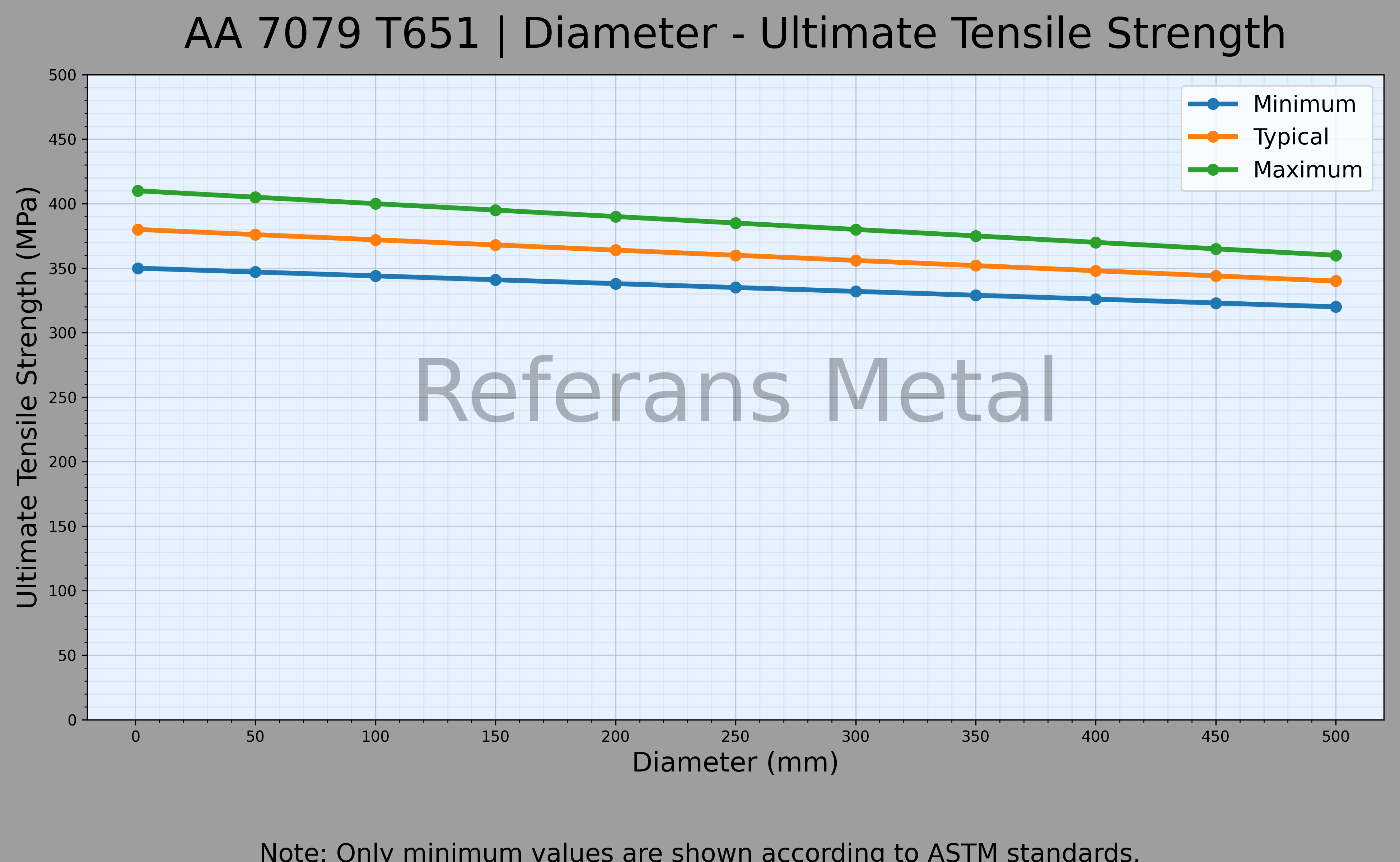
| 7079 T651 Diameter – Ultimate Tensile Strength Graph |
 |
7079-T651 aluminum alloy is one of the high-strength zinc-based alloys in the 7xxx series. The T651 temper includes solution heat treatment, artificial aging, and stress relieving by stretching. This results in high strength combined with dimensional stability and reduced internal stresses. Although 7079 has a chemical composition similar to 7075, it has been preferred in some applications involving thicker sections.
In terms of corrosion resistance, 7079-T651 generally exhibits moderate performance. It is known to be more susceptible to stress corrosion cracking (SCC) compared to 7075-T6. Therefore, surface protection methods such as anodizing, alodine coating, or painting are typically applied. Compared to 5xxx series alloys (such as 5083), it performs worse in marine environments, while its corrosion resistance is similar to or slightly lower than that of 2024 alloy.
Regarding strength and machinability, 7079-T651 provides very high yield and tensile strength, significantly outperforming 6061-T6 in this respect. It can reach strength levels comparable to 7075-T651, and in some cases offers more uniform mechanical properties in thick sections. It has good machinability and performs reliably in machining operations, making it suitable for high-strength structural components.
In terms of bending properties and weldability, 7079 in the T651 temper has limited ductility, so bending operations must be performed carefully. Its formability is lower compared to the O temper condition. Weldability is generally poor, as is typical for most 7xxx series alloys. In contrast, 6061 offers much better weldability. Regarding coatability, anodizing can be applied, but due to its copper content, surface finish and color uniformity may vary.
Regarding vibration behavior and applications, 7079-T651 has been used particularly in aerospace and defense industries due to its high specific strength. It has been preferred for large, thick-section structural components. However, due to its susceptibility to stress corrosion cracking, it has been gradually replaced in many applications by more resistant alloys such as 7075-T73. While 6061 is widely used in general engineering, 2024 in aircraft structures, and 5083 in marine applications, 7079 stands out in high-strength critical components.
MATERIAL COMPOSITION STANDARDS
7079 T651 can be produced according to the following standards:
• 7079 T651 Sheet; ASTM B209, AMS 4024, UNS A97079, ISO AlZn4Mg3Cu
Characteristic Properties of 7079 T651:
- Strength: Excellent
- Machinability: Good
- Weldability: Poor
- Formability: Average
- Corrosion Resistance: Good
- Heat Treatment: Yes
Some Well-Known Applications of 7079 T651:
In mobile military vehicles,
In hydraulic power units,
Also used in aircraft fuselages and wings.
STOCK
We supply 7079 T651 in sheet form.
- Sheet
 Weight Calculator