
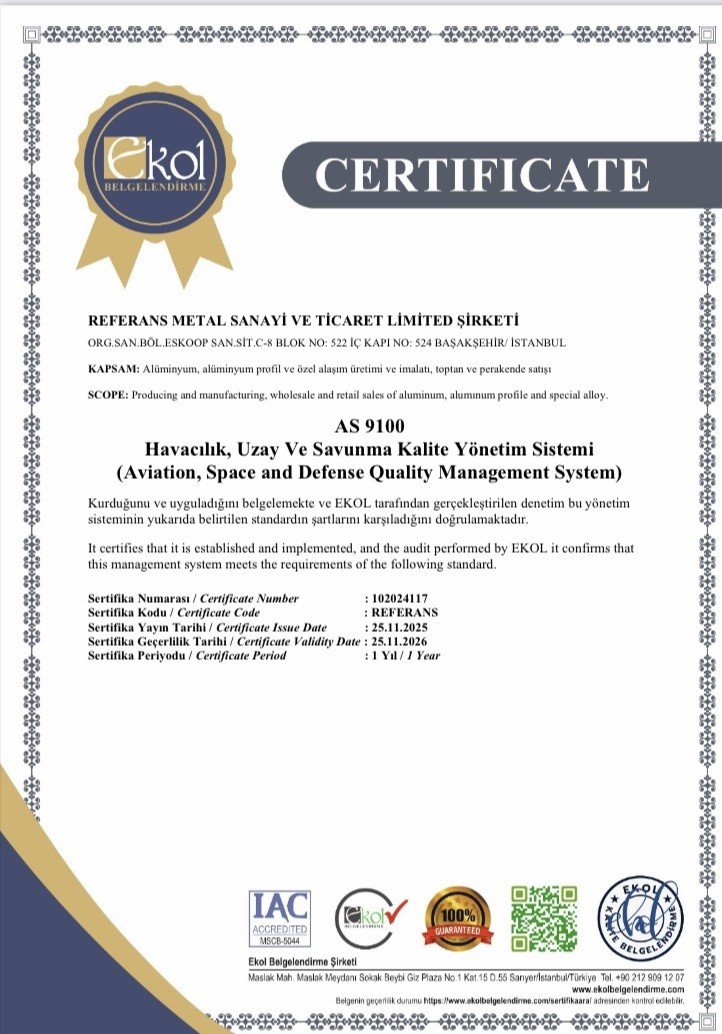
 AS 9100
 SPACE 2009
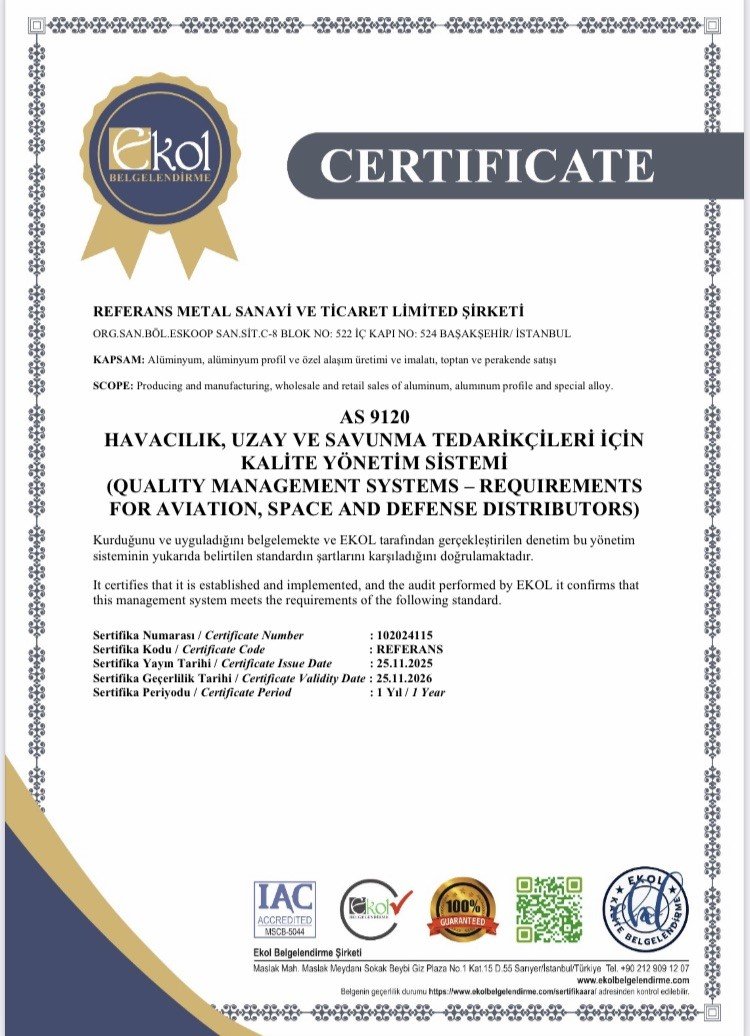 AS 9120




Plates
Sheets
Rod/Round Bar/Flat Bar
Tube/Extrusions/Profile
7075
QQ-A-250/12 / AlZn5.5MgCu / 7075 / F
| Chemical Properties | % Value |
| Silicon (Si) | 0,00 - 0,40 |
| Chromium (Cr) | 0,18 - 0,28 |
| Manganese (Mn) | 0,00 - 0,30 |
| Magnesium (Mg) | 2,10 - 2,90 |
| Copper (Cu) | 1,20 - 2,00 |
| Titanium (Ti) | 0,00 - 0,20 |
| Iron (Fe) | 0,00 - 0,50 |
| Zinc (Zn) | 5,10 - 6,10 |
| Aluminium (Al) | Balance |
| Physical Properties | Value |
| Density | 2.81 g/cm³ |
| Melting Point | 466°C |
| Thermal Expansion | 23 µm/m.°C |
| Modulus of Elasticity | 71 GPa |
| Thermal Conductivity | 173 W/m.K |
| Electrical Resistivity | 33 % IACS |
| Mechanical Properties | Value |
| Proof Strength | 200 MPa |
| Yield Strength | 300 MPa |
| Shear Strength | 210 MPa |
| Elongation A50 mm | 5%-12% |
| Hardness | 50-60 HB |
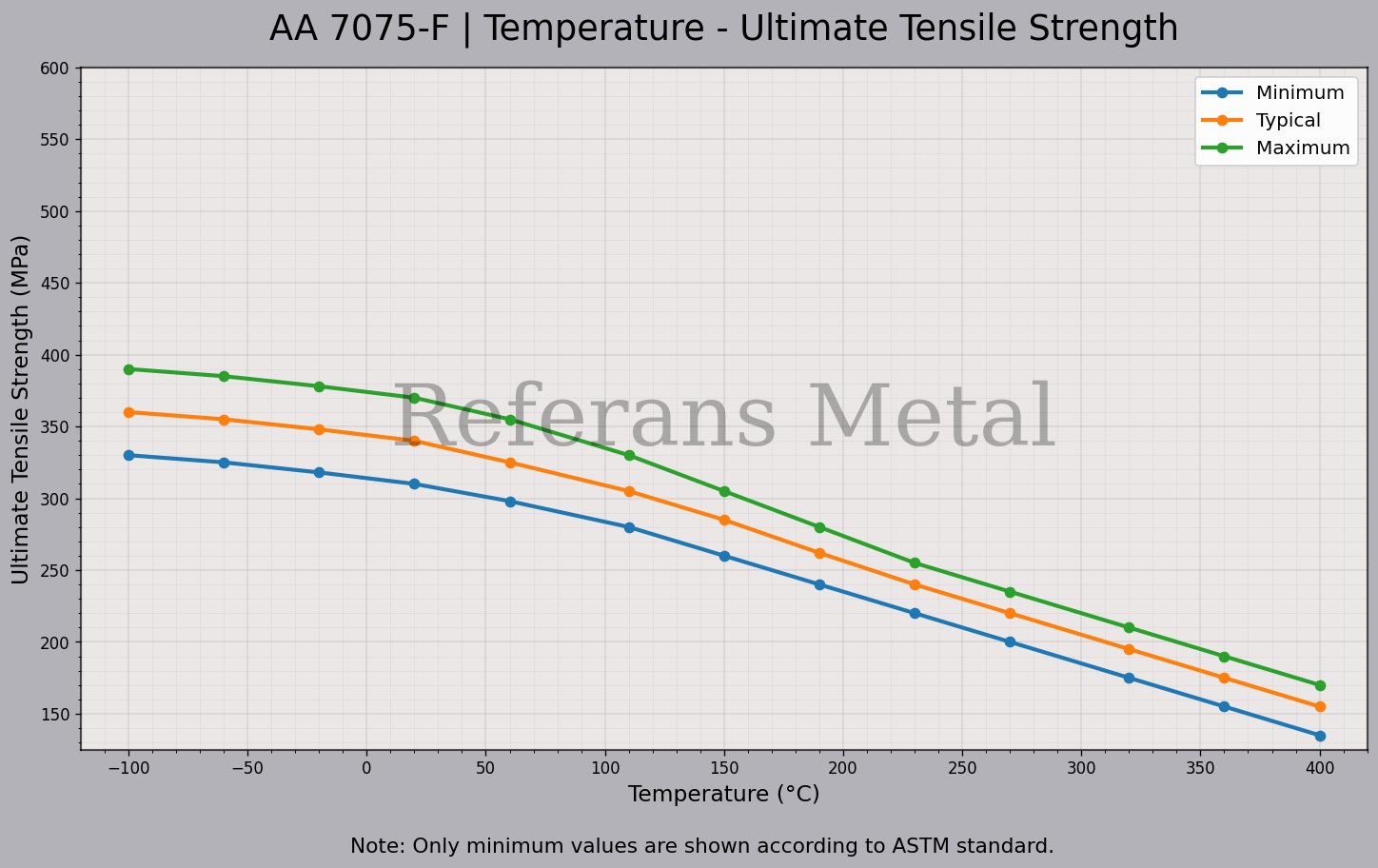
| 7075 F Temperature – Ultimate Tensile Strength Graph |
 |
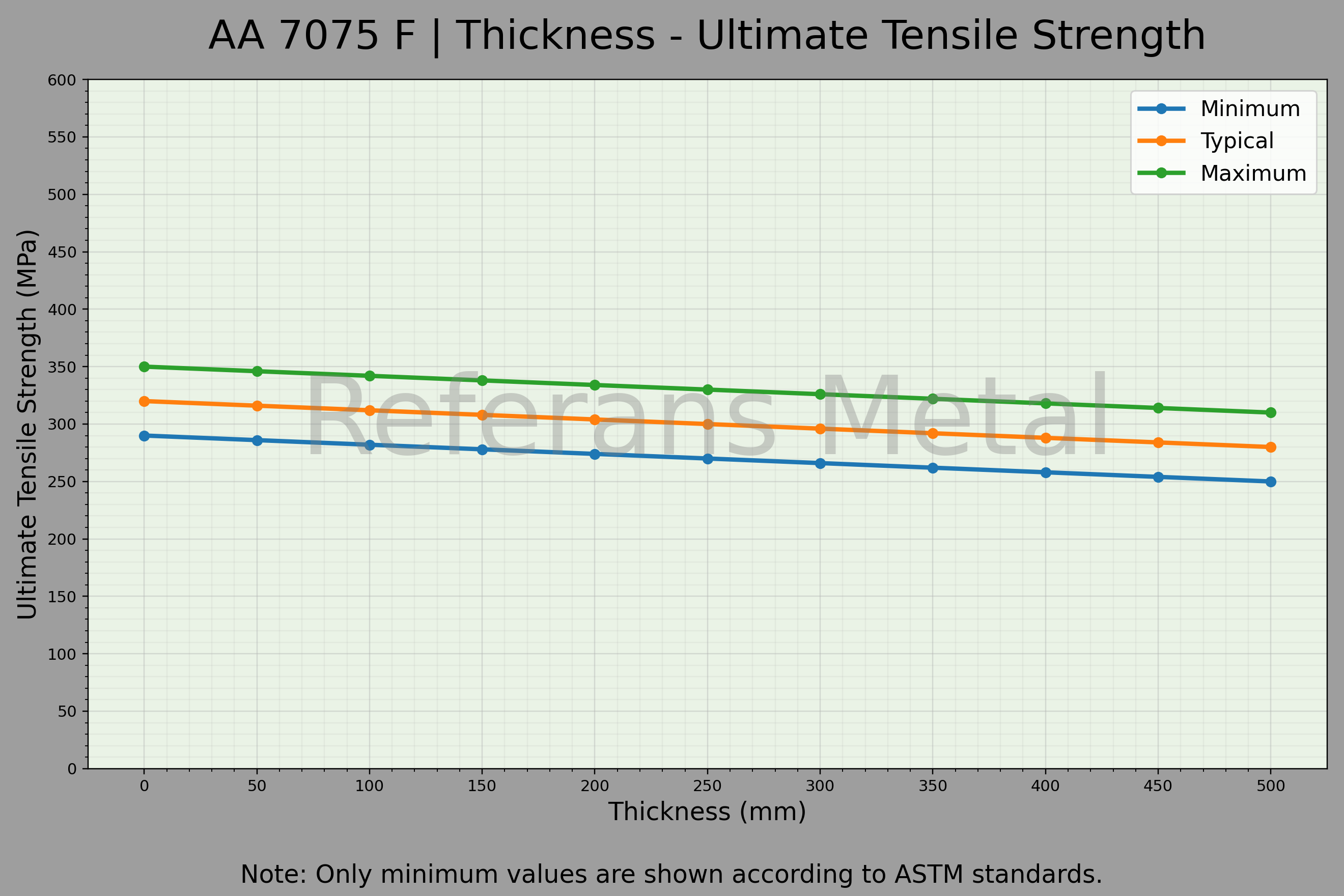
| 7075 F Thickness – Ultimate Tensile Strength Graph |
 |
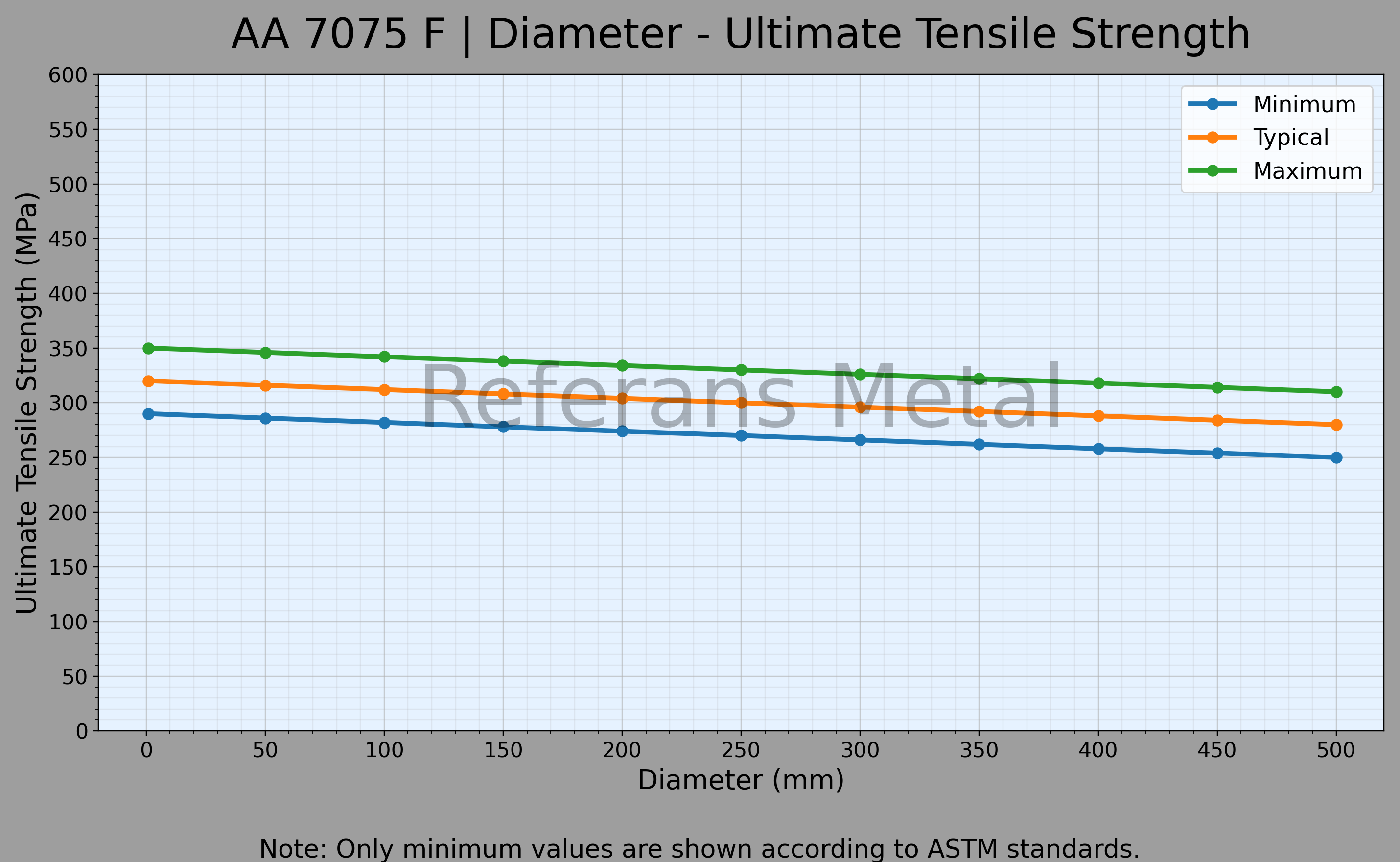
| 7075 F Diameter – Ultimate Tensile Strength Graph |
 |
7075-F aluminum alloy refers to the temper condition in which no specific thermal or mechanical treatment has been applied, meaning it is used in the as-fabricated condition. Therefore, its mechanical properties may vary depending on the production method (extrusion, forging, rolling, etc.). The 7075 alloy is a zinc (Zn)-based high-strength alloy, and the F temper is typically encountered in semi-finished products or intermediate production stages where final properties have not yet been established.
In terms of corrosion resistance, 7075-F exhibits moderate performance. Compared to alloys like the 5xxx series (such as 5083), which are highly resistant in marine environments, it has lower corrosion resistance. The 6061 alloy provides a more balanced corrosion performance. The copper content in 7075 limits its corrosion resistance, so surface protection such as anodizing or coating is generally recommended.
Regarding strength and machinability, 7075-F has lower strength compared to heat-treated conditions such as T6 or T73. However, this improves machinability. It shows similar machinability to 2024, while offering higher potential strength than 6061 after heat treatment. Therefore, the F temper is generally considered a transitional condition before achieving final properties.
In terms of bending properties, coatability, and weldability, 7075-F may exhibit lower formability compared to the O temper due to residual stresses from processing. Its weldability is generally poor; in this regard, 6061 is much more advantageous. Anodizing is possible for surface finishing, although copper content may affect surface appearance.
Regarding vibration behavior and applications, 7075 alloy is widely used in aerospace, defense, and high-performance mechanical applications due to its high specific strength. The 7075-F condition is typically used as an intermediate form before further heat or mechanical treatment rather than for final applications. While 5083 is used in shipbuilding, 6061 in general engineering, and 2024 in aircraft structures, 7075 stands out as one of the alloys with the highest strength potential.
MATERIAL COMPOSITION STANDARDS
7075-F is available according to the following standards:
• 7075-F Sheet; AMS QQ-A-250/12, ASTM B209, ISO AlZn5.5MgCu, WNR 3.4365
• 7075-F Plate / Sheet; AMS QQ-A-250/12, ASTM B209, ISO AlZn5.5MgCu, WNR 3.4365
• 7075-F Extrusion Round Bar; AMS QQ-A-200/11, ASTM B221, ISO AlZn5.5MgCu, WNR 3.4365, BS L 160
• 7075-F Extrusion Bar; AMS QQ-A-200/11, ASTM B221, ISO AlZn5.5MgCu, WNR 3.4365, BS L 160
Characteristic Properties of 7075-F:
- Strength: Normal
- Machinability: Medium
- Weldability: Poor
- Formability: Low
- Corrosion Resistance: Medium
- Heat Treatment: Yes
Some Known Applications of 7075-F:
In the automotive industry,
In spare parts produced by hot and cold forming,
In machinery and equipment manufacturing, during forging and pressing operations.
STOCK
7075-F is supplied in plate/sheet and sheet forms.
- Plate / Sheet
- Sheet
 Weight Calculator