
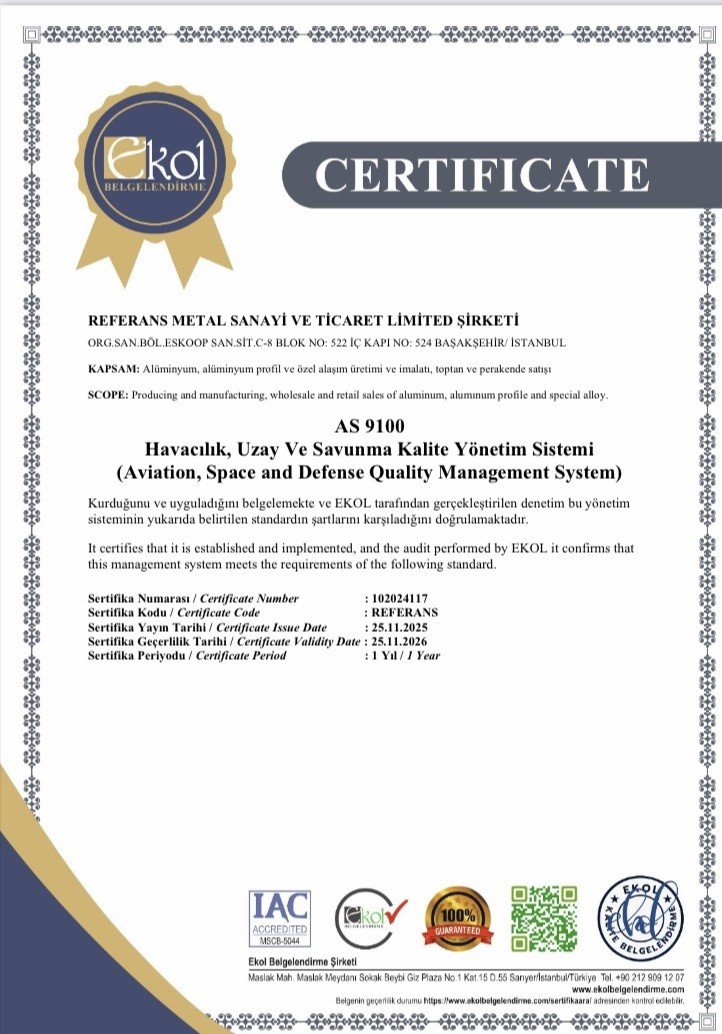
 AS 9100
 SPACE 2009
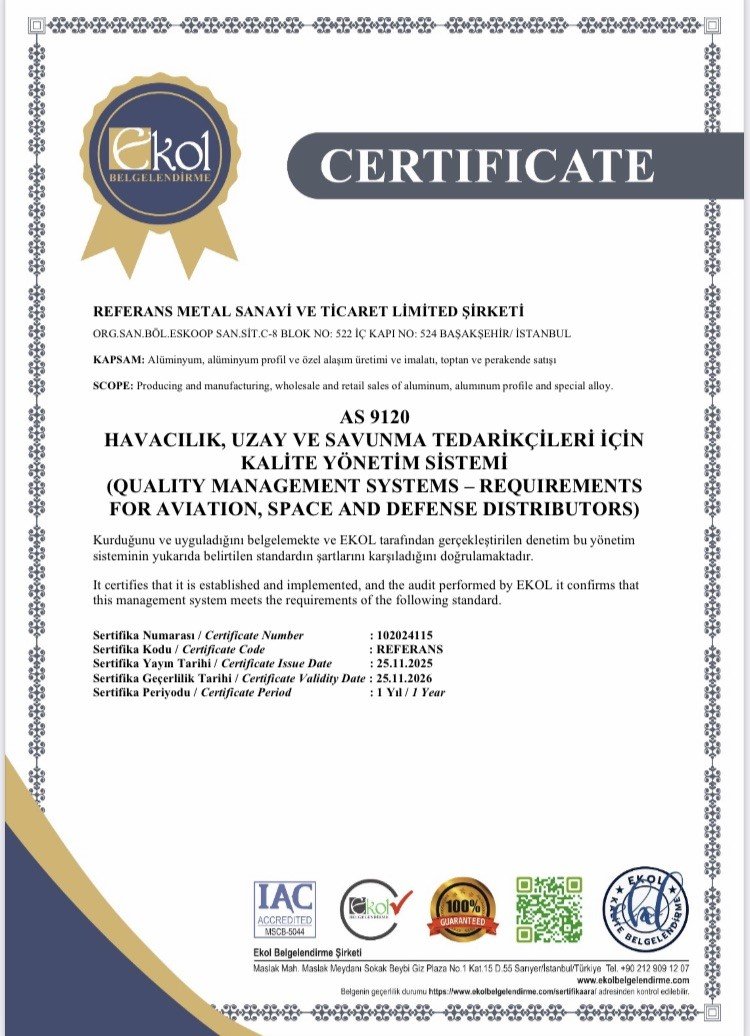 AS 9120




2017
UNS A92017 / AlCu4MgSi / 2017 / O
| Chemical Properties | % Value |
| Silicon (Si) | 0,20 - 0,80 |
| Chromium (Cr) | 0,00 - 0,10 |
| Manganese (Mn) | 0,40 - 1,0 |
| Magnesium (Mg) | 0,40 - 1,00 |
| Copper (Cu) | 3,50 - 4,50 |
| Titanium (Ti) | 0,00 - 0,25 |
| Iron (Fe) | 0,00 - 0,70 |
| Zinc (Zn) | 0,00 - 0,25 |
| Aluminium (Al) | Balance |
| Physical Properties | Value |
| Density | 2.79 g/cm³ |
| Melting Point | 510 °C |
| Thermal Expansion | 22.9 µm/m.°C |
| Modulus of Elasticity | 72 GPa |
| Thermal Conductivity | 140 W/m.K |
| Electrical Resistivity | 38 % IACS |
| Mechanical Properties | Value |
| Yield Strength | 76 MPa |
| Ultimate Strength | 190 MPa |
| Shear Strength | 130 MPa |
| Elongation A50 mm | %15 |
| Hardness | 45 HB |
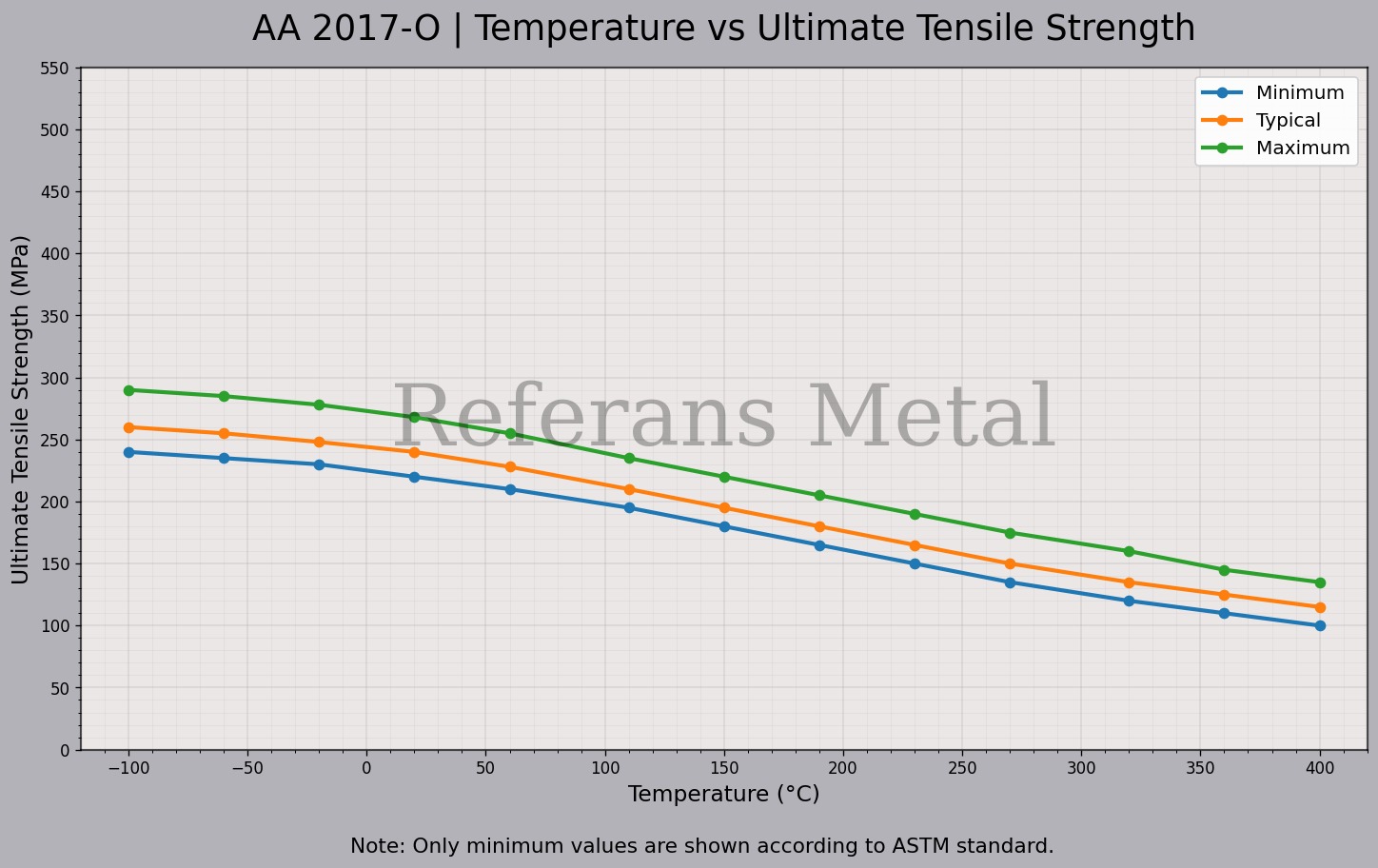
| 2017 O Temperature – Ultimate Tensile Strength Graph |
 |
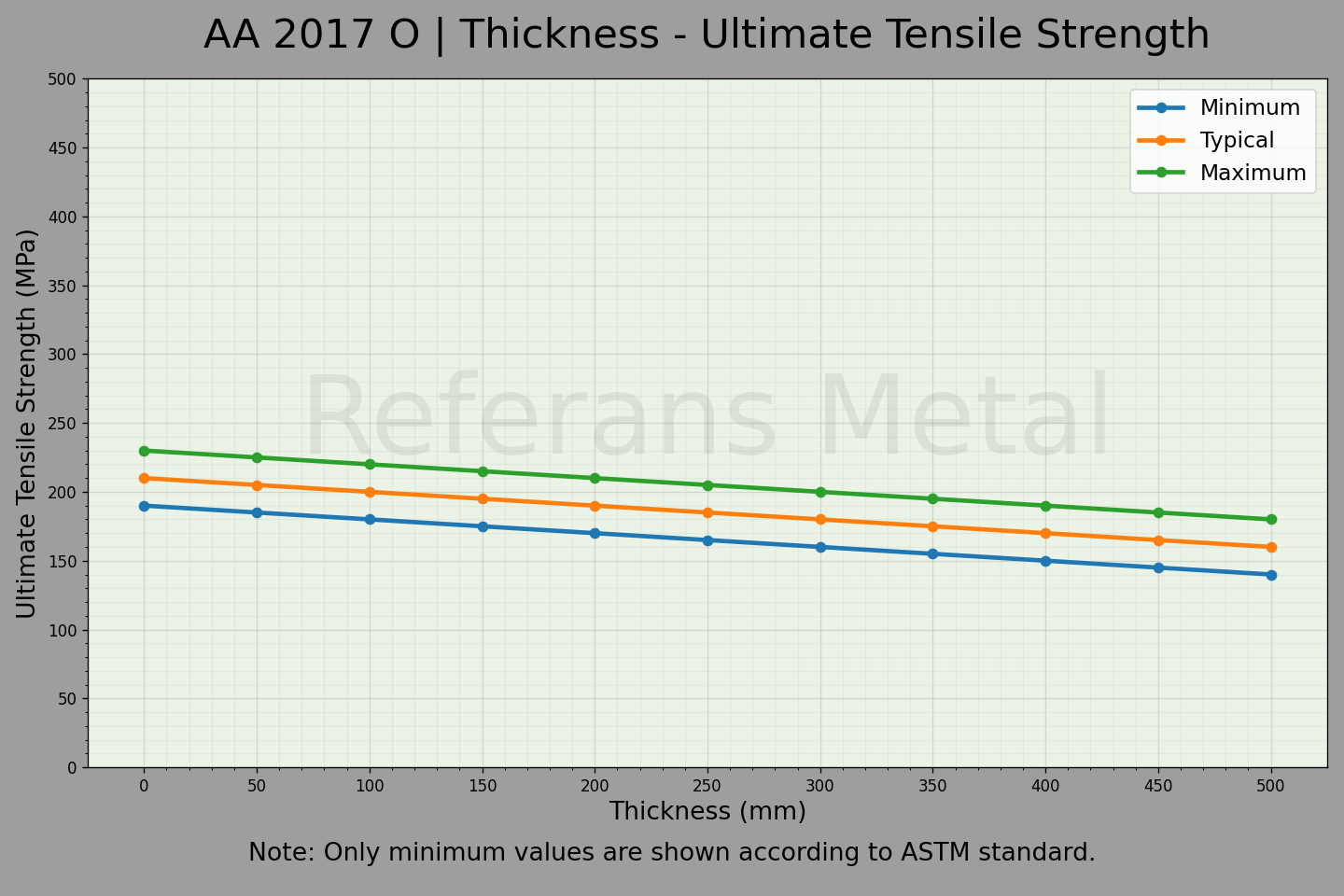
| 2017 O Thickness – Ultimate Tensile Strength Graph |
 |
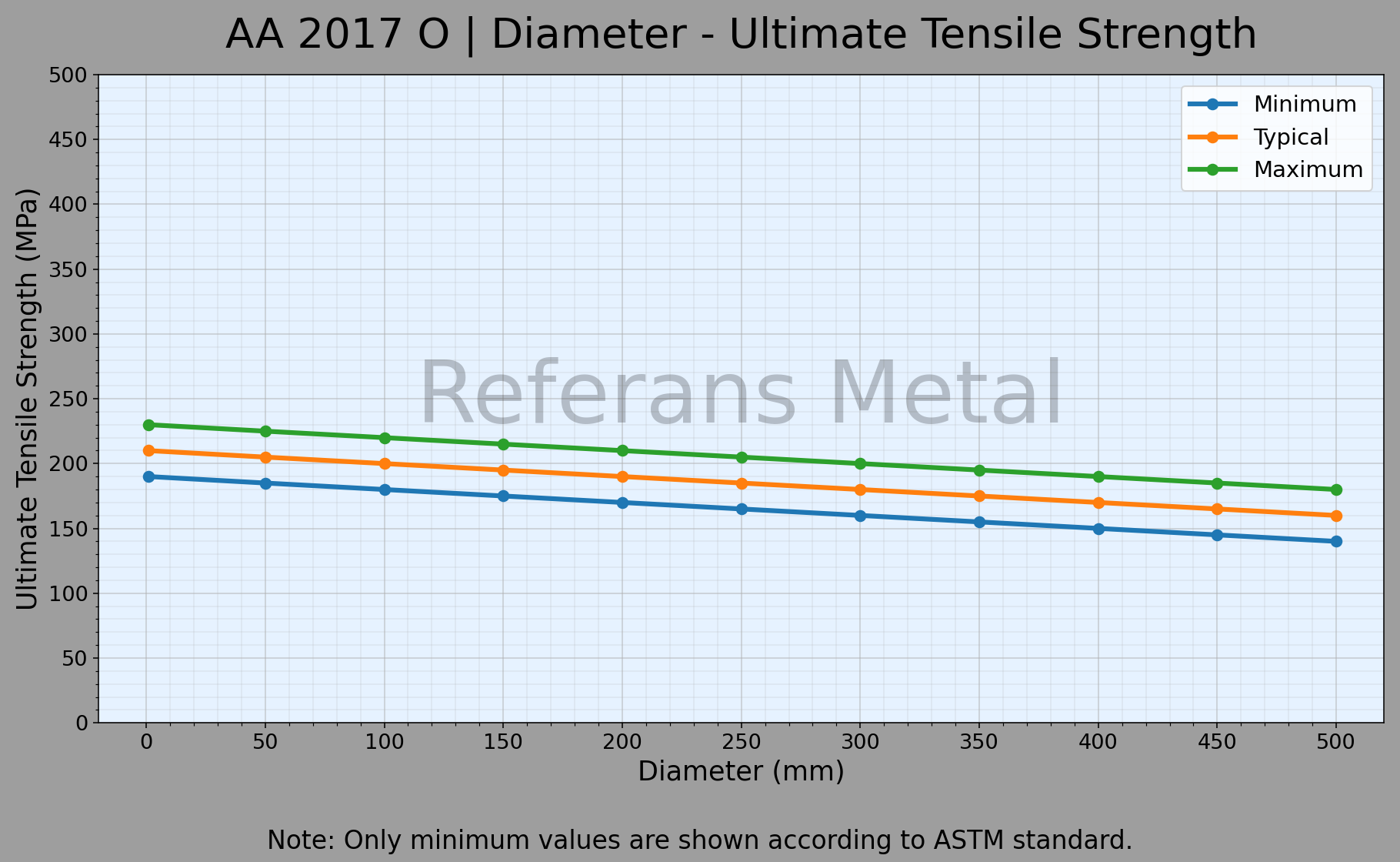
| 2017 O Diameter – Ultimate Tensile Strength Graph |
 |
2017-O aluminum alloy is a member of the 2000 series and stands out due to its copper (Cu) content. The “O” temper condition indicates that the alloy is annealed, meaning it has maximum ductility and minimum strength. This characteristic provides a significant advantage in applications requiring forming. The alloy exhibits stable performance thanks to its homogeneous microstructure and adapts well to various manufacturing processes.
One of the most notable properties of this alloy is its corrosion resistance. Although the 2000 series is generally more susceptible to corrosion, in the 2017-O temper condition, corrosion behavior is more balanced due to reduced internal stresses. However, when compared to 5000 series alloys such as 5083, its corrosion resistance is lower. Therefore, it is usually supported with surface treatments or coatings.
In terms of strength, the 2017-O alloy has lower values compared to high-strength tempers such as T4 and T6. However, this significantly enhances its bendability and formability. For example, while the 2024-T3 alloy provides higher strength, 2017-O can be bent and formed much more easily. Additionally, compared to the 6061 alloy, 2017-O offers lower strength but greater ease of shaping.
Regarding machinability, the 2017 alloy generally performs very well. Since it is softer in the O temper condition, machining operations can be carried out more controllably. However, its weldability is limited; due to its copper content, there is a risk of cracking during welding. In this respect, the 6061 alloy is more advantageous in terms of welding capability. Nevertheless, 2017-O is highly suitable for riveting and mechanical fastening.
The alloy is used in aerospace, automotive, machinery parts, and structural applications. In addition, in terms of vibration response, it provides moderate damping properties. Therefore, careful design is required in vibrating environments. Coating capability (anodizing and other surface treatments) is possible, but it may not yield as aesthetic results as the 6000 series. Overall, 2017-O is a balanced alloy preferred in applications where formability and machinability are prioritized.
MATERIAL COMPOSITION STANDARDS
2017A O can be found in the following standards.
• 2017A O Sheet; ASTM B209, ISO AlCu4MgSi, UNS A92017, WNR 3.1325, DIN AlCuMg1
• 2017A O Plate; ASTM B209, ISO AlCu4MgSi, UNS A92017, WNR 3.1325, DIN AlCuMg1
• 2017A O Cold Drawn Round Bar; AMS QQ-A-225/5, ASTM B211, UNS A92017, WNR 3.1325, DIN AlCuMg1, ASTM B565, ASTM B316
• 2017A O Cold Drawn Tube; AMS QQ-A-225/5, ASTM B211, UNS A92017, WNR 3.1325, DIN AlCuMg1, ASTM B565, ASTM B316
• 2017A O Cold Drawn Flat Bar; AMS QQ-A-225/5, ASTM B211, UNS A92017, WNR 3.1325, DIN AlCuMg1, ASTM B565, ASTM B316
• 2017A O Cold Drawn Profile; AMS QQ-A-225/5, ASTM B211, UNS A92017, WNR 3.1325, DIN AlCuMg1, ASTM B565, ASTM B316
• 2017A O Extruded Round Bar; AMS QQ-A-200/2, ASTM B221, UNS A92017, WNR 3.1325, DIN AlCuMg1
• 2017A O Extruded Tube; AMS QQ-A-200/2, ASTM B221, UNS A92017, WNR 3.1325, DIN AlCuMg1
• 2017A O Extruded Flat Bar; AMS QQ-A-200/2, ASTM B221, UNS A92017, WNR 3.1325, DIN AlCuMg1
• 2017A O Extruded Profile; AMS QQ-A-200/2, ASTM B221, UNS A92017, WNR 3.1325, DIN AlCuMg1
Characteristic Properties for 2017A O:
- Strength: Medium High
- Machinability: Excellent
- Weldability: Moderate (Filler welding and brazing are preferred)
- Formability: Very Good
- Corrosion Resistance: Medium (Improved with coating)
- Heat Treatment: Yes
Common Applications for 2017A O:
In hydraulic applications, rivet nails,
In military vehicles and equipment,
Used in automatic screw machines.
STOCK
We supply/produce 2017A O in sheet/plate, coil, round bar/flat bar, and tube/profile forms.
- Sheet / Plate
- Coil
- Round Bar / Flat Bar
- Tube / Profile
 Weight Calculator