• Plates

  • Sheets

  • Rod/Round Bar/Flat Bar

  • Tube/Extrusions/Profile

3003

AMS 4008 / AlMn1Cu / 3003 / H14

Chemical Properties % Value
Silicon (Si)0,00 - 0,60
Manganese (Mn)1,00 - 1,50
Copper (Cu)0,05 - 0,20
Iron (Fe)0,00 - 0,70
Zinc (Zn)0,00 - 0,10
Aluminium (Al)Balance
Physical Properties Value
Density2.73 g/cm³
Melting Point582 °C
Thermal Expansion23.2 µm/m.°C
Modulus of Elasticity69 GPa
Thermal Conductivity159 W/m-K
Electrical Resistivity%43 IACS
Mechanical Properties Value
Proof Strength145 MPa
Yield Strength152 MPa
Shear Strength96.5 MPa
Elongation A50 mm%15
Hardness40 HB
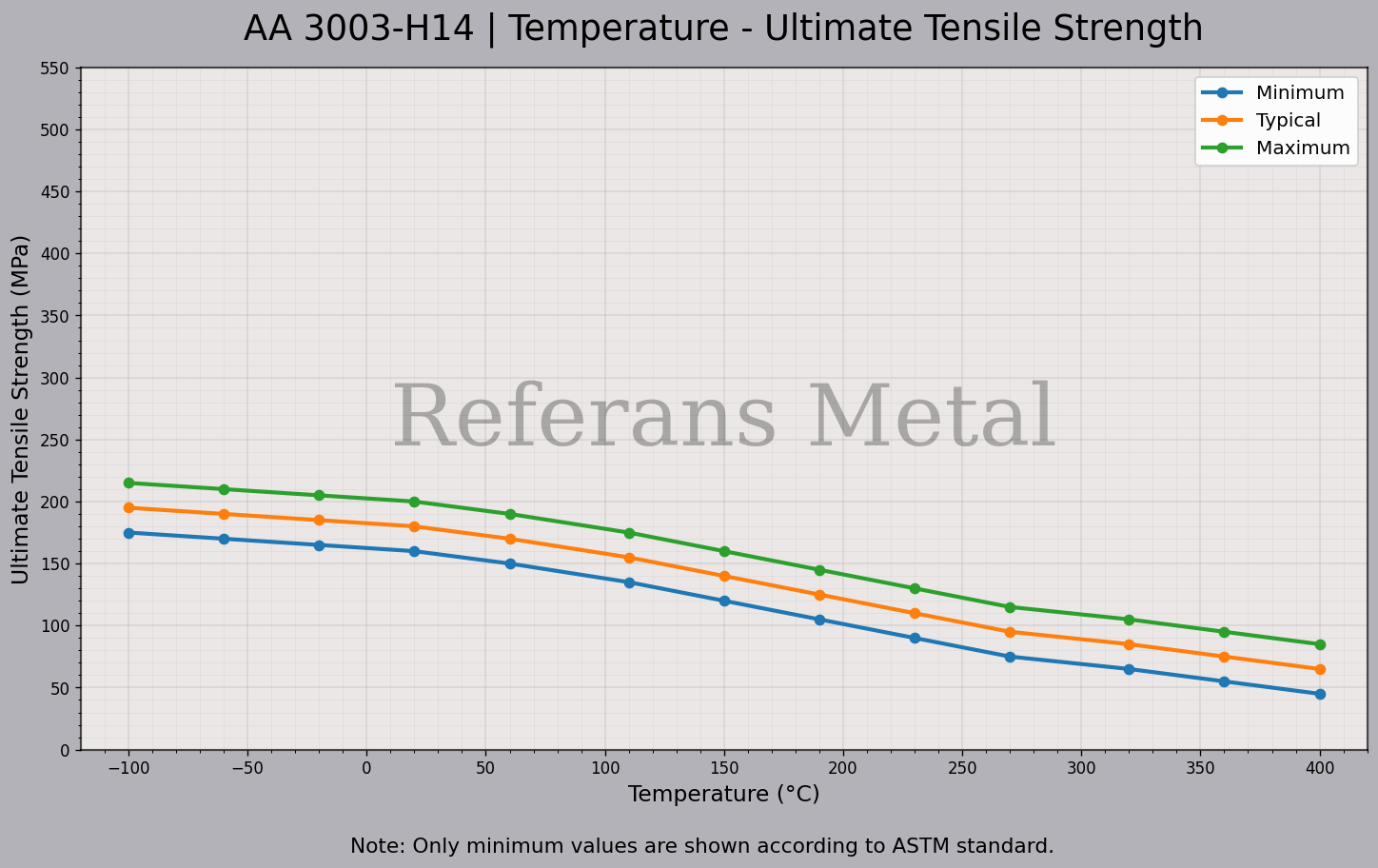
3003 H14 Temperature – Ultimate Tensile Strength Graph
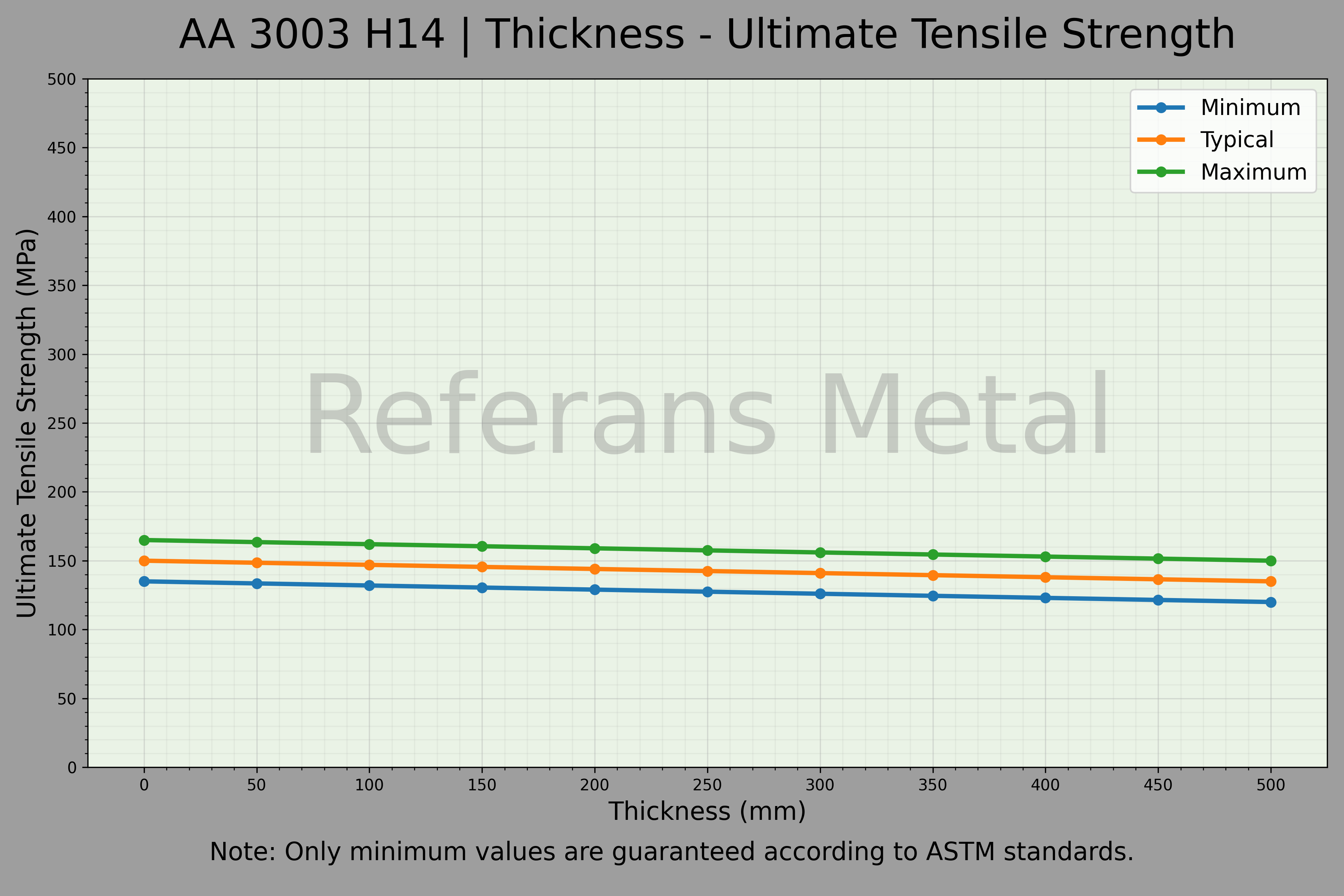
3003 H14 Thickness – Ultimate Tensile Strength Graph
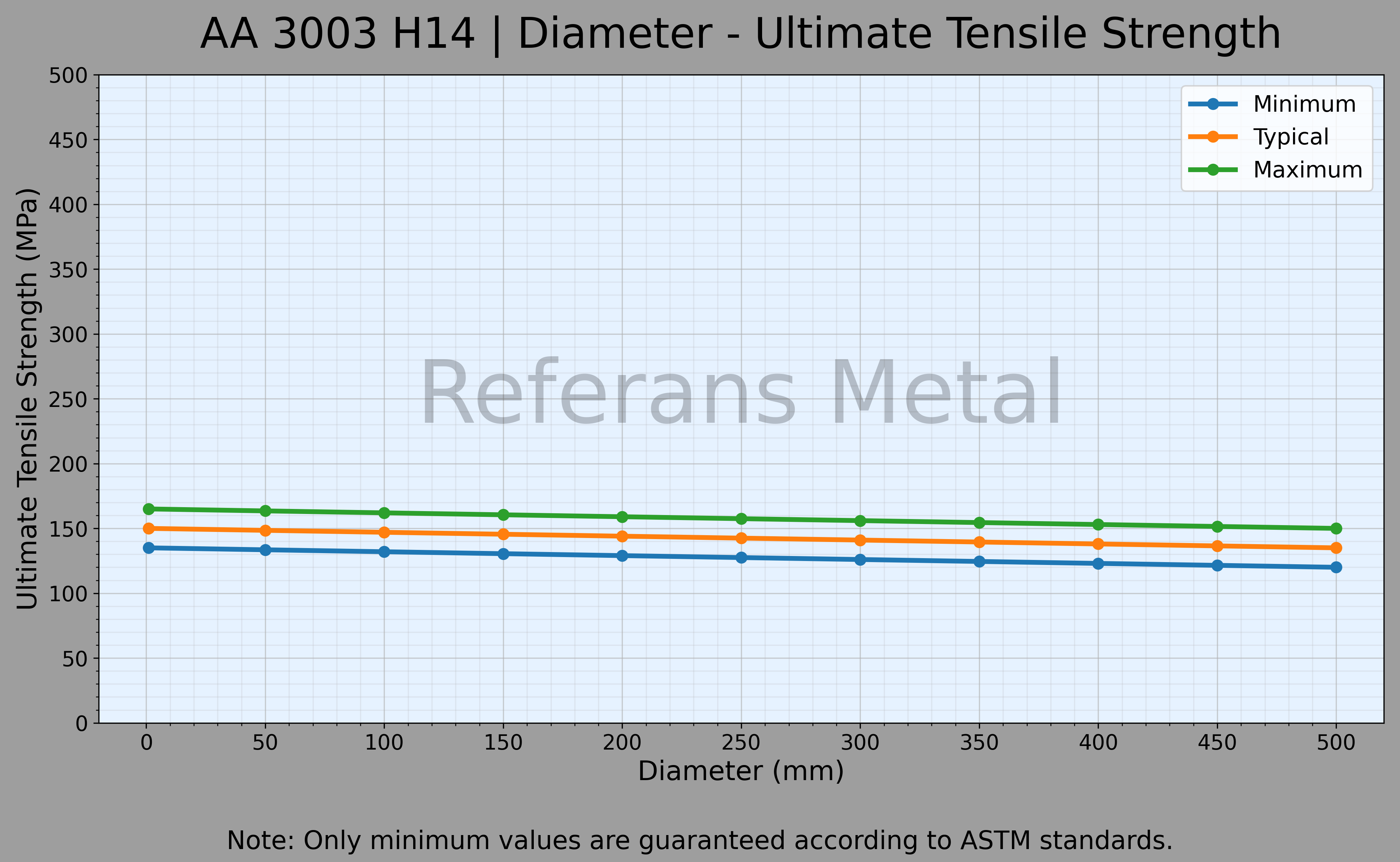
3003 H14 Diameter – Ultimate Tensile Strength Graph
Print

3003 H14 aluminum alloy is a manganese (Mn)-containing material belonging to the 3xxx series, in a strain-hardened temper condition, offering a combination of moderate strength and high corrosion resistance. This alloy is highly resistant to atmospheric conditions and is preferred in many industrial and structural applications in terms of corrosion resistance. It performs reliably in marine environments, humid air, and chemically exposed areas. Compared to pure aluminum, it provides higher strength while largely maintaining its workability.

In terms of strength, 3003 H14 offers higher strength than the H112 temper but still remains below high-strength alloys. For example, compared to 6061-T6, it has lower strength but better formability. Compared to 5052-H32, it has similar corrosion resistance but slightly lower strength. Compared to 2024-T3, it has much lower strength but significantly better corrosion resistance and weldability.

In terms of machinability, 3003 H14 is moderate; although not ideal for machining, it can be easily processed especially in sheet and plate form. Its bending capability is very good, although slightly more limited than H112 due to the H14 temper. However, the risk of cracking is still low, making it suitable for moderately complex geometries. Its suitability for cold forming makes it important in mass production.

In terms of coating capability, 3003 H14 performs very well. It is suitable for anodizing, painting, and other surface treatments. This provides a major advantage in decorative and architectural applications. Additionally, it offers good damping in terms of vibration response, making it suitable for vibration-prone environments.

Its weldability is very high and it can be easily joined using MIG and TIG welding methods. This makes it advantageous in applications such as tanks, pressure vessels, heat exchangers, and piping systems. The 3003 H14 alloy is widely used in industries such as automotive, HVAC systems, food equipment, appliances, chemical industry, and architectural applications.

MATERIAL COMPOSITION STANDARDS

3003 H14 can be produced according to the following standards:
• 3003 H14 Sheet; AMS 4008, ASTM B209, UNS A93003, AFNOR A-M1, UNE L-3810, UNI 9003/1 DIN AlMnCu, WNR 3.0517, ISO AlMn1Cu
• 3003 H14 Plate; AMS 4008, ASTM B209, UNS A93003, AFNOR A-M1, UNE L-3810, UNI 9003/1 DIN AlMnCu, WNR 3.0517, ISO AlMn1Cu
• 3003 H14 Seamless Extrusion Tube; AMS 4067, WW-T-700/2, ASTM B234, ASTM B241, UNS A93003, AFNOR A-M1, UNE L-3810, UNI 9003/1 DIN AlMnCu, WNR 3.0517, ISO AlMn1Cu


Characteristic Properties of 3003 H14: 

  • Strength: Moderate
  • Machinability: Above Average
  • Weldability: Excellent
  • Formability: Above Average
  • Corrosion Resistance: Excellent
  • Heat Treatment: No
     

Common Applications of 3003 H14: 
Aluminum trims,
Oven molds,
Used as insulation material in construction industry.


STOCK
3003 H14 is produced/supplied in sheet, tube, and plate forms.

  • Sheet
  • Plate
  • Tube
DELIVERY: