
 AS 9100
 SPACE 2009
 AS 9120




Cold Drawn Round Bar
Cold Drawn Tube
2030
Cold Drawn/Finished (CF) / AlCu4PbMg (Soğuk Çekim) / 2030 / T3
| Chemical Properties | % Value |
| Silicon (Si) | 0,00 - 0,80 |
| Chromium (Cr) | 0,00 - 0,10 |
| Manganese (Mn) | 0,20 - 1,00 |
| Magnesium (Mg) | 0,50 - 1,00 |
| Copper (Cu) | 3,50 - 4,50 |
| Titanium (Ti) | 0,00 - 0,20 |
| Iron (Fe) | 0,00 - 0,70 |
| Zinc (Zn) | 0,00 - 0,50 |
| Lead (Pb) | 0,80 - 1,00 |
| Aluminium (Al) | Balance |
| Physical Properties | Value |
| Density | 2.81 g/cm³ |
| Melting Point | 520 °C |
| Thermal Expansion | 23 µm/m.°C |
| Modulus of Elasticity | 73.6 GPa |
| Thermal Conductivity | 130 W/m.K |
| Electrical Resistivity | 34% IACS |
| Mechanical Properties | Value |
| Yield Strength | 250 MPa |
| Ultimate Strength | 390 MPa |
| Shear Strength | 230 MPa |
| Elongation A50 mm | 7% |
| Hardness | 115 HB |
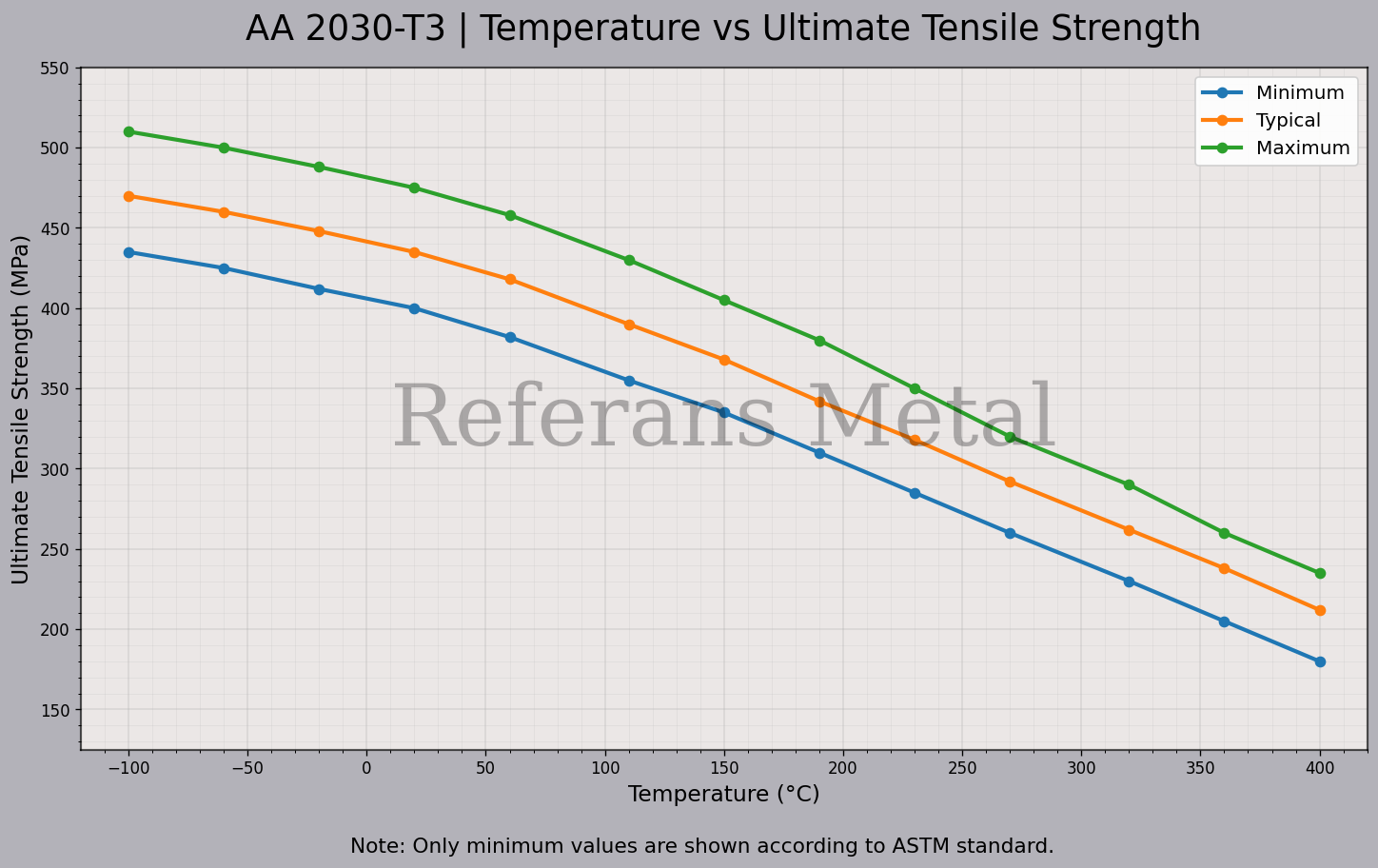
| 2030 T3 Temperature – Ultimate Tensile Strength Graph |
 |
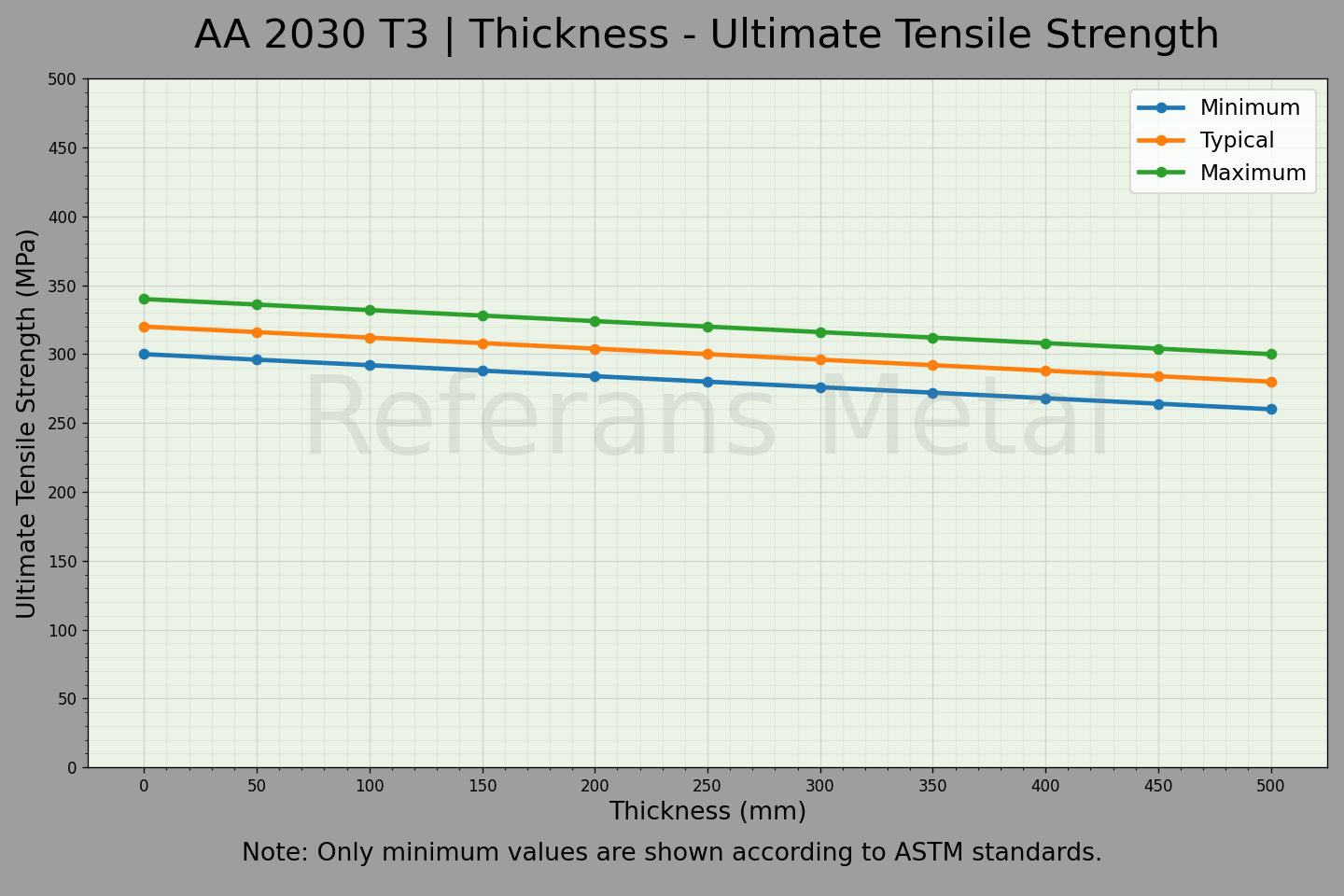
| 2030 T3 Thickness – Ultimate Tensile Strength Graph |
 |
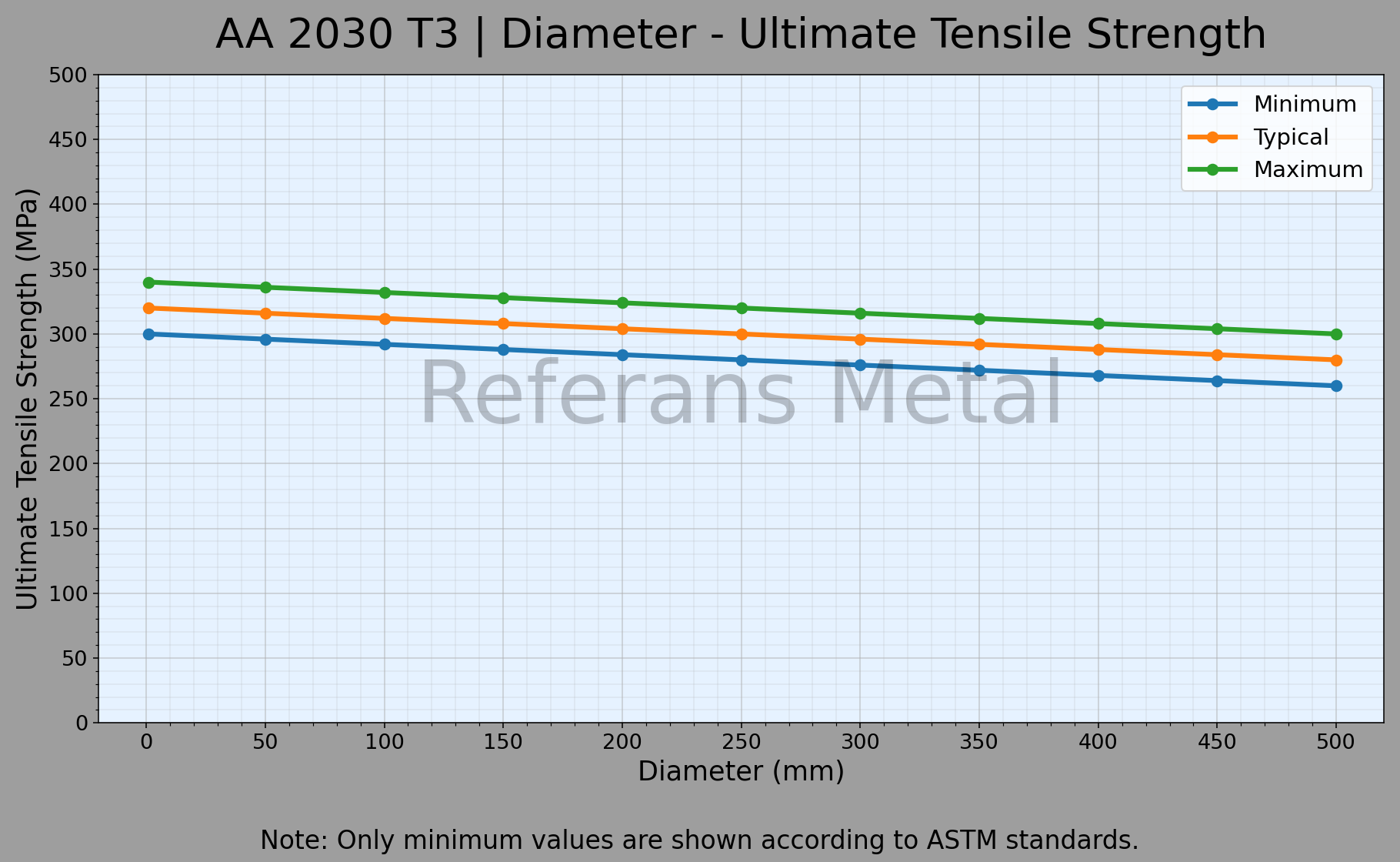
| 2030 T3 Diameter – Ultimate Tensile Strength Graph |
 |
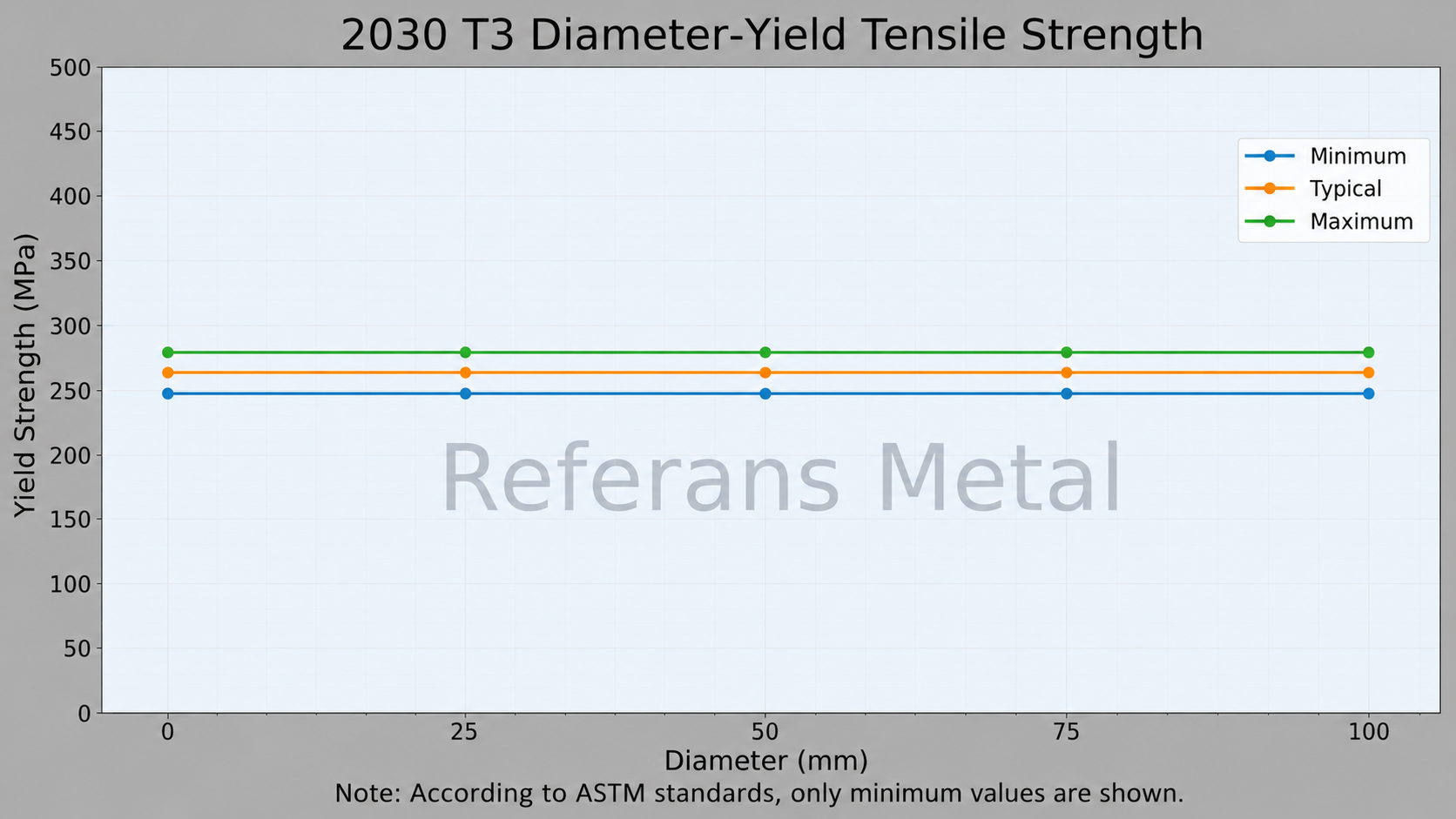
| 2030 T3 Diameter-Yield Tensile Strength |
 |
The 2030 T3 aluminum alloy is a copper-based (Al-Cu) alloy developed for high-strength applications. The T3 temper is achieved through solution heat treatment followed by cold working and natural aging. This results in an excellent strength-to-weight ratio, making it particularly suitable for aerospace and defense industries. It provides reliable performance in structural components requiring high durability.
The strength of this alloy is quite high, but this comes with some disadvantages in terms of corrosion resistance. Compared to pure aluminum,.png) 2030 T3 has lower corrosion resistance and typically requires surface protection treatments such as anodizing or cladding. For example, alloy 5052 offers better corrosion resistance, while 7075 provides higher strength but exhibits similar corrosion weaknesses.
2030 T3 has lower corrosion resistance and typically requires surface protection treatments such as anodizing or cladding. For example, alloy 5052 offers better corrosion resistance, while 7075 provides higher strength but exhibits similar corrosion weaknesses.
In terms of machinability, 2030 T3 performs very well. It is suitable for machining and is often used in the production of high-precision components. However, its formability is moderate; similar to 2024, its high strength results in lower bending capability. In contrast, alloy 6061 stands out with better bending performance.
Regarding coatability, the alloy offers advantages especially when used in alclad form, which enhances corrosion resistance and extends service life. In terms of vibration and fatigue behavior, it performs well under dynamic loads, making it suitable for aircraft structures and load-bearing systems. It provides fatigue resistance similar to 2024 and may offer slightly better crack propagation resistance than 7075.
Weldability of 2030 T3 is limited. Due to its copper content, it has a high risk of cracking during welding, so mechanical fastening methods are generally preferred. This is a significant disadvantage compared to 6061, which has excellent weldability. Overall, 2030 T3 is an essential material in aerospace, defense, and high-performance engineering applications when used with proper surface treatments.
MATERIAL COMPOSITION STANDARDS
2030 T3 is available in the following standards:
• 2030 T3 Cold-Drawn Round Bar; ISO AlCu4PbMg, DIN AlCuMgPb, UNS A92030, ASTM B211, AFNOR AU4Pb
• 2030 T3 Cold-Drawn Flat Bar; ISO AlCu4PbMg, DIN AlCuMgPb, UNS A92030, ASTM B211, AFNOR AU4Pb
• 2030 T3 Cold-Drawn Tube; ISO AlCu4PbMg, DIN AlCuMgPb, UNS A92030, ASTM B210, AFNOR AU4Pb
Characteristic Properties of 2030 T3:
- Strength: Very High
- Machinability: Excellent
- Weldability: Moderate
- Formability: Fair
- Corrosion Resistance: Poor
- Heat Treatment: Yes
Common Applications of 2030 T3:
Hydraulic pistons,
Forged and machined products,
Widely used in the automotive industry as well.
STOCK
2030 T3 is supplied in rod/flat bar and tube/profile forms.
- Rod/Flat Bar
- Tube/Profile
 Weight Calculator