
 AS 9100
 SPACE 2009
 AS 9120


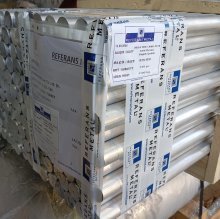

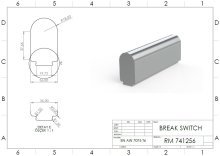

Plates
Sheets
Rod/Round Bar/Flat Bar
Tube/Extrusions/Profile
2024
AMS 4120 / AlCu4Mg1 / 2024 / T42
| Chemical Properties | % Value |
| Silicon (Si) | 0,00 - 0,50 |
| Chromium (Cr) | 0,00 - 0,10 |
| Manganese (Mn) | 0,30 - 0,90 |
| Magnesium (Mg) | 1,20 - 1,80 |
| Copper (Cu) | 3,80 - 4,90 |
| Titanium (Ti) | 0,00 - 0,15 |
| Iron (Fe) | 0,00 - 0,50 |
| Zinc (Zn) | 0,00 - 0,25 |
| Aluminium (Al) | Balance |
| Physical Properties | Value |
| Density | 2.78 g/cm³ |
| Melting Point | 502 °C |
| Thermal Expansion | 22.9 µm/m.°C |
| Modulus of Elasticity | 73.1 GPa |
| Thermal Conductivity | 121 W/m.K |
| Electrical Resistivity | 30% IACS |
| Mechanical Properties | Value |
| Proof Strength | 324 MPa |
| Yield Strength | 469 MPa |
| Shear Strength | 283 MPa |
| Elongation A50 mm | 16% |
| Hardness | 120 HB |
2024 T42 aluminum alloy is a high-strength aluminum alloy with good fatigue resistance, used particularly in the aerospace and defense industries. This alloy belongs to the Al-Cu-Mg system, and the T42 temper is obtained when material in the O or F condition is solution heat-treated by the user or processor, rather than by the original material manufacturer, and then naturally aged. Although T42 is similar to the T4 temper in terms of its treatment sequence, it indicates that the heat treatment was applied after manufacture of the material. This provides an advantage particularly for structural components that must gain high strength after forming.
Corrosion resistance is one of the weakest aspects of 2024 T42 alloy, and therefore it is generally improved by surface treatment processes. Methods such as Alclad coating, anodizing, or protective painting increase the resistance of the alloy to atmospheric conditions. In contrast, its strength is quite high, particularly in terms of tensile and fatigue strength. The T42 temper can be used in formed aircraft skin panels, fuselage components, fittings, and load-bearing elements. It provides good fatigue performance under repeated loading; however, component geometry and surface protection must be carefully designed.
In terms of machinability, 2024 T42 alloy provides good performance after natural aging is completed and is suitable for machining operations. However, its weldability is poor, and mechanical joining methods such as riveting, bolting, and similar techniques are generally preferred. Resistance or spot welding may be applied when the necessary process controls are provided. Bending and forming operations are generally carried out while the material is in the O or F condition; solution heat treatment and natural aging are then applied to obtain the T42 temper. Distortion, dimensional changes, and quenching stresses that may occur during heat treatment should be taken into consideration.
Coating capability is a critical parameter for this alloy because surface treatments improve corrosion resistance while also providing aesthetic and functional properties. In environments involving vibration and repeated loading, 2024 T42 alloy offers reliable fatigue performance when supported by suitable design and surface protection. Therefore, it is used in formed fuselage panels, aircraft repair parts, brackets, reinforcement elements, and connecting components in aerospace applications, as well as in defense-industry components and high-performance lightweight structures.
2024 T42 alloy has distinct advantages and disadvantages when compared with other alloys and tempers. Although it has a heat-treatment structure similar to 2024-T4, the T42 temper is applied by the user or processor after manufacture of the material, and the resulting mechanical properties may depend more strongly on product form, section thickness, and process control. It generally offers higher strength than 6061-T6 alloy, but lower corrosion resistance and weldability. Compared with 7075-T6 alloy, it offers lower maximum strength, but generally provides better formability and damage tolerance. These comparisons demonstrate the importance of the forming and heat-treatment sequence in alloy selection.
MATERIAL COMPOSITION STANDARDS
2024 T42 may be obtained within the following product standards by applying suitable heat treatment to material in the O or F condition.
• 2024 T42 Cold-Drawn Bar; AMS 4120, AMS QQ-A-225/6, ASTM B211
• 2024 T42 Cold-Drawn Flat Bar; AMS 4120, AMS QQ-A-225/6, ASTM B211
• 2024 T42 Cold-Drawn Wire; AMS 4120, AMS QQ-A-225/6, ASTM B211
• 2024 T42 Extruded Bar; AMS QQ-A-200/3, ASTM B221
• 2024 T42 Alclad Sheet; AMS 4040, AMS QQ-A-250/5, ASTM B209
Characteristic Properties of 2024 T42:
- Strength: High
- Machinability: Good
- Weldability: Fair (Spot or resistance welding may be preferred)
- Formability: Good (Generally formed in the O or F condition)
- Corrosion Resistance: Fair
- Heat Treatment: Yes
Some Common Applications of 2024 T42:
Formed aircraft fuselage and skin panels,
Aircraft repair parts, brackets, and reinforcement elements,
Connecting components requiring high strength after heat treatment.
STOCK
2024 T42 may be supplied in sheet/plate, bar/flat bar, and sheet forms, or may be obtained by applying suitable heat treatment to products in the O/F condition.
- Sheet/plate
- Sheet
- Bar/flat bar
| Mechanical Properties | |||
| Thickness (mm) | Yield Strength (Min.) | Ultimate Strength (Min.) | Elongation A50 mm % |
| over 0,25 up to & incl. 6,35 mm | 265 MPa | 427 MPa | 12% - 15% |
| over 6,35 up to & incl. 12,7 mm | 265 MPa | 427 MPa | 10% |
| over 12,7 up to & incl. 25,43 mm | 260 MPa | 420 MPa | ≥8% |
| over 25,4 up to & incl. 50,8 mm | 260 MPa | 415 MPa | ≥6% - 7% |
| over 50,8 up to & incl. 76,2 mm | 260 MPa | 400 MPa | ≥4% |
 Weight Calculator