
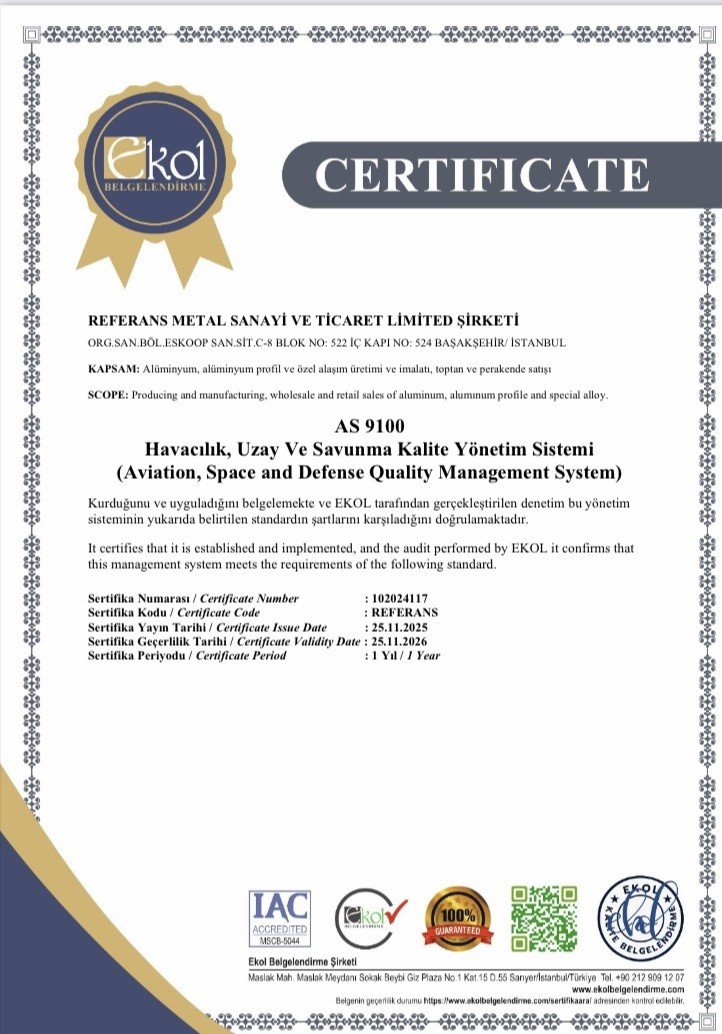
 AS 9100
 SPACE 2009
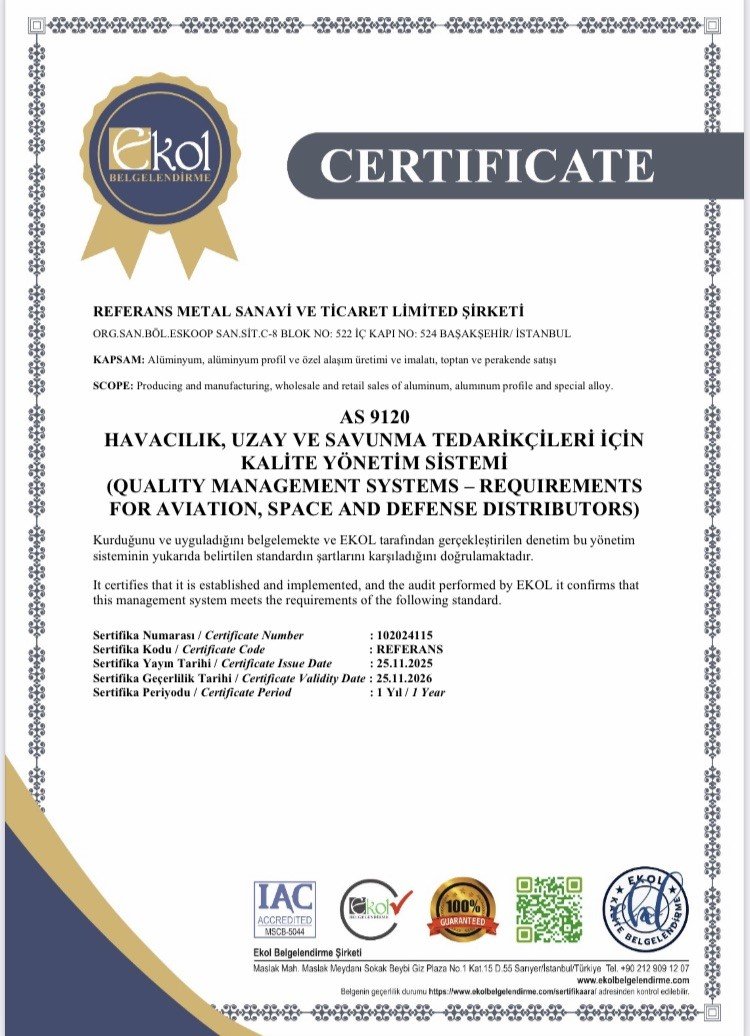 AS 9120




Plates
Sheets
Rod/Round Bar/Flat Bar
Tube/Extrusions/Profile
1060
ASTM B209 / Al99.6 / 1060 / H18
| Chemical Properties | % Value |
| Silicon (Si) | 0,00 - 0,25 |
| Manganese (Mn) | 0,00 - 0,03 |
| Magnesium (Mg) | 0,00 - 0,03 |
| Copper (Cu) | 0,00 - 0,03 |
| Titanium (Ti) | 0,00 - 0,03 |
| Iron (Fe) | 0,00 - 0,35 |
| Zinc (Zn) | 0,00 - 0,05 |
| Aluminium (Al) | Balance |
| Physical Properties | Value |
| Density | 2.705 g/cm³ |
| Melting Point | 650 °C |
| Thermal Expansion | 21.8 µm/m.°C |
| Modulus of Elasticity | 68 GPa |
| Thermal Conductivity | 230 W/m.K |
| Electrical Resistivity | %62 IACS |
| Mechanical Properties | Value |
| Yield Strength | 110 MPa |
| Ultimate Strength | 130 MPa |
| Shear Strength | 75 MPa |
| Elongation A50 mm | %4 |
| Hardness | 68 HB |
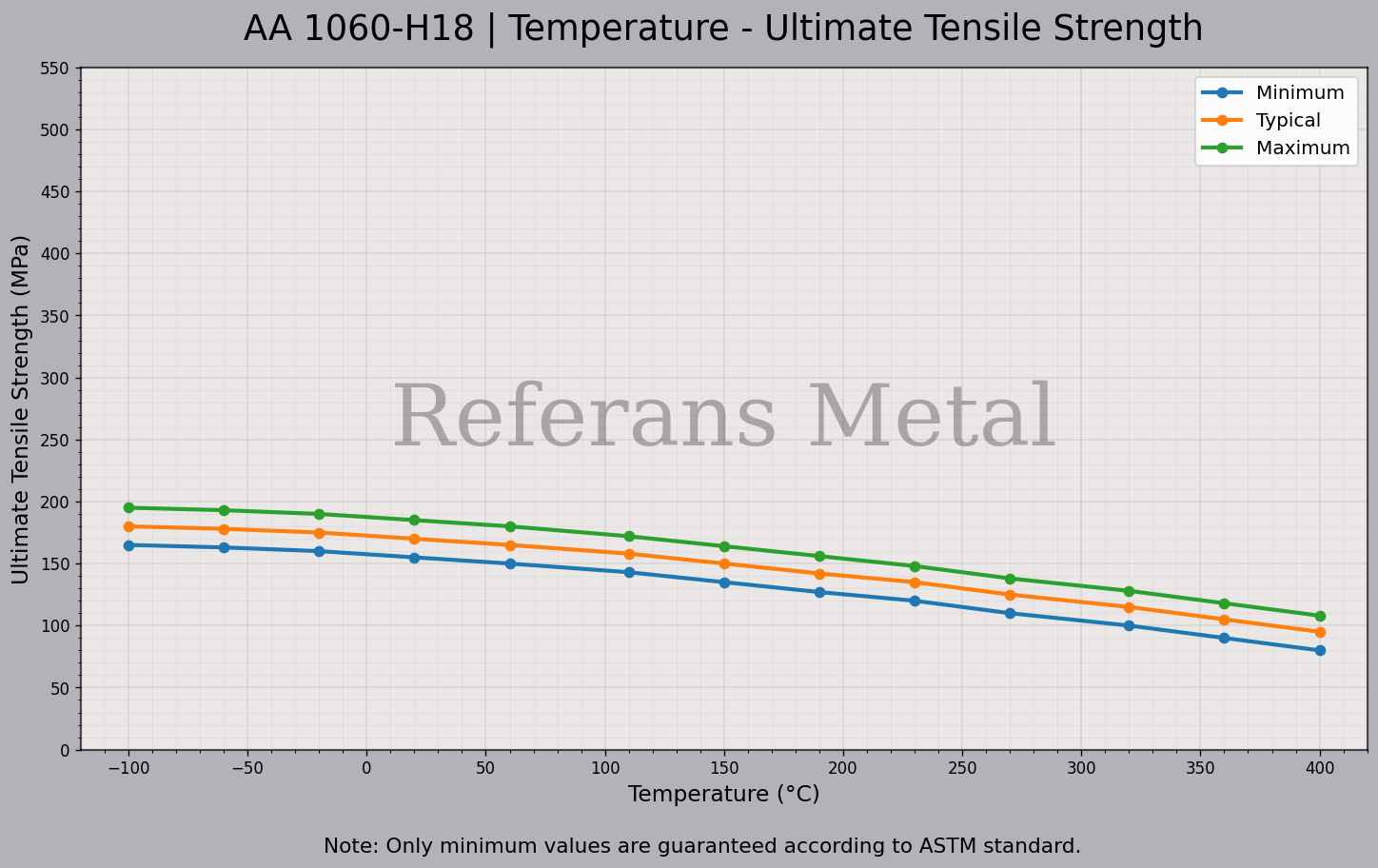
| 1060 H18 Temperature – Ultimate Tensile Strength Graph |
 |
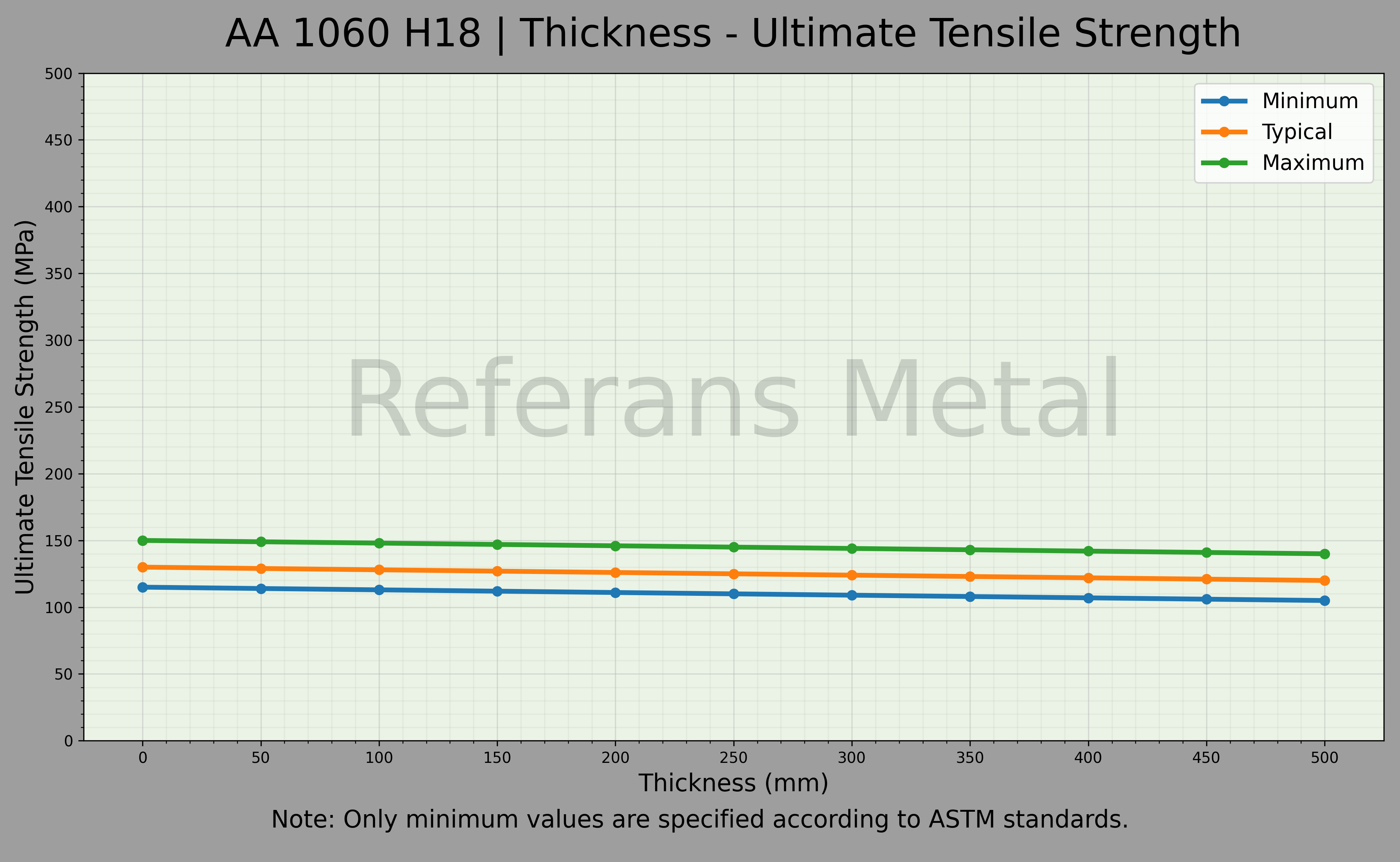
| 1060 H18 Thickness – Ultimate Tensile Strength Graph |
 |
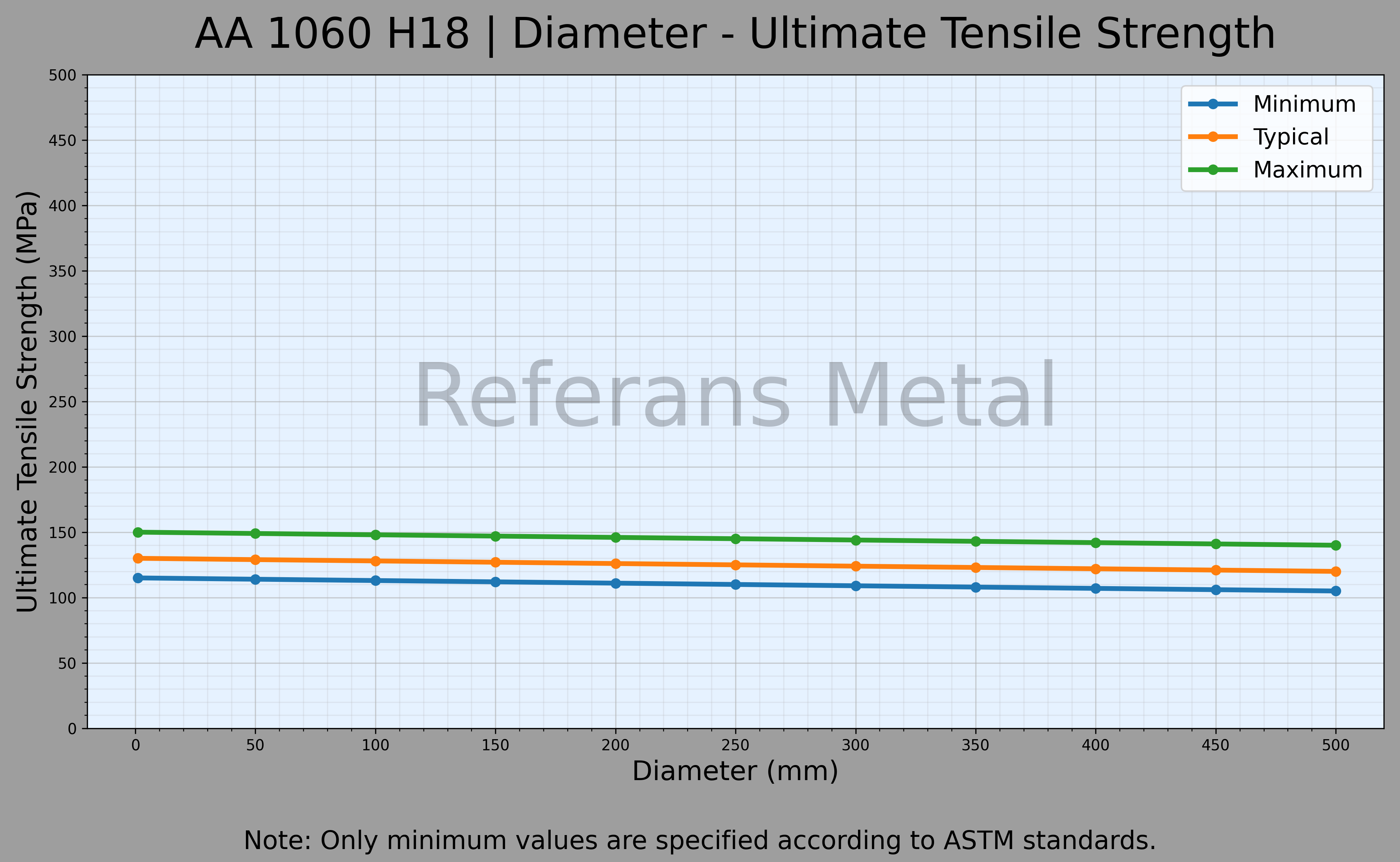
| 1060 H18 Diameter – Ultimate Tensile Strength Graph |
 |
The 1060 H18 aluminum alloy belongs to the 1xxx series of high-purity aluminum alloys and contains approximately 99.6% aluminum. The “H18” temper indicates that the material is strain hardened to a full hard condition through cold working. This temper significantly increases the strength of the alloy while reducing its ductility to some extent. The alloy is known for its excellent corrosion resistance, high electrical and thermal conductivity, and good surface quality. It performs well in atmospheric environments and can provide long-term durability in many industrial applications.
The mechanical strength of 1060 H18 is higher than that of annealed alloys such as 1050 O, since cold working increases hardness and strength. However, in this temper condition, formability and bending capability are more limited. For example, annealed alloys like 1050 O or 1100 O offer better formability, while 1060 H18 provides higher surface hardness and strength. In comparison, the 3003 alloy can offer higher structural strength due to its manganese content.
In terms of machinability, the 1060 H18 alloy generally shows moderate machinability. Because of its high aluminum purity, chip formation and chip breaking can sometimes be difficult during machining. For high-precision machining applications, alloys such as 2011 or 2007, which are known for their excellent machinability, may be more suitable. However, 1060 H18 performs well in applications where surface quality is an important requirement.
The alloy also provides good weldability and excellent surface finishing capability. It can be welded using common methods such as TIG and MIG welding, and its surface is suitable for anodizing, painting, and other coating processes. In terms of vibration behavior, its relatively pure aluminum structure can absorb and damp certain vibration energies, although for applications requiring higher structural strength, alloys such as 5052 or 6061 are typically preferred.
Due to these characteristics, the 1060 H18 aluminum alloy is widely used in electrical conductors, lighting reflectors, decorative panels, sheet and foil products, chemical equipment, and packaging industries. Its good corrosion resistance and excellent surface quality also make it suitable for architectural applications. However, for applications requiring higher mechanical strength, such as aerospace or structural engineering, alloys like 2024, 6061, or 7075 are generally preferred.
MATERIAL COMPOSITION STANDARDS
1060 H18 is available in the following standards.
• 1060 H18 Sheet; ASTM B209, UNS A91060, ISO Al99.6
Typical Properties of 1060 H18:
- Strength: Moderate
- Machinability: Low
- Weldability: Very Good
- Formability: High
- Corrosion Resistance: High
- Heat Treatment: Yes
Well-known Applications of 1060 H18:
Used in beverage containers in the food industry,
Billboard frames,
Also used in tank wagons in railways.
STOCK
We manufacture/supply 1060 H18 in sheet form.
- Sheet
 Weight Calculator