
 AS 9100
 SPACE 2009
 AS 9120




Plates
Sheets
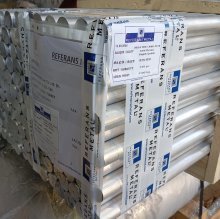
Rod/Round Bar/Flat Bar
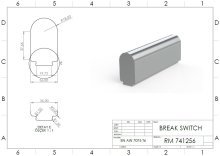
Tube/Extrusions/Profile
2033
ASME SB211 / AW-2033 / 2033 / T3
| Chemical Properties | % Value |
| Silicon (Si) | 0,10 - 1,20 |
| Chromium (Cr) | 0,00 - 0,15 |
| Manganese (Mn) | 0,40 - 1,00 |
| Magnesium (Mg) | 0,20 - 0,60 |
| Copper (Cu) | 2,20 - 2,70 |
| Titanium (Ti) | 0,00 - 0,10 |
| Iron (Fe) | 0,00 - 0,50 |
| Zinc (Zn) | 0,00 - 0,50 |
| Aluminium (Al) | Balance |
| Nickel (Ni) | 0,00 - 0,15 |
| Physical Properties | Value |
| Density | 2.77 g/cm³ |
| Melting Point | 502 °C |
| Thermal Expansion | 22,9 µm/m.°C |
| Modulus of Elasticity | 70 GPa |
| Thermal Conductivity | 151 W/m.K |
| Electrical Resistivity | 0,046 Ωmm² /m |
| Mechanical Properties | Value |
| Yield Strength | 230 MPa |
| Ultimate Strength | 355 MPa |
| Shear Strength | 283 MPa |
| Elongation A50 mm | 8% |
| Hardness | 100 HB |
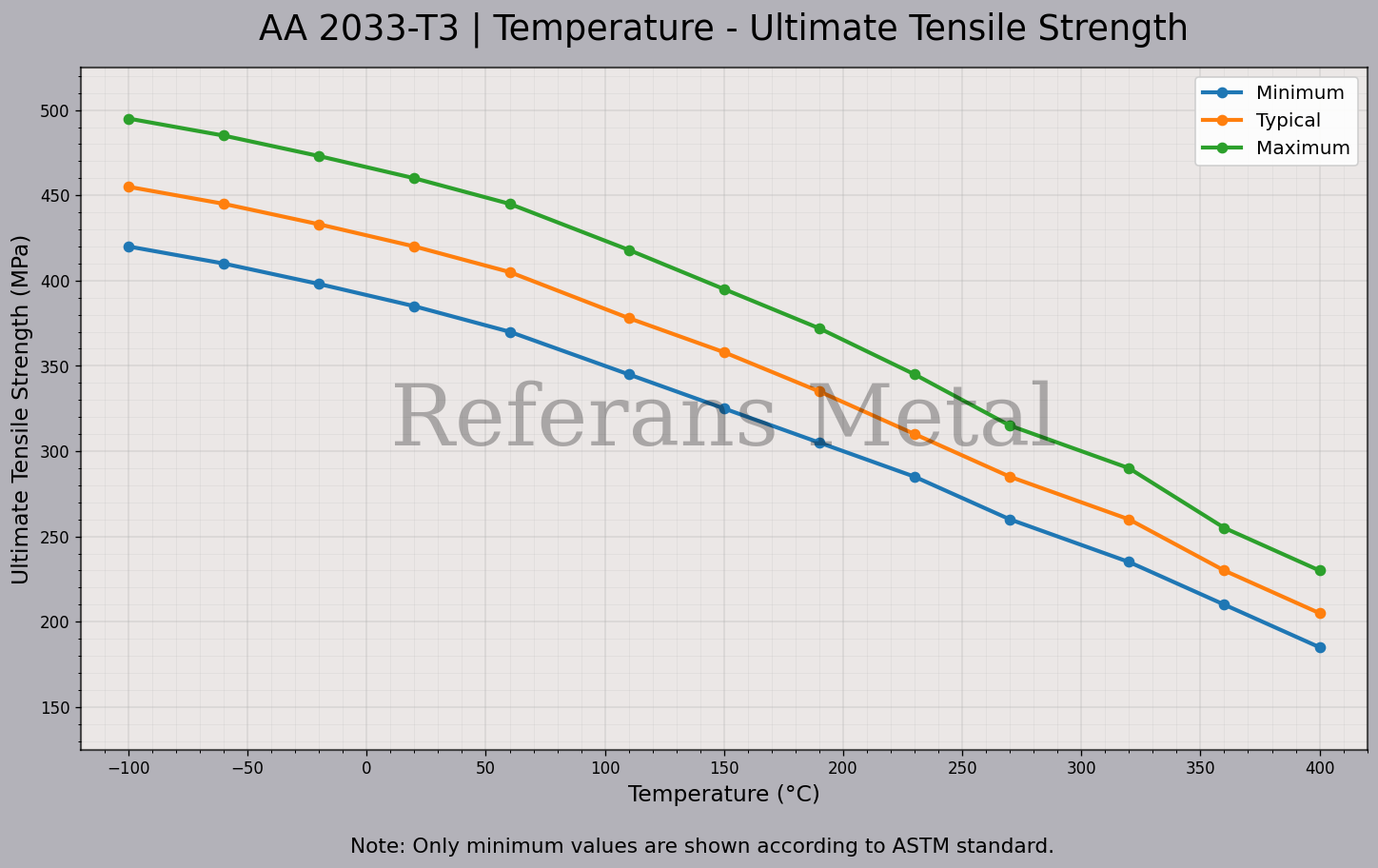
| 2033 T3 Temperature – Ultimate Tensile Strength Graph |
 |
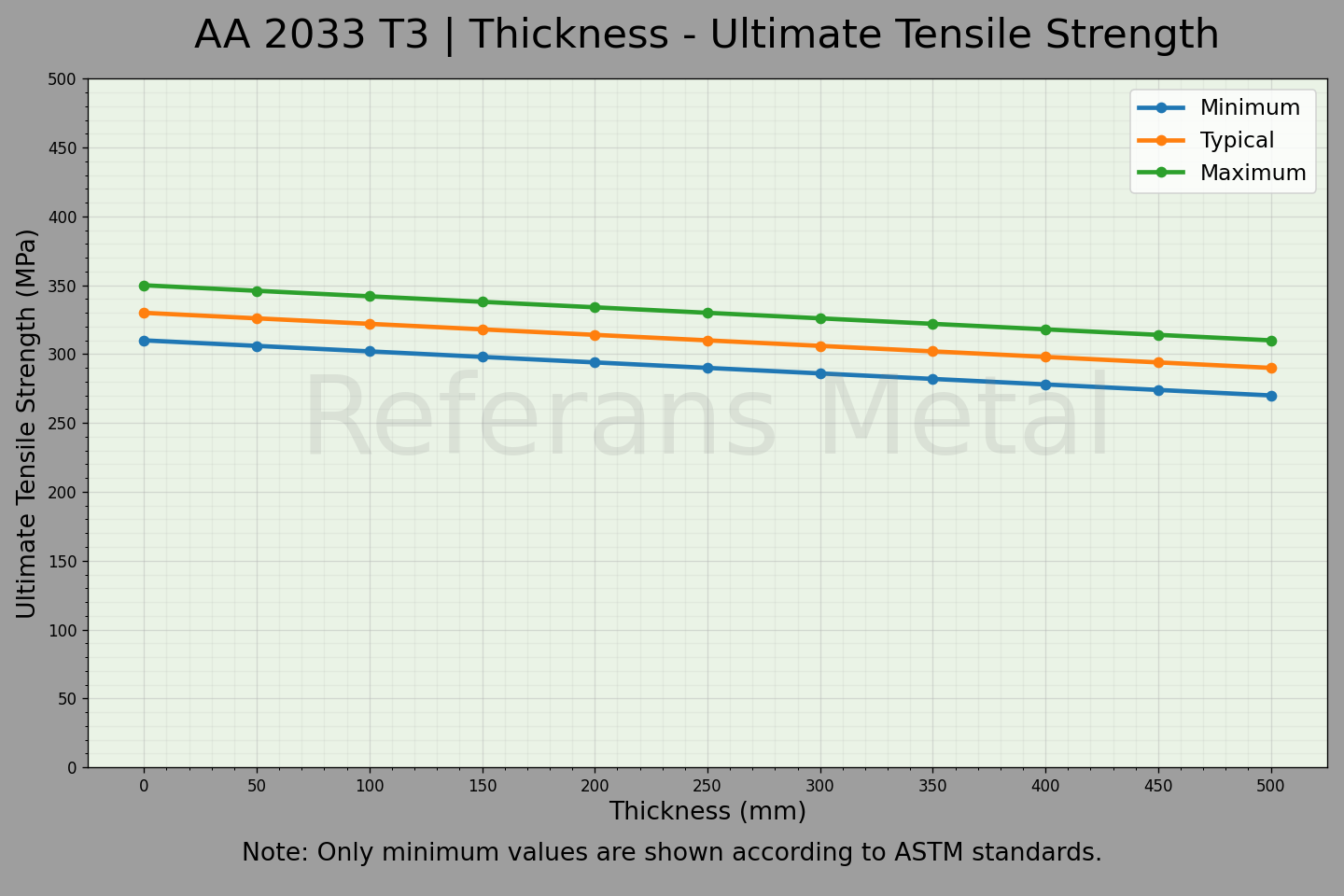
| 2033 T3 Thickness – Ultimate Tensile Strength Graph |
 |
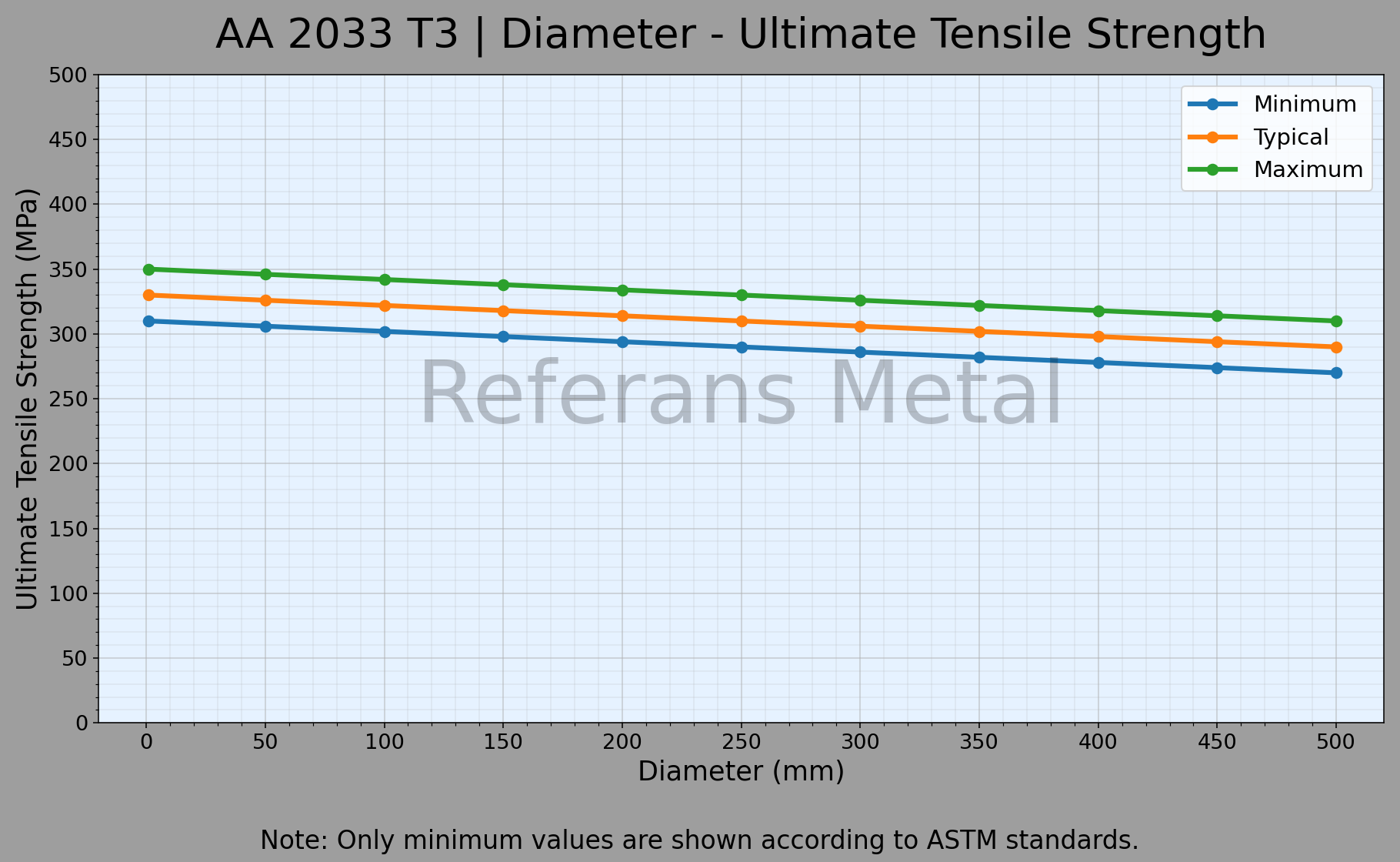
| 2033 T3 Diameter – Ultimate Tensile Strength Graph |
 |
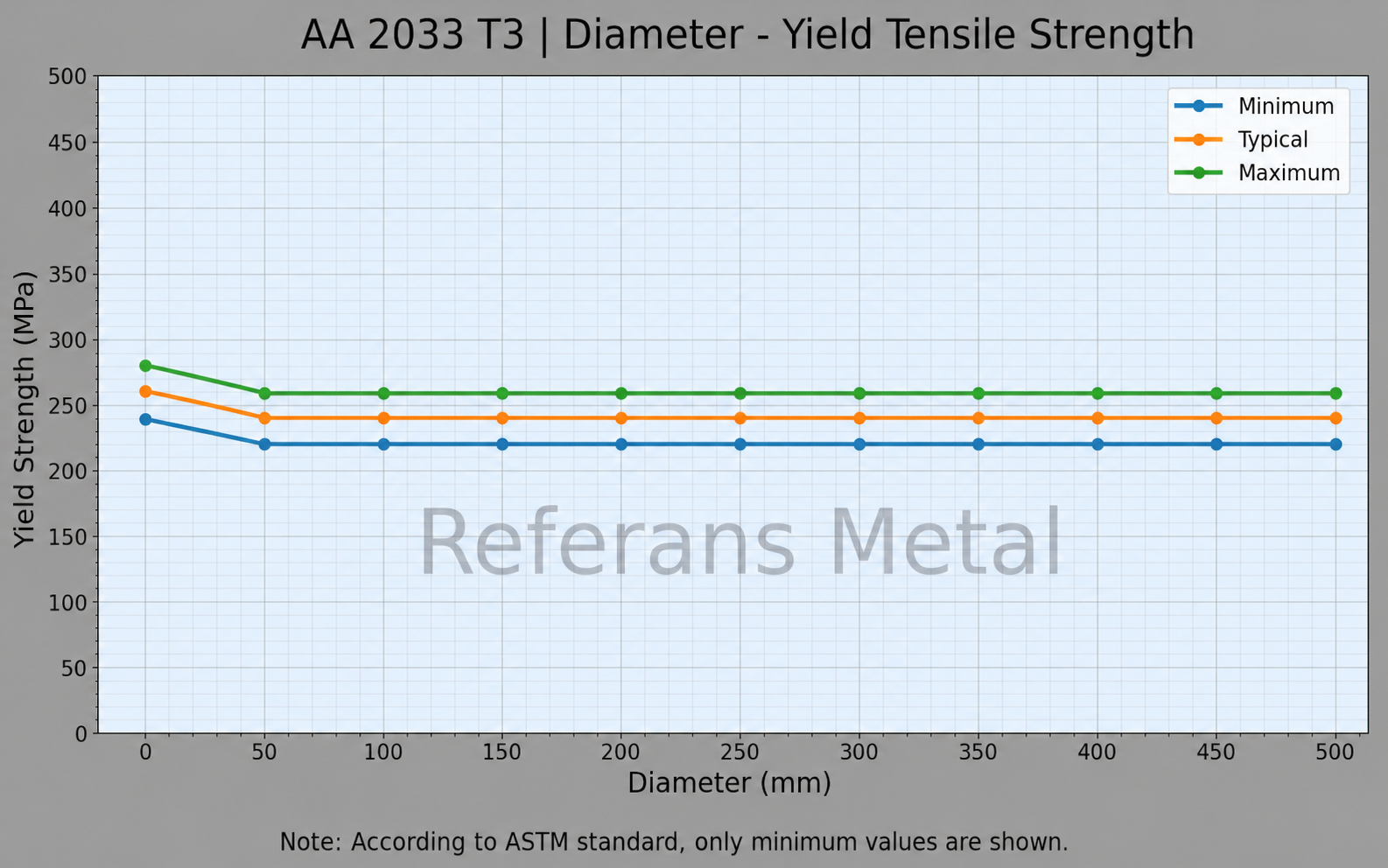
| 2033 T3 Diameter-Yield Tensile Strength |
 |
The 2033-T3 aluminum alloy belongs to the Al-Cu (aluminum-copper) series and is a material that offers high strength and good fatigue resistance. This alloy is particularly preferred in the aerospace and defense industries. The T3 temper refers to a stress-relieved structure after solution heat treatment and natural aging processes. In this way, the alloy provides both high mechanical performance and dimensional stability.
Corrosion resistance of the 2033-T3 alloy is at a moderate level and requires protective coating especially in marine environments. Compared to.png) the 6061 alloy, its corrosion resistance is lower, but it is at a similar level to the 2024 alloy. In terms of coatability, surface durability can be increased by anodizing and alclad coating methods. This feature provides a critical advantage, especially for use in outdoor conditions.
the 6061 alloy, its corrosion resistance is lower, but it is at a similar level to the 2024 alloy. In terms of coatability, surface durability can be increased by anodizing and alclad coating methods. This feature provides a critical advantage, especially for use in outdoor conditions.
In terms of strength, the 2033-T3 alloy offers lower strength compared to the 7075 alloy, but significantly higher strength than the 6061 alloy. This makes it ideal for applications that carry high loads but do not require excessive brittleness. Its fatigue resistance is also quite good and it performs reliably in structures operating under vibration.
Machinability and bending properties provide a balanced structure in the 2033-T3 alloy. Although its machinability is lower than the 2011 alloy, it can be machined while maintaining structural integrity. Its bending capability is limited, and large deformations are generally not recommended in the T3 temper. Weldability is low, and riveting or mechanical fastening methods are mostly preferred.
Applications include aircraft fuselage components, load-bearing structures, automotive performance parts, and defense industry components. Thanks to its vibration damping capability, it provides advantages in environments with high dynamic loads. It is preferred as an alternative to 2024 and 7075 alloys in applications requiring a balance of strength and machinability.
MATERIAL COMPOSITION STANDARDS
2033 T3 is available according to the following standards.
• 2033 T3 Cold Drawn Round Bar; 2000/53/EU(ELV)-2018/740/EU(RoHS II), UNS A92033, ASTM B211
• 2033 T3 Cold Drawn Flat Bar; 2000/53/EU(ELV)-2018/740/EU(RoHS II), UNS A92033, ASTM B211
• 2033 T3 Cold Drawn Tube; 2000/53/EU(ELV)-2018/740/EU(RoHS II), UNS A92033, ASTM B210
Characteristic Properties of 2033 T3:
- Strength: Very good
- Machinability: Very good
- Weldability: Average
- Formability: High
- Corrosion Resistance: Low
- Heat Treatment: Yes
Some Known Applications for 2033 T3:
In the automotive industry,
In precision machine parts,
In the production of screws and bolts.
STOCK
2033 T3 is supplied in round bar / flat bar and tube / profile forms.
- Round Bar / Flat Bar
- Tube / Profile
| Mechanical Properties | |||
| Thickness (mm) | Yield Strength (Min.) | Ultimate Strength (Min.) | Elongation A50 mm % |
| Over 2,5 up to & incl. 30,00 mm | 240 MPa | 370 MPa | 7% |
| Over 30 up to & incl. 80,00 mm | 220 MPa | 340 MPa | 7% |
 Weight Calculator