
 AS 9100
 SPACE 2009
 AS 9120




Plates
Sheets
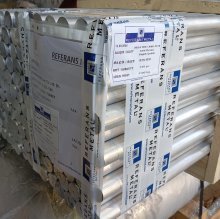
Rod/Round Bar/Flat Bar
Tube/Extrusions/Profile
2033
ASTM B210 / AW-2033 / 2033 / T8
| Chemical Properties | % Value |
| Silicon (Si) | 0,10 - 1,20 |
| Chromium (Cr) | 0,00 - 0,15 |
| Manganese (Mn) | 0,40 - 1,00 |
| Magnesium (Mg) | 0,20 - 0,60 |
| Copper (Cu) | 2,20 - 2,70 |
| Titanium (Ti) | 0,00 - 0,20 |
| Iron (Fe) | 0,00 - 0,70 |
| Zinc (Zn) | 0,00 - 0,50 |
| Aluminium (Al) | Balance |
| Nickel (Ni) | 0,00 - 0,15 |
| Physical Properties | Value |
| Density | 2.78 g/cm³ |
| Melting Point | 502 °C |
| Thermal Expansion | 22.9 µm/m.°C |
| Modulus of Elasticity | 73.1 GPa |
| Thermal Conductivity | 173 W/m.K |
| Electrical Resistivity | 0,046 Ωmm² /m |
| Mechanical Properties | Value |
| Yield Strength | 370 MPa |
| Ultimate Strength | 370 MPa |
| Shear Strength | 240 MPa |
| Elongation A50 mm | 8% |
| Hardness | 95 HB |
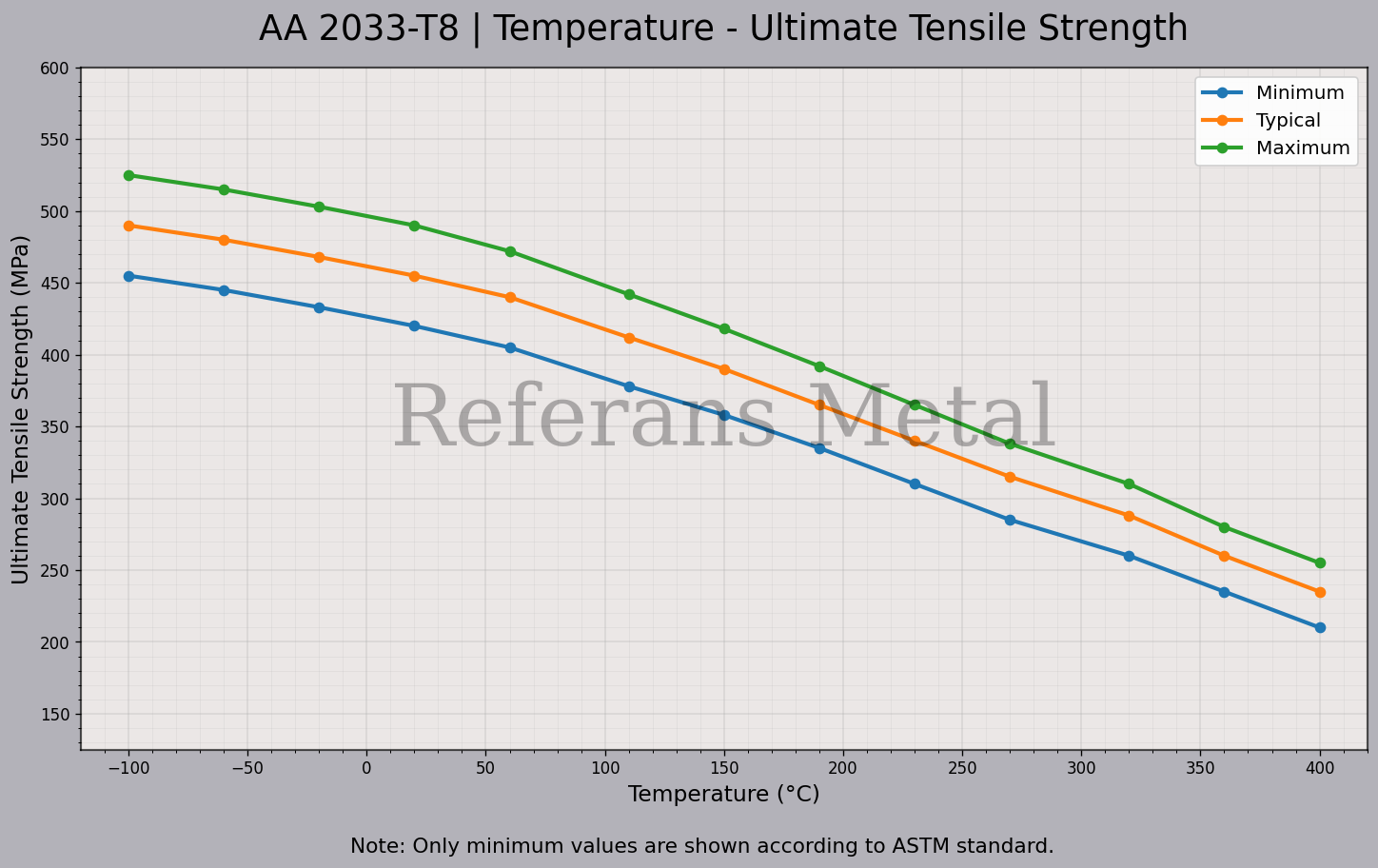
| 2033 T8 Temperature – Ultimate Tensile Strength Graph |
 |
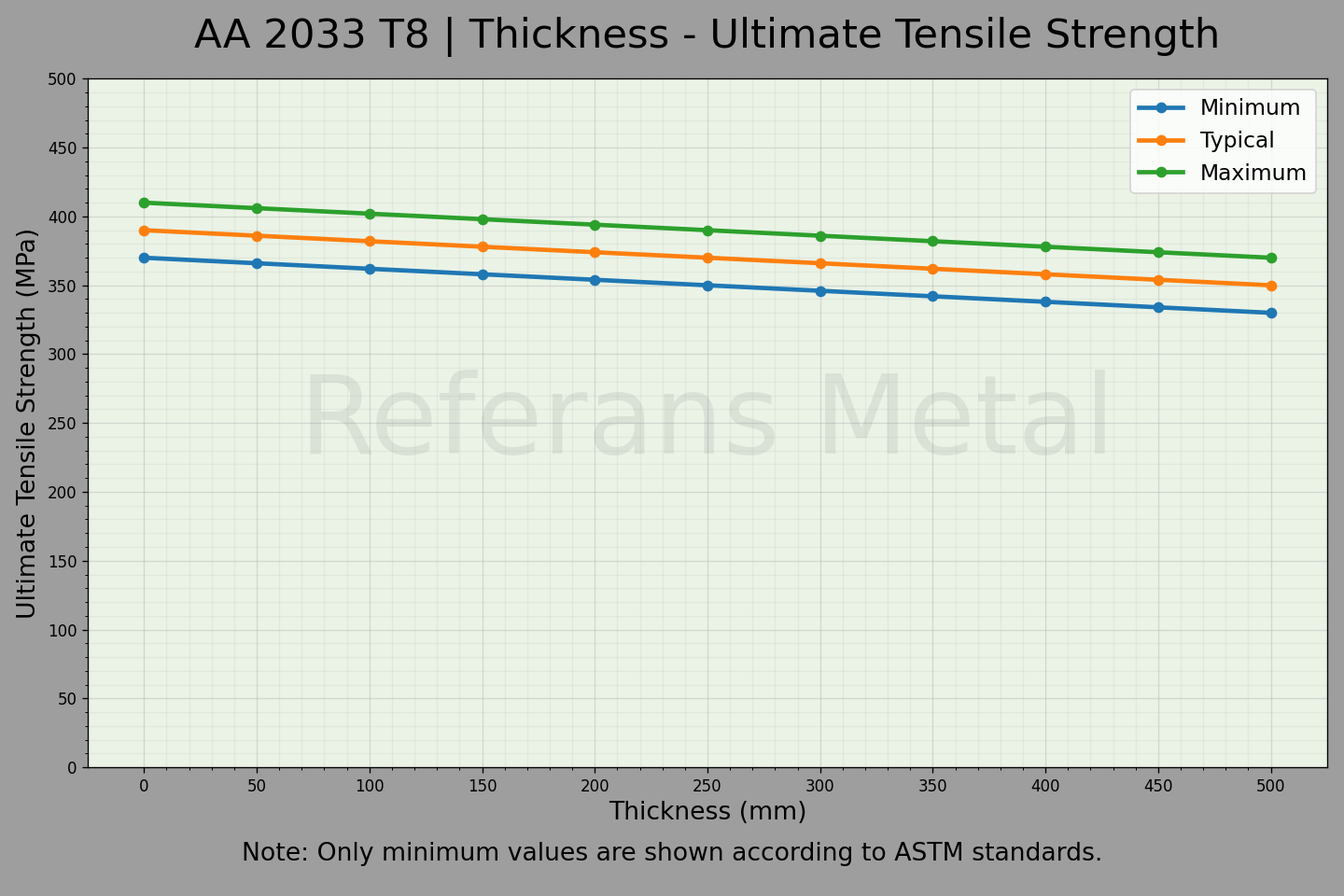
| 2033 T8 Thickness – Ultimate Tensile Strength Graph |
 |
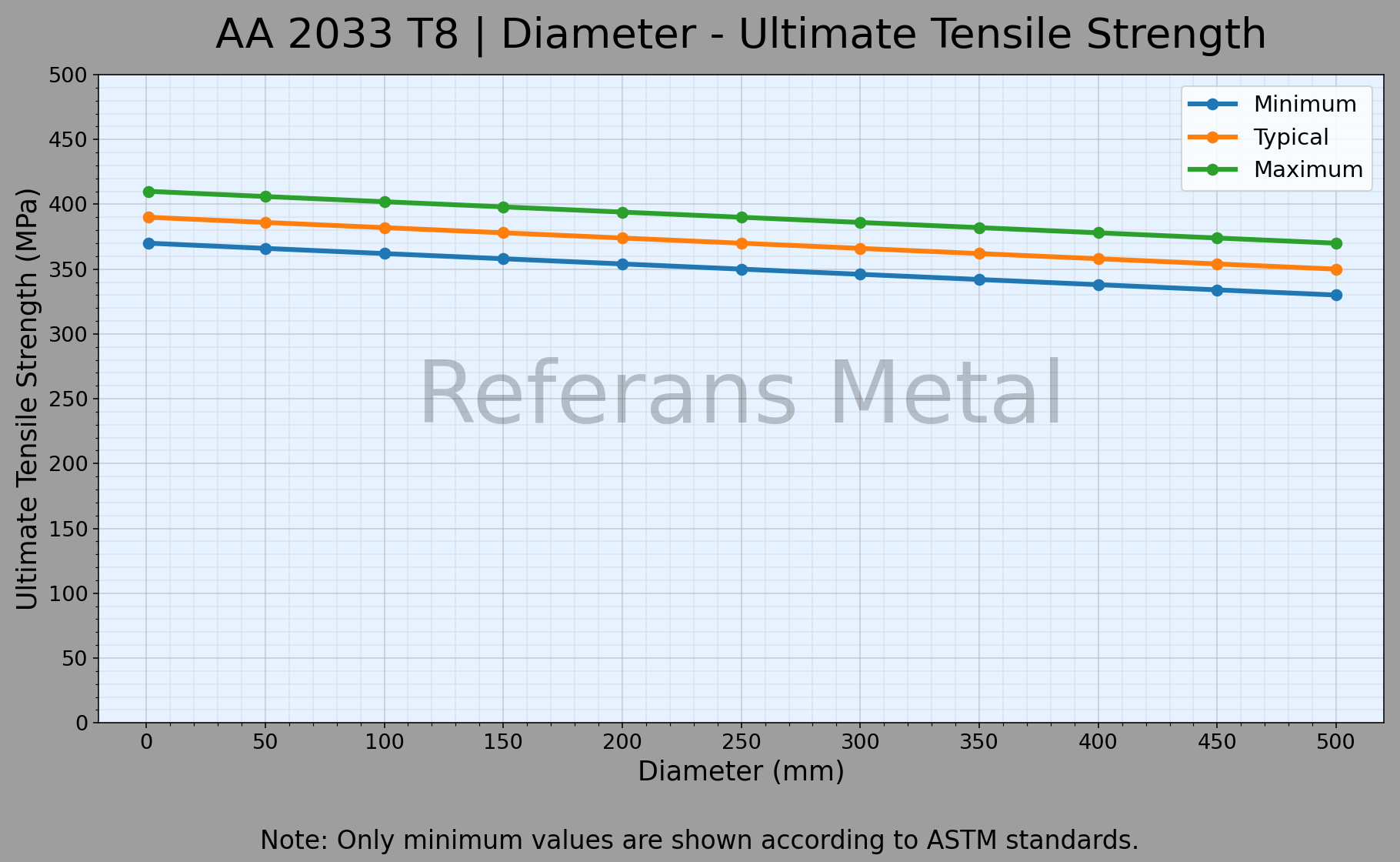
| 2033 T8 Diameter – Ultimate Tensile Strength Graph |
 |
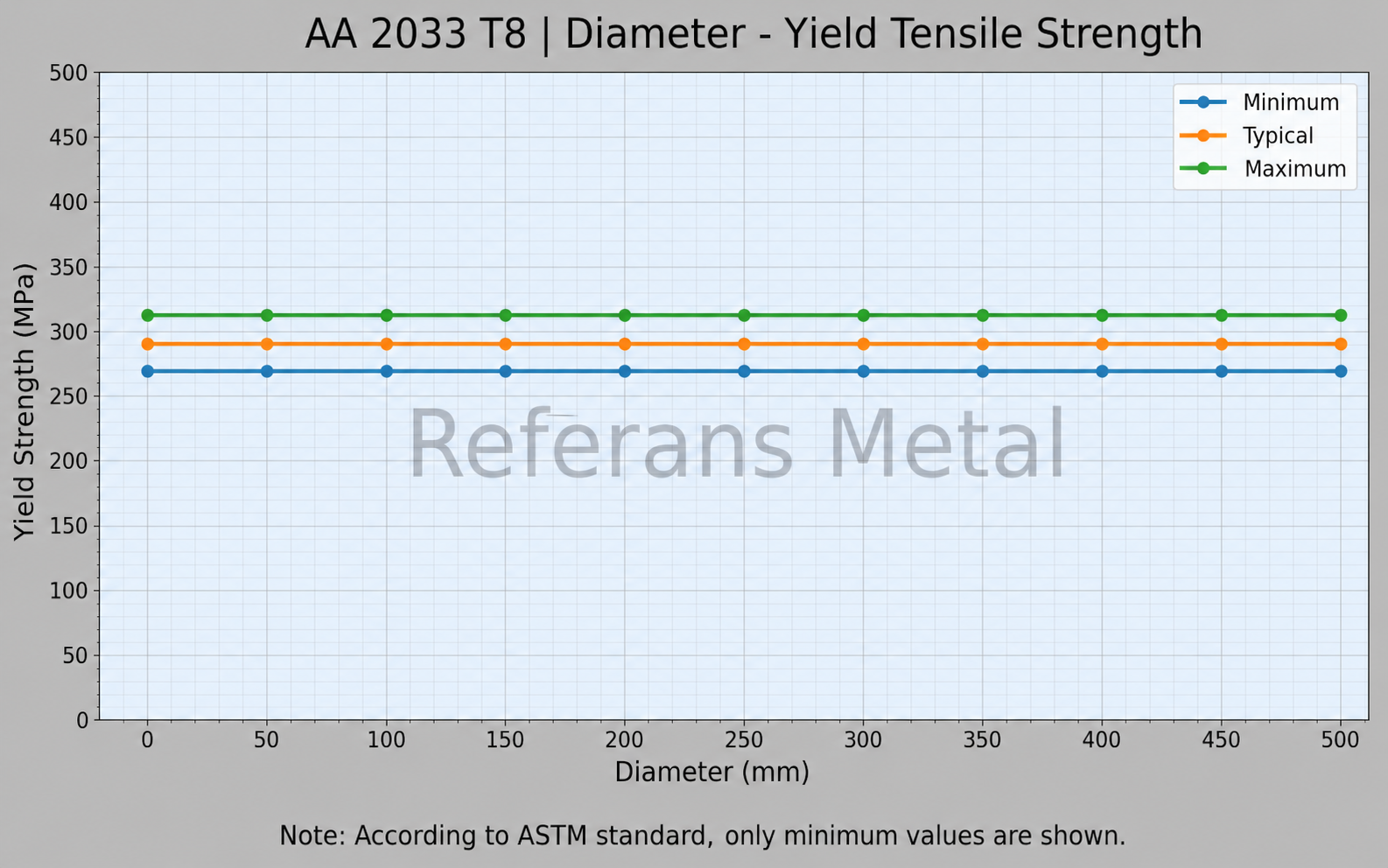
| 2033 T8 Diameter-Yield Tensile Strength |
 |
2033 T8 aluminum alloy is a copper-based (2xxx series) alloy specifically developed for applications requiring high strength. The T8 temper is achieved through a combination of solution heat treatment, cold working, and artificial aging, which maximizes the mechanical properties of the alloy. This alloy stands out with its high tensile and yield strength and is commonly used in critical sectors such as aerospace, defense, and automotive industries. However, despite its high strength, its corrosion resistance is lower compared to 5xxx and 6xxx series alloys, so it often requires surface protection such as coatings or anodizing.
The 2033 T8 alloy provides high strength and fatigue resistance, ensuring reliable performance under dynamic loading conditions. Its stable behavior under vibration makes it ideal for aircraft structural components and high-performance mechanical parts. Compared to 2024 and 2014 alloys, it offers similar strength levels while providing improved machinability in certain cases. Although its strength is slightly lower than 7075, it can offer a more balanced performance in terms of toughness and machinability.
In terms of machinability, 2033 T8 has good chip removal characteristics, allowing high surface quality in CNC machining processes. Compared to 6061 alloy, it offers higher strength while maintaining similar ease of machining. However, its bending and forming capability is limited due to the T8 temper, so forming operations are usually performed before aging. Alloys like 5052 have superior formability, but 2033 T8 provides significantly higher strength.
Regarding corrosion resistance, the 2033 T8 alloy is sensitive due to its copper content, especially in humid and aggressive environments. Therefore, it is typically protected through cladding, painting, or anodizing. It has good coating compatibility when proper surface preparation is applied. Weldability is limited, as with other 2xxx series alloys, due to the risk of cracking after welding. Therefore, mechanical fastening methods such as riveting and bolting are more commonly used.
Applications of this alloy include aerospace structural components, high-performance automotive parts, defense equipment, and precision machinery components. It is especially preferred in applications requiring a high strength-to-weight ratio. Compared to 6061, it offers higher strength, while compared to 7075, it may provide better machinability and toughness. Although it shares similar applications with 2024, it can offer optimized performance in certain cases. These characteristics make 2033 T8 an important alternative material in engineering applications.
ALLOY DESIGNATIONS
The 2033 T8 aluminum alloy shows similarities with the following standard definitions and specifications:
• 2033 T8 Cold Drawn Round Bar; 2000/53/EU(ELV)-2018/740/EU(RoHS II), UNS A92033, ASTM B211
• 2033 T8 Cold Drawn Tube; 2000/53/EU(ELV)-2018/740/EU(RoHS II), UNS A92033, ASTM B210
Selection Factors for 2033 T8
- Strength: Very good
- Machinability: Excellent
- Weldability: Moderate
- Formability: Acceptable
- Corrosion Resistance: Low
- Heat Treatment: Yes
Some Known Applications of 2033 T8
In gas cylinders,
In electrical and electronic components,
Also used in the production of bolts and nuts.
AVAILABLE FORMS
2033 T8 is supplied in flat/round bar and tube/profile forms.
- Flat/round bar
- Tube/profile
| Mechanical Properties | |||
| Thickness (mm) | Yield Strength (Min.) | Ultimate Strength (Min.) | Elongation A50 mm % |
| over 0,2 up to & incl. 0,25 mm | 290 | 435 | 10% - 15% |
| over 0,25 up to & incl. 0,35 mm | 305 | 441 | 10% - 15% |
| over 0,35 up to & incl. 0,65 mm | 311 | 443 | 10% - 15% |
| over 3,28 up to & incl. 6,32 mm | 330 | 450 | ≥15% |
| over 6,35 up to & incl. 12,7 mm | 290 | 440 | ≥15% |
 Weight Calculator