• Plates

  • Sheets

  • Rod/Round Bar/Flat Bar

  • Tube/Extrusions/Profile

7475

AMS 4202 / AlZn5.5MgCu / 7475 / T7351

Chemical Properties % Value
Silicon (Si)0,00 - 0,10
Chromium (Cr)0,18 - 0,25
Manganese (Mn)0,00 - 0,06
Magnesium (Mg)1,90 - 2,60
Copper (Cu)1,20 - 1,90
Titanium (Ti)0,00 - 0,06
Iron (Fe)0,00 - 0,12
Zinc (Zn)5,20 - 6,20
Aluminium (Al)Balance
Physical Properties Value
Density2,81 g/cm³
Melting Point477 °C
Thermal Expansion23 µm/m.°C
Modulus of Elasticity71,7 GPa
Thermal Conductivity163 W/m.K
Electrical Resistivity%42 IACS
Mechanical Properties Value
Proof Strength425 MPa
Yield Strength510 MPa
Shear Strength300 MPa
Elongation A50 mm12%
Hardness135 HB
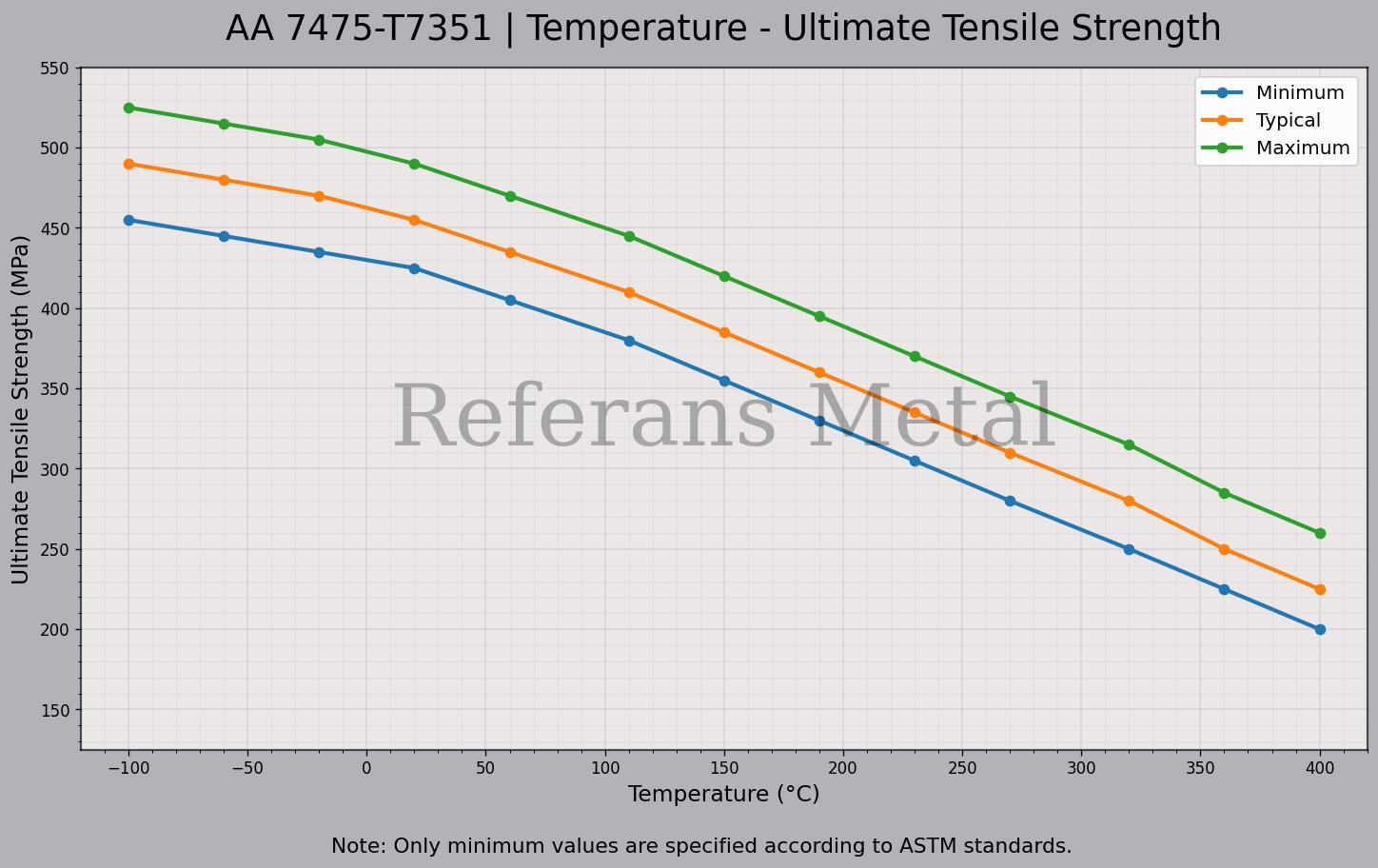
7475 T7351 Temperature – Ultimate Tensile Strength Graph
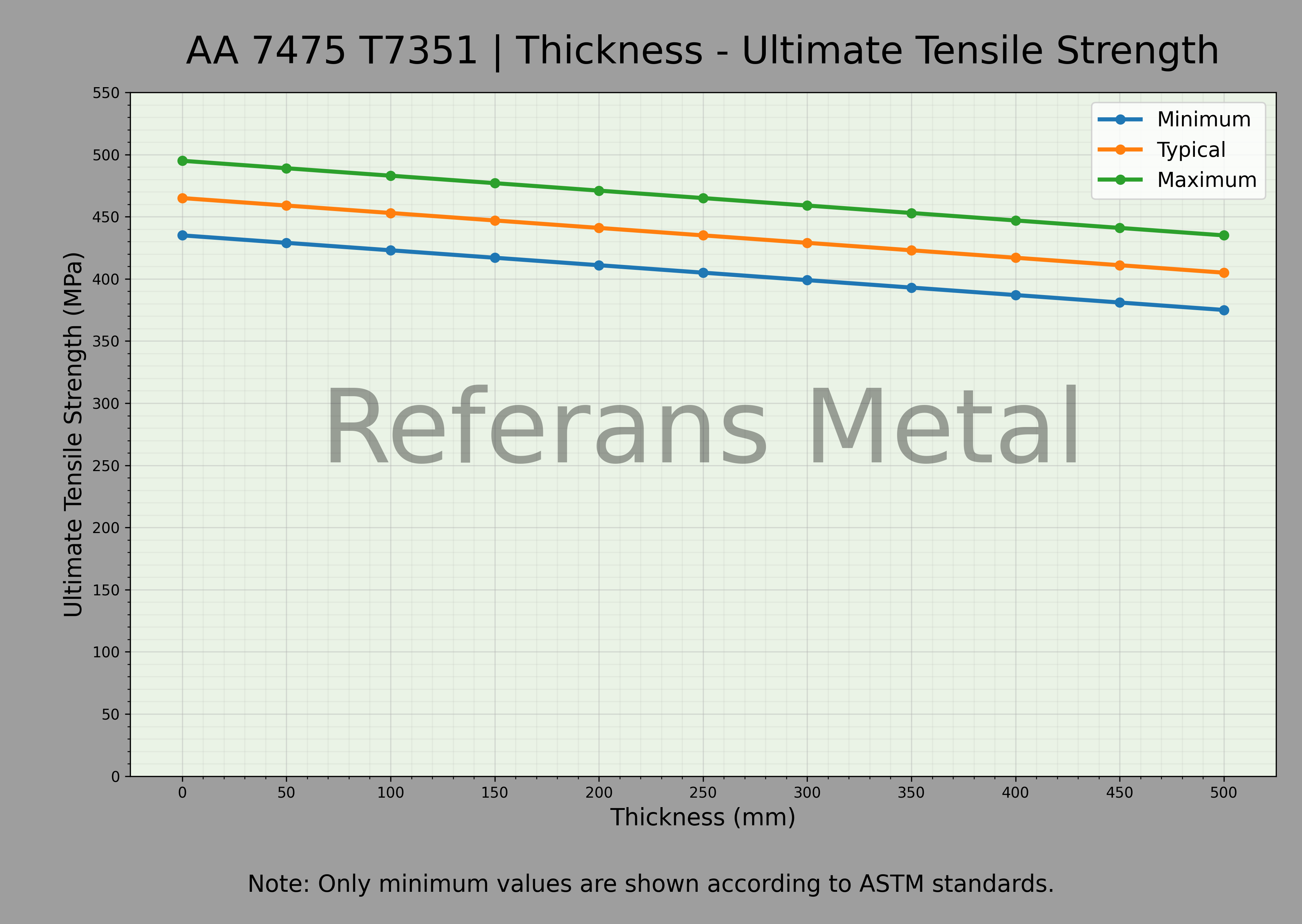
7475 T7351 Thickness – Ultimate Tensile Strength Graph
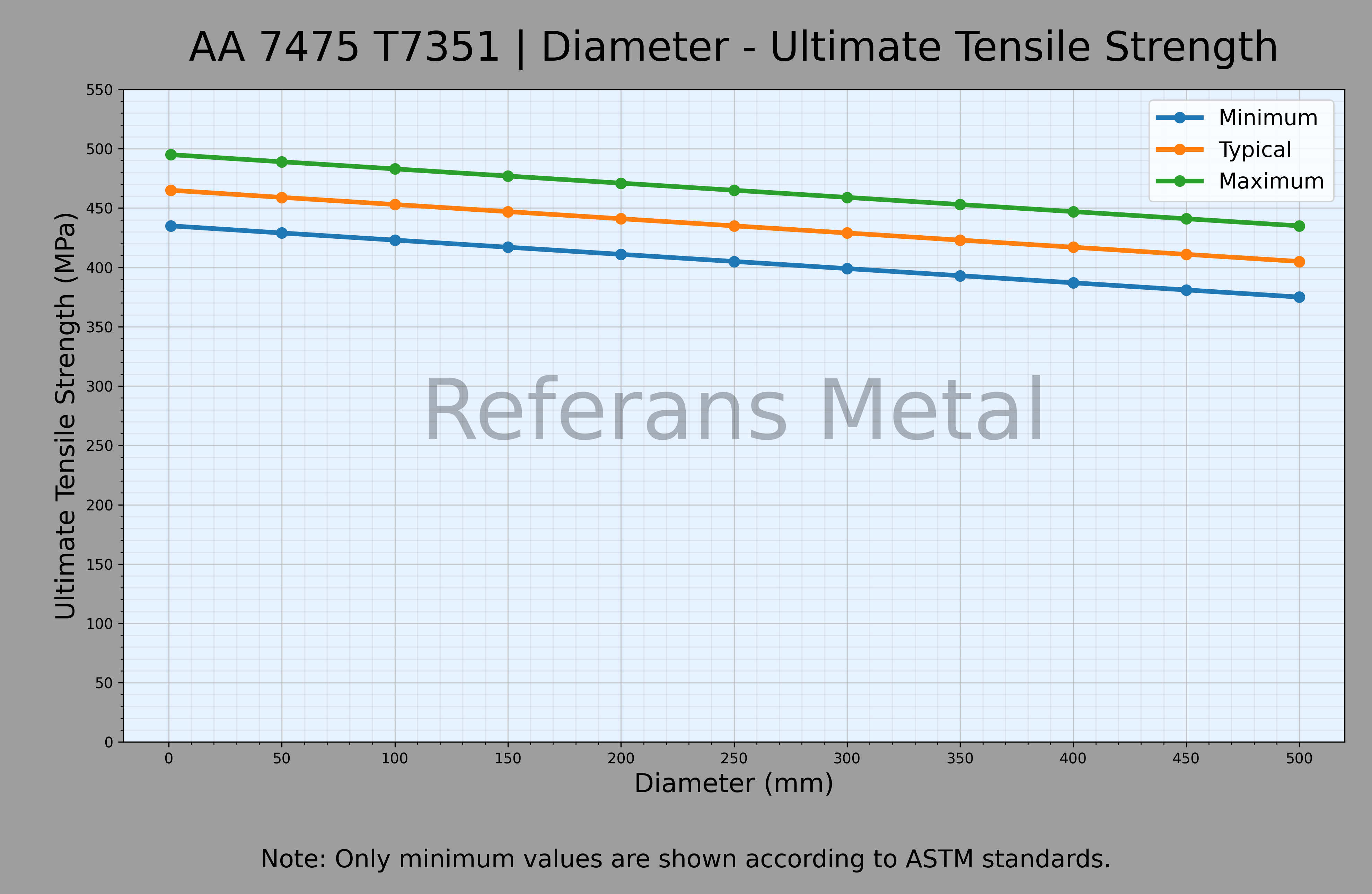
7475 T7351 Diameter – Ultimate Tensile Strength Graph
Print

7475 T7351 aluminum alloy is a zinc-based 7xxx series aluminum alloy developed for engineering applications requiring high strength and improved damage tolerance. The T7351 temper indicates that the alloy has undergone stress relief and over-aging treatments, which enhance resistance to stress corrosion cracking while maintaining stable mechanical properties. The alloy exhibits very high tensile strength and is therefore widely preferred in structural components in the aerospace industry. Although it has strength levels similar to 7075, the 7475 alloy provides higher fracture toughness and better resistance to crack propagation.

In terms of corrosion resistance, the 7475 T7351 alloy demonstrates improved performance especially against stress corrosion cracking. Compared with higher strength tempers such as 7075-T6, the T7351 temper behaves more reliably in corrosive environments. However, its general corrosion resistance is slightly lower than magnesium-silicon alloys such as 6061, and therefore surface protection methods are commonly used in many applications. The alloy is compatible with anodizing and various surface coating processes, allowing it to be protected in long-term service environments.

Regarding machinability and manufacturing properties, the 7475 alloy offers good machinability and is frequently used in aerospace components requiring precision machining. Its bending and forming capability is limited, as is typical for high-strength 7xxx series alloys, but it can be applied under controlled conditions. Compared with the 2024 alloy, 7475 generally provides higher strength and better fracture toughness, although its formability is slightly lower. Weldability is limited, as with most 7xxx series alloys, and mechanical fastening or riveting is typically preferred instead of welding.

In terms of vibration and fatigue behavior, the 7475 T7351 alloy performs very well. Due to its high fracture toughness and resistance to fatigue crack propagation, it is considered a reliable material in structures subjected to dynamic loads. For this reason, it is widely used in aircraft wing panels, fuselage structures, high-performance aerospace components, and certain defense industry parts. Compared with the 7050 alloy, 7050 may offer better stress corrosion resistance in thick sections, whereas 7475 generally provides superior fracture toughness.

From an application perspective, the 7475 T7351 alloy is particularly preferred for critical structural components in the aerospace and aviation industries. Aircraft fuselage panels, wing skins, high-strength fasteners, and certain military system components are typical uses of this alloy. While the 6061 alloy provides better general corrosion resistance and weldability, 7475 offers significantly higher strength and fatigue resistance. Therefore, the 7475 alloy is considered an important engineering material for applications requiring high performance and safety.


MATERIAL COMPOSITION STANDARDS

EN 4457 7475 T7351 can be produced according to the following standards:
• 7475 T7351 Sheet / Plate; AIR 9048.720, 3.4384, AMS 4202 Alloy 7475, UNS A97475AlZn5.5MgCu


MINIMUM FRACTURE TOUGHNESS VALUES FOR 7475 T7351

(Fracture Toughness)

                                                        KIc: ksi√in.(MPa√m)*
Temper              Thickness                  L-T            T-L

T7351           1.250-4.000 in.       41.0 (45.0)    34.0 (37.3)
                  (31.75-101.60 mm)


Characteristic Properties for 7475 T7351: 

  • Strength: Good
  • Machinability: Medium
  • Weldability: Poor
  • Formability: Normal
  • Corrosion Resistance: High
  • Heat Treatment: Yes
     

Some Known Applications for 7475 T7351: 
Designs of steam exhaust systems operating at high temperatures.
Widely used in aerospace transportation and logistics applications.
Components in railway transportation vehicles.


STOCK
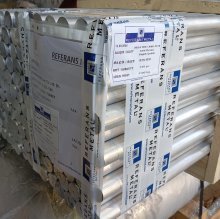
7475 T7351 is supplied in plate and sheet form.

  • Plate
  • Sheet
DELIVERY:
Mechanical Properties
Thickness (mm) Proof Strength (Min.) Yield Strength (Min.) Elongation A50 mm %
over 25.43 up to & incl. 38.10 414 MPa 490 MPa 9
over 50.83 up to & incl. 63.50 393 MPa 476 MPa 8
over 76.25 up to & incl. 88.90 365 MPa 448 MPa 8