
 AS 9100
 SPACE 2009
 AS 9120


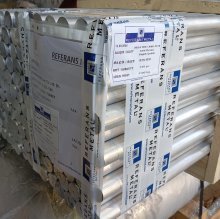

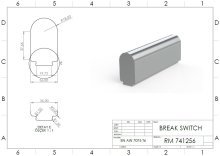

Cold Drawn Round Bar
Cold Drawn Tube
2024
Cold Drawn/Finished (CF) / AlCu4Mg1 (Soğuk Çekim) / 2024 / O
| Chemical Properties | % Value |
| Silicon (Si) | 0,00 - 0,50 |
| Chromium (Cr) | 0,00 - 0,10 |
| Manganese (Mn) | 0,30 - 0,90 |
| Magnesium (Mg) | 1,20 - 1,80 |
| Copper (Cu) | 3,80 - 4,90 |
| Titanium (Ti) | 0,00 - 0,15 |
| Iron (Fe) | 0,00 - 0,50 |
| Zinc (Zn) | 0,00 - 0,25 |
| Aluminium (Al) | Balance |
| Titanium + Zirconium (Ti+Zr) | 0,00 - 0,20 |
| Physical Properties | Value |
| Density | 2.78 g/cm³ |
| Melting Point | 502 °C |
| Thermal Expansion | 23.2 µm/m-°C |
| Modulus of Elasticity | 73.1 GPa |
| Thermal Conductivity | 193 W/m.K |
| Electrical Resistivity | 30% IACS |
| Mechanical Properties | Value |
| Yield Strength | 100 MPa |
| Ultimate Strength | 210 MPa |
| Shear Strength | 130 MPa |
| Elongation A50 mm | 15% |
| Hardness | 47 HB |
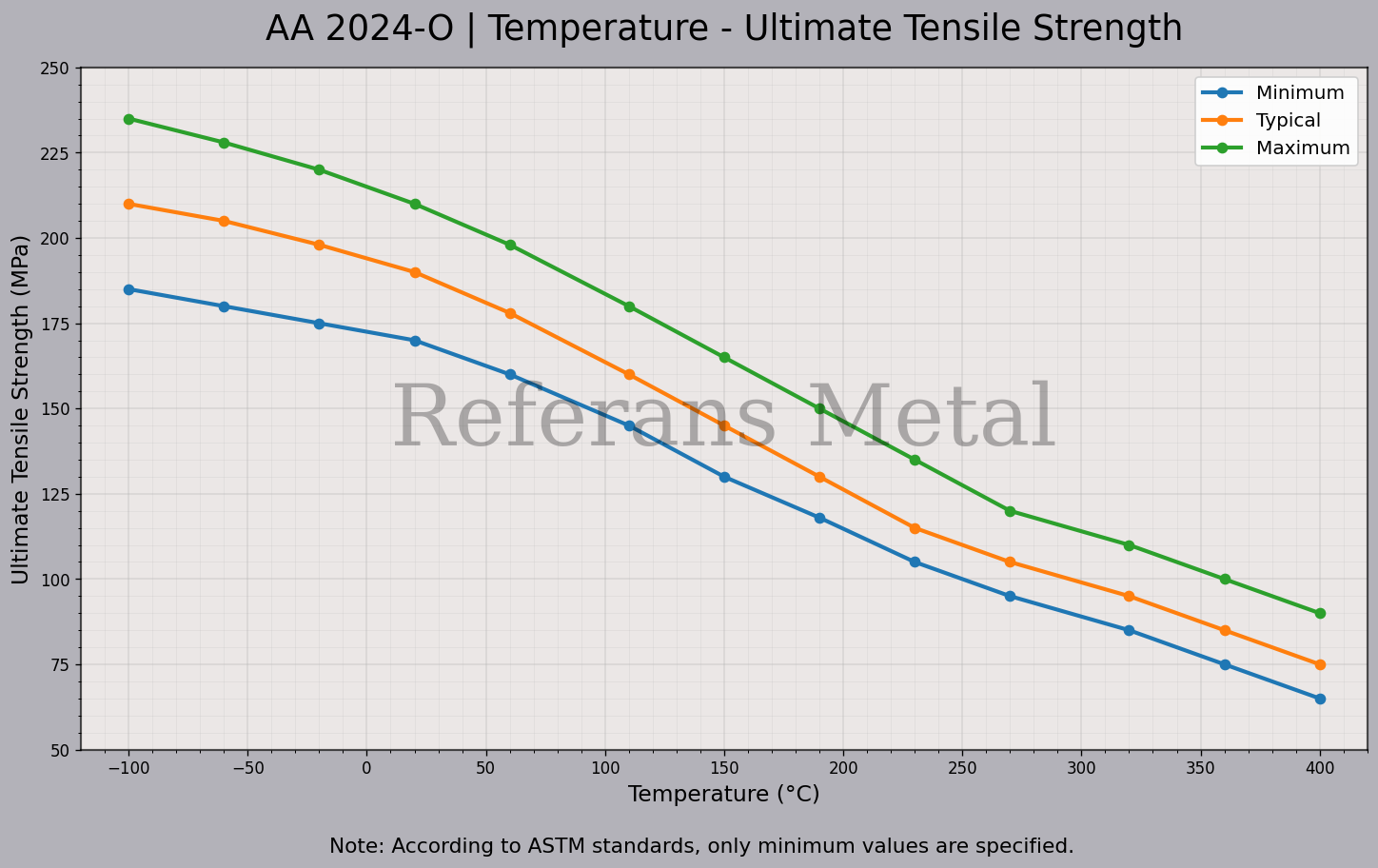
| 2024 O Temperature – Ultimate Tensile Strength Graph |
 |
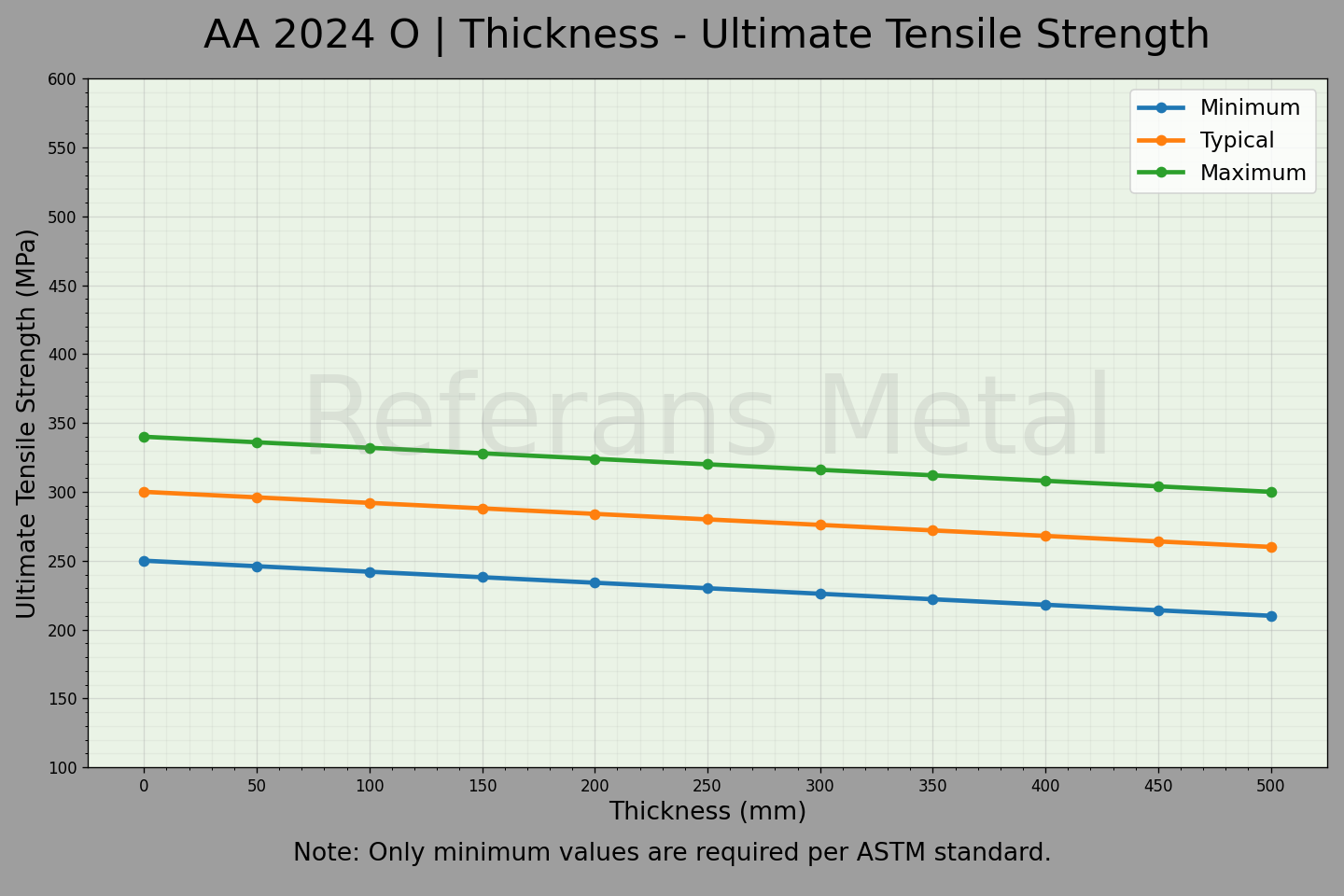
| 2024 O Thickness – Ultimate Tensile Strength Graph |
 |
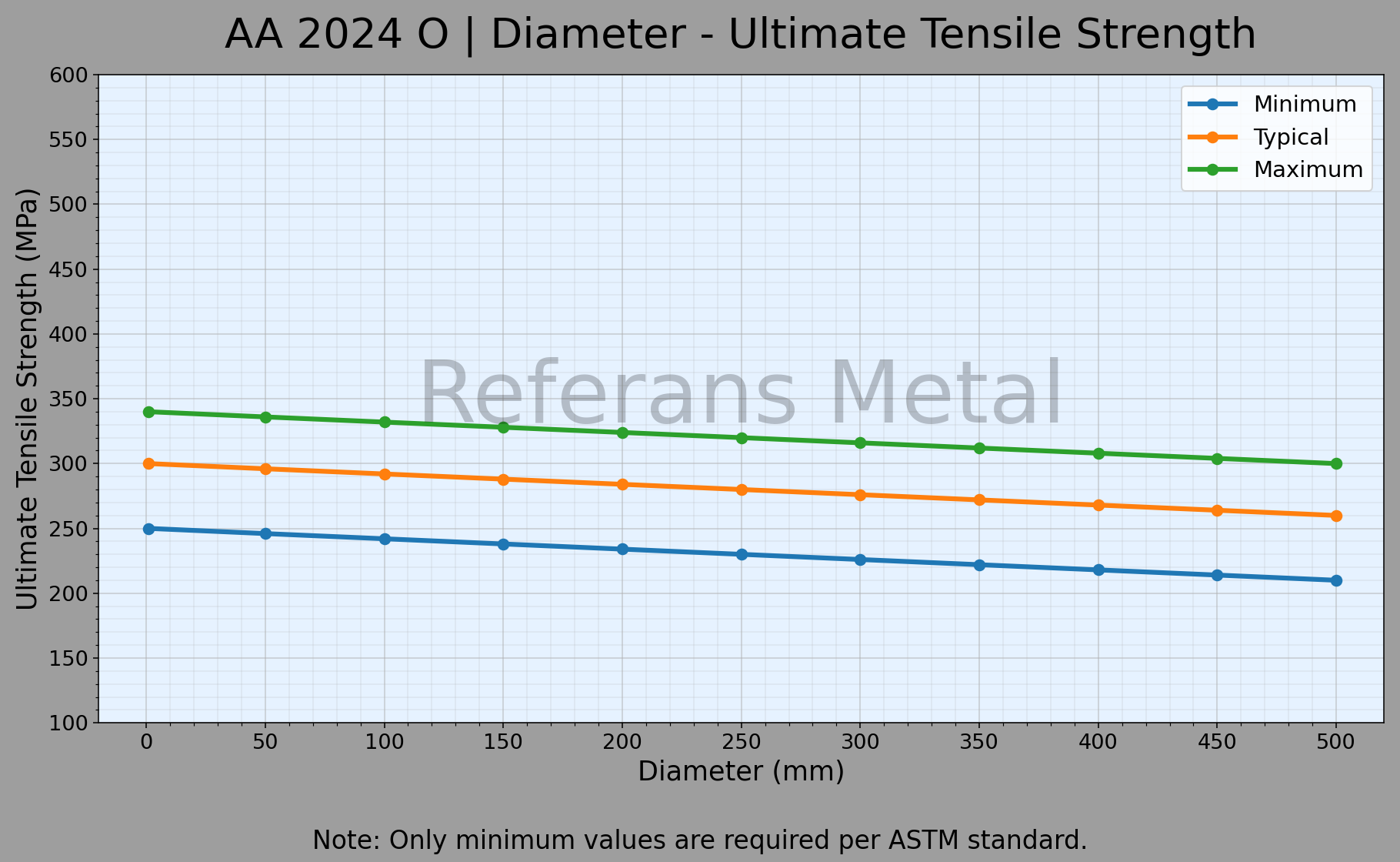
| 2024 O Diameter – Ultimate Tensile Strength Graph |
 |
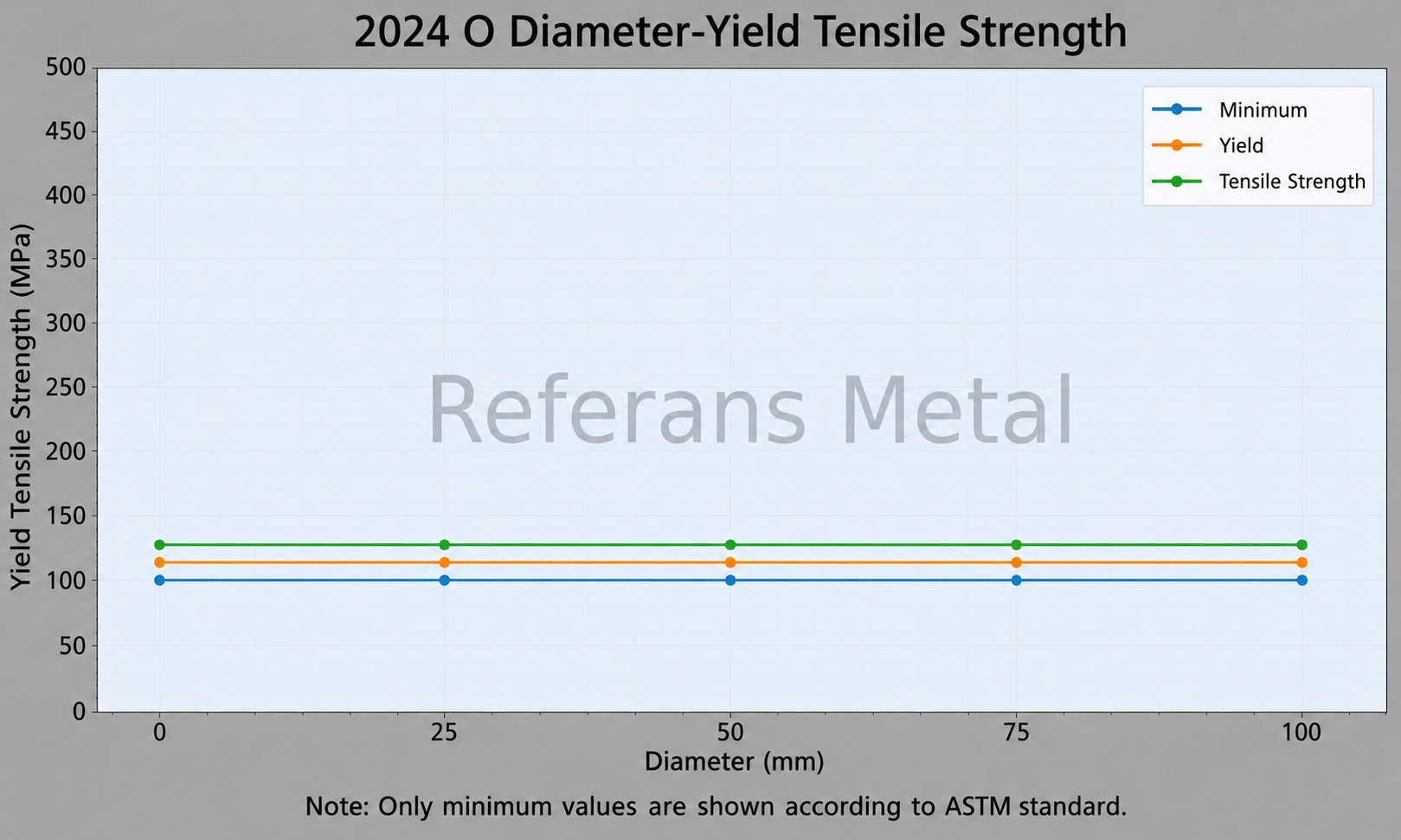
| 2024 O Diameter-Yield Tensile Strength |
 |
2024-0 aluminum alloy belongs to the Al-Cu-Mg (aluminum-copper-magnesium) system and is an engineering material preferred especially in applications requiring high strength. Thanks to the 0 temper condition (annealed state), the alloy offers maximum ductility and formability. Although its strength is relatively low in this condition, it can be significantly increased through post-processing hardening. Corrosion resistance is lower compared to pure aluminum and is generally improved by surface coating or anodizing.
In terms of strength, the 2024 alloy provides lower strength compared to 7075, but higher strength compared to 6061. This difference is more pronounced in the 0 temper because the alloy has not yet undergone precipitation hardening. Its machinability is not as high as 2011 alloy but is still at a good level. Especially after machining, good surface quality can be achieved. In terms of vibration behavior, its high-strength structure provides good fatigue resistance and stable performance under dynamic loads.
Bendability and formability are among the most important advantages of 2024-0 alloy. Since it is in an annealed condition, it can be easily shaped into complex geometries. In this respect, it offers much better formability than 2024-T3 or 2024-T4 tempers. However, due to the low mechanical properties after forming, heat treatment is usually applied afterward.
Weldability is limited for this alloy and is generally not recommended because of the high risk of cracking in the weld zone. Therefore, mechanical joining methods are preferred. In terms of claddability, it is quite suitable; especially corrosion resistance is increased with pure aluminum cladding. This feature has significantly expanded its use in the aerospace industry.
Application areas primarily include aerospace industry, automotive, defense, and high-performance structural applications. It is used in critical components such as aircraft fuselage panels, wing structures, and fasteners. Compared to 7075’s extremely high strength, 2024 offers better fatigue resistance, higher strength than 6061, and better structural performance than 2011, providing a balanced engineering solution.
STANDARDS FOR MATERIAL COMPOSITION
2024 O is available in the following standards.
• 2024 O Sheet; AMS QQ-A-250/4, AMS 4035, AIR 9048-100, WS 3.1359, ASTM B209
• 2024 O Alclad Plate; AMS QQ-A-250/5, AMS 4040, AIR 9048-130, BS L 110, WS 3.1364, ASTM B209
• 2024 O Cold Drawn Rod; WW-T-700/3, AMS 4087
Characteristic Properties of 2024 O:
- Strength: Very good
- Machinability: Good
- Weldability: Medium (Spot welding is preferred)
- Formability: Poor
- Corrosion Resistance: Moderate
- Heat Treatment: Yes
Some Well-Known Applications for 2024 O:
Used in leading edge wing coverings on airplanes,
Landing gear parts,
Internal fuselage connection elements on airplanes.
STOCK
2024 O is supplied in aluminum sheet/plate, coil, rod, strip, tube, and profile forms.
- Sheet/plate
- Coil
- Rod / Strip
- Tube / Profile
| Mechanical Properties | |||
| Thickness (mm) | Yield Strength (Min.) | Ultimate Strength (Min.) | Elongation A50 mm % |
| 0,5 mm | 109,6 MPa | 193 MPa | 12% |
| 1,5 mm | 105 MPa | 185 MPa | 20% |
| 2,0 mm | 110 MPa | 196 MPa | 20% |
 Weight Calculator