
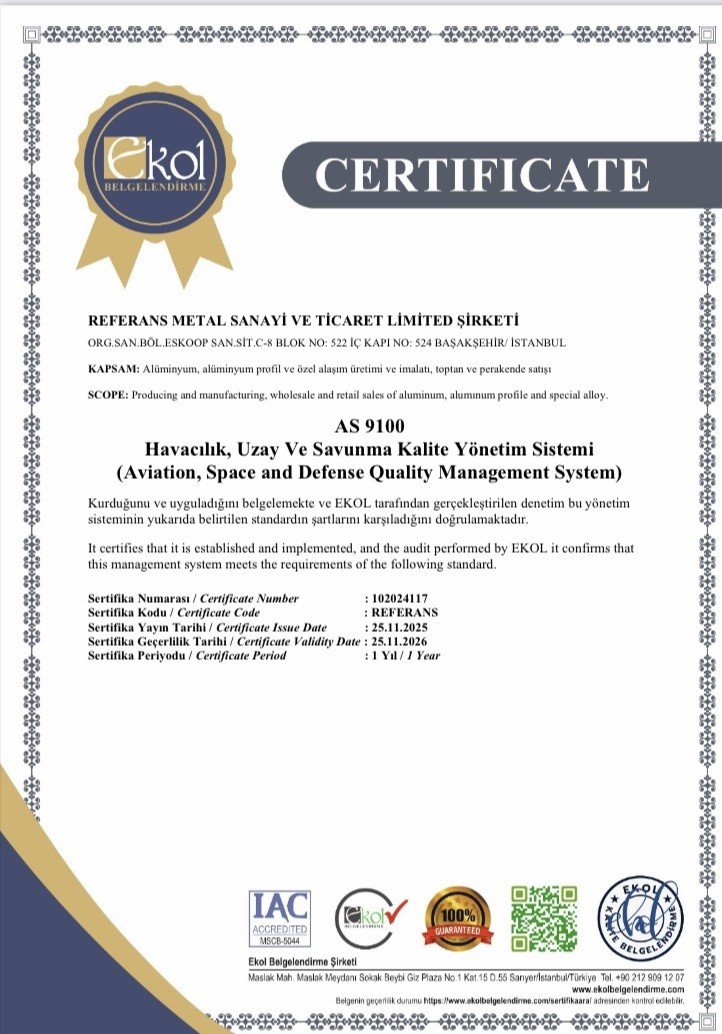
 AS 9100
 SPACE 2009
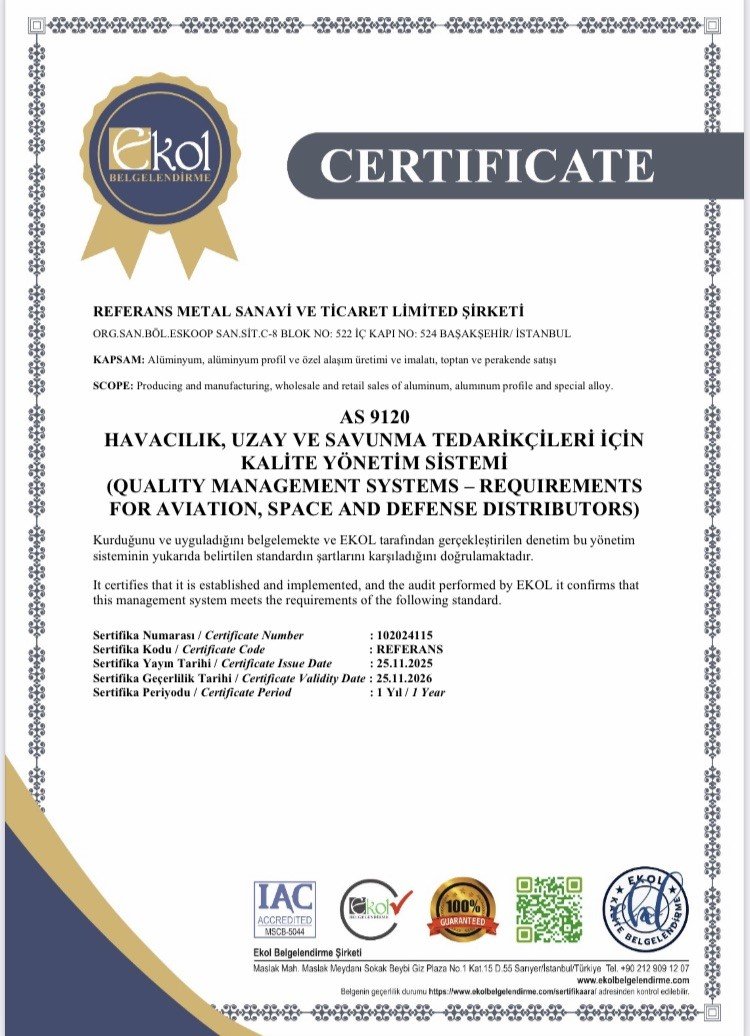 AS 9120




Plates
Sheets
Rod/Round Bar/Flat Bar
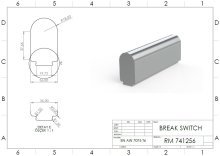
Tube/Extrusions/Profile
2219
AMS 4313 / AlCu6Mn / 2219 / T351
| Chemical Properties | % Value |
| Silicon (Si) | 0,00 - 0,20 |
| Manganese (Mn) | 0,20 - 0,40 |
| Magnesium (Mg) | 0,00 - 0,02 |
| Copper (Cu) | 5,80 - 6,80 |
| Titanium (Ti) | 0,02 - 0,10 |
| Iron (Fe) | 0,00 - 0,30 |
| Zinc (Zn) | 0,00 - 0,10 |
| Aluminium (Al) | Balance |
| Physical Properties | Value |
| Density | 2.85 g/cm³ |
| Melting Point | 543 °C |
| Thermal Expansion | 22.3 µm/m.°C |
| Modulus of Elasticity | 74 GPa |
| Thermal Conductivity | 116 W/m.K |
| Electrical Resistivity | 30% IACS |
| Mechanical Properties | Value |
| Yield Strength | 248 MPa |
| Ultimate Strength | 359 MPa |
| Shear Strength | 230 MPa |
| Elongation A50 mm | 13% |
| Hardness | 100 HB |
| 2219 T351 Temperature – Ultimate Tensile Strength Graph |
 |
| 2219 T351 Thickness – Ultimate Tensile Strength Graph |
 |
| 2219 T351 Diameter – Ultimate Tensile Strength Graph |
 |
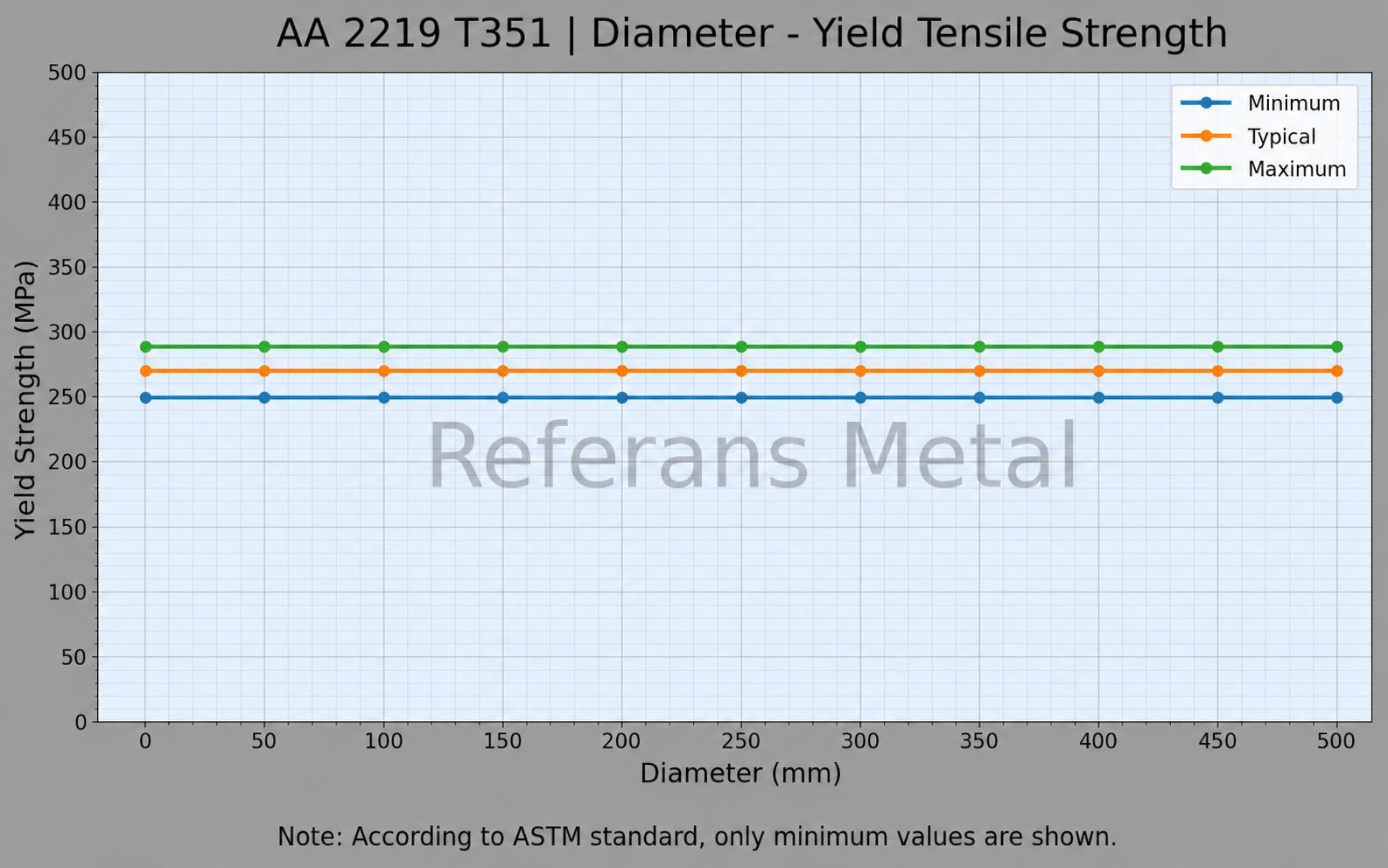
| 2219 T351 Diameter-Yield Tensile Strength |
 |
2219 T351 aluminum alloy is a copper-based (Al-Cu) high-strength alloy that is especially preferred in applications requiring high-temperature performance. This alloy gains an optimized internal structure through solution heat treatment, stress relieving, and natural aging processes thanks to the T351 temper. Its mechanical strength is quite high, standing out particularly in tensile and yield strength. Its ability to maintain mechanical properties at elevated temperatures makes it a critical material in aerospace and aviation industries. Compared to 2024 and 7075 alloys, its high-temperature stability is better, although its maximum strength at room temperature is slightly lower than 7075.
In terms of corrosion resistance, 2219 T351 does not offer as high resistance as pure aluminum or 5xxx series alloys due to its copper content. Therefore, it is generally used with protective coatings or anodizing processes. Its coatability is quite good, and its performance can be enhanced with surface treatments. Compared to 6061 alloy, its corrosion resistance is lower but its mechanical strength is higher. Although its direct use in marine environments is limited, this disadvantage can be significantly reduced with appropriate coating techniques.
In terms of machinability and formability, 2219 T351 offers a moderate level of performance. While suitable for machining operations, it cannot be machined as easily as free-machining alloys like 2011 or 2007. Its bending and forming capabilities are more limited than T3 or T4 tempers because the T351 temper provides higher strength but slightly reduces ductility. Nevertheless, complex geometries can be achieved with controlled processes, and it is especially preferred in precision engineering components.
In terms of weldability, 2219 alloy demonstrates quite good performance among aluminum alloys. Successful results can be achieved particularly with TIG and MIG welding methods. Thanks to this feature, it is widely used in the production of welded structures such as cryogenic tanks, fuel tanks, and space vehicles. Compared to 7075 alloy, it has much better weldability, making it more advantageous in structural applications.
In terms of vibration and fatigue behavior, 2219 T351 alloy provides stable and reliable performance. Due to its high strength, it shows good resistance under dynamic loads and its fatigue life is sufficient for many applications. Thanks to these properties, it is preferred in rocket bodies, aircraft structural components, and high-performance engineering systems. Compared to 2024 alloy, its fatigue resistance is at similar levels, but in terms of high-temperature performance, 2219 stands out as a superior option.
ALLOY DESIGNATIONS
Choosing Factors for 2219 T351
- Strength: Very good
- Machining: Poor
- Weldability: Great
- Formability: Good
- Corrosion Resistance: Satisfactory
- Heat Treating: Yes
Some Well-Known Applications for 2219 T351
In high strength weldaments,
In fuel tanks and aircraft materials,
It is used in engineering applications and generally in the aerospace sector.
2219 T351 is produced/supplied in plate/sheet, round/flat bar and tube/profile forms.
- Rod / Round Bar / Flat Bar
- Plate/Sheet
- Tube/Profile
| Mechanical Properties | |||
| Thickness (mm) | Yield Strength (Min.) | Ultimate Strength (Min.) | Elongation A50 mm % |
| Over 6.3 up to & incl. 25.4 | 317 MPa | 427 MPa | %8 |
| Over 25,4 up to & incl. 50,8 | 317 MPa | 427 MPa | %7 |
 Weight Calculator